


























Views
Downloads


Grade 9 Natural Selection — Printable No-Prep Worksheet
Paste this activity's link or code into your existing LMS (Google Classroom, Canvas, Teams, Schoology, Moodle, etc.).
Students can open and work on the activity right away, with no student login required.
You'll still be able to track student progress and results from your teacher account.
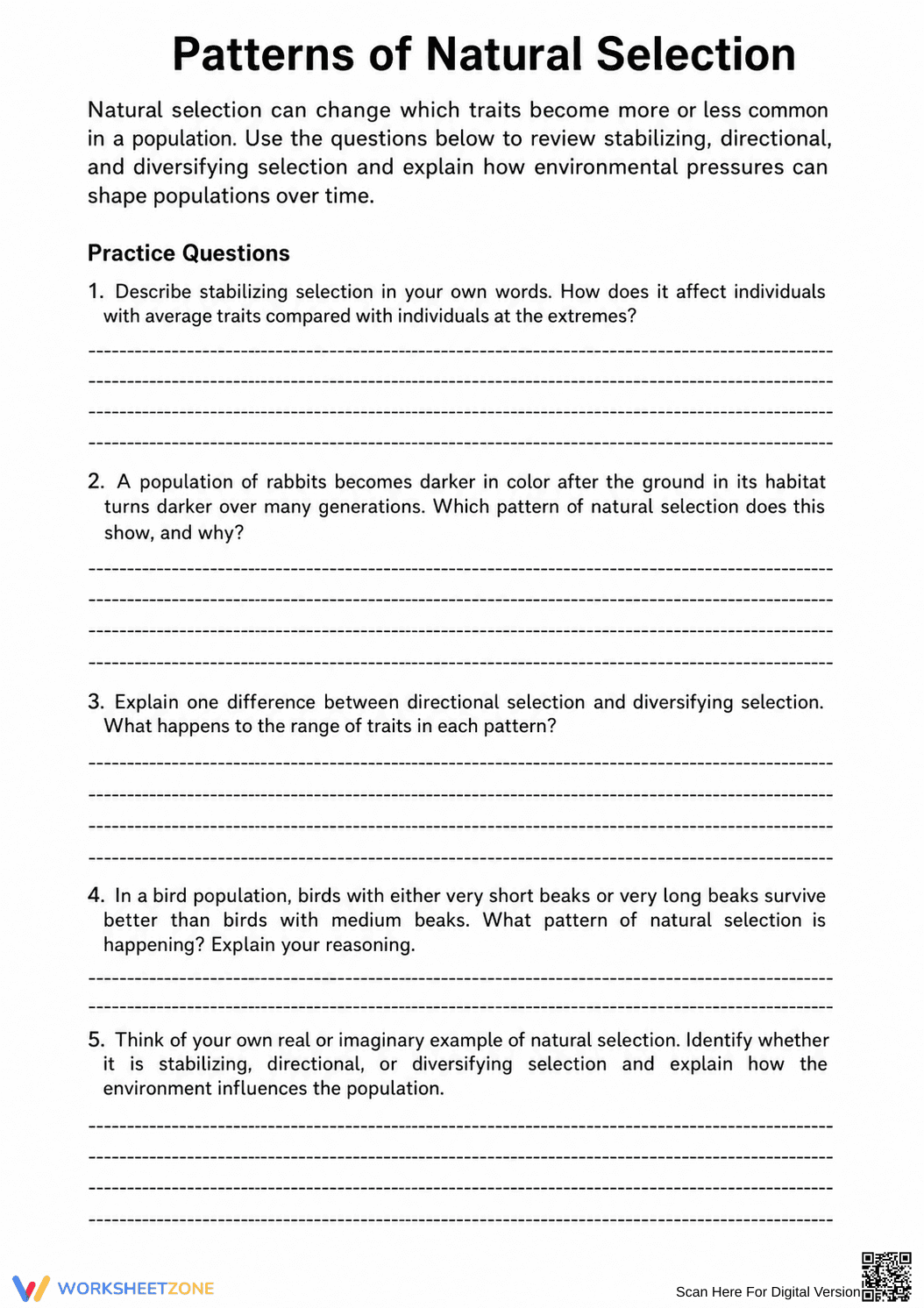
This printable biology worksheet helps students master the three major patterns of natural selection: stabilizing, directional, and diversifying. By analyzing environmental pressures and population changes, students will construct evidence-based explanations and apply evolutionary concepts to real-world scenarios.
At a Glance
- Grade: 9 · Subject: Biology
- Standard:
HS-LS4-4— Explain how natural selection leads to population adaptation- Skill Focus: Identifying patterns of natural selection
- Format: 2 pages · 10 problems · Answer key included · PDF
- Best For: Independent practice and review
- Time: 20–30 minutes
This resource features two pages of open-ended practice questions. Students will define key terms in their own words, analyze specific scenarios (such as changes in rabbit coat color or bird beak size), and compare the long-term effects of different selection pressures on genetic variation. A complete answer key is included for easy grading.
- Print (1 min): Download the PDF and print copies for your biology classes.
- Distribute (1 min): Hand out as a standalone assignment or attach to your current evolution unit packet.
- Review (5 mins): Use the included answer key to quickly check student explanations or guide a whole-class discussion.
Total teacher prep time is under two minutes, making this an ideal resource for emergency sub plans or immediate classroom use.
Aligned to HS-LS4-4: Construct an explanation based on evidence for how natural selection leads to adaptation of populations. It also supports middle school progression for MS-LS4-4. Both standard codes can be copied directly into lesson plans, IEP goals, or district curriculum mapping tools.
Assign this worksheet immediately following direct instruction on stabilizing, directional, and disruptive selection to solidify comprehension. It also serves as an excellent formative assessment; observe whether students can correctly identify the selection pattern in the rabbit and bird scenarios to gauge their readiness for more complex evolutionary modeling. Expect completion to take 20 to 30 minutes.
Designed for high school biology and middle school life science students. The open-ended format allows for natural differentiation, as advanced learners can provide more detailed, multi-step evolutionary mechanisms in their responses. Pair this with a visual anchor chart showing the bell curve shifts for each selection pattern.
Aligning instruction to HS-LS4-4 ensures students can effectively explain how natural selection leads to population adaptation over time. According to recent findings published in the RAND AIRS 2024 report, requiring students to construct written scientific explanations rather than simply selecting from multiple-choice options significantly improves their long-term retention of complex biological mechanisms. When learners are prompted to articulate the specific environmental pressures that drive stabilizing, directional, and diversifying selection, they develop a more robust conceptual framework for evolutionary theory. This structured practice helps bridge the gap between rote memorization and true scientific literacy. By consistently integrating open-ended analytical tasks into daily biology instruction, educators foster the critical thinking and evidence-based reasoning skills that are absolutely essential for success in advanced STEM coursework and future scientific endeavors.


