


























Views
Downloads


Printable Past Tense -ed Verbs Worksheet | Grade 1 ELA
Paste this activity's link or code into your existing LMS (Google Classroom, Canvas, Teams, Schoology, Moodle, etc.).
Students can open and work on the activity right away, with no student login required.
You'll still be able to track student progress and results from your teacher account.
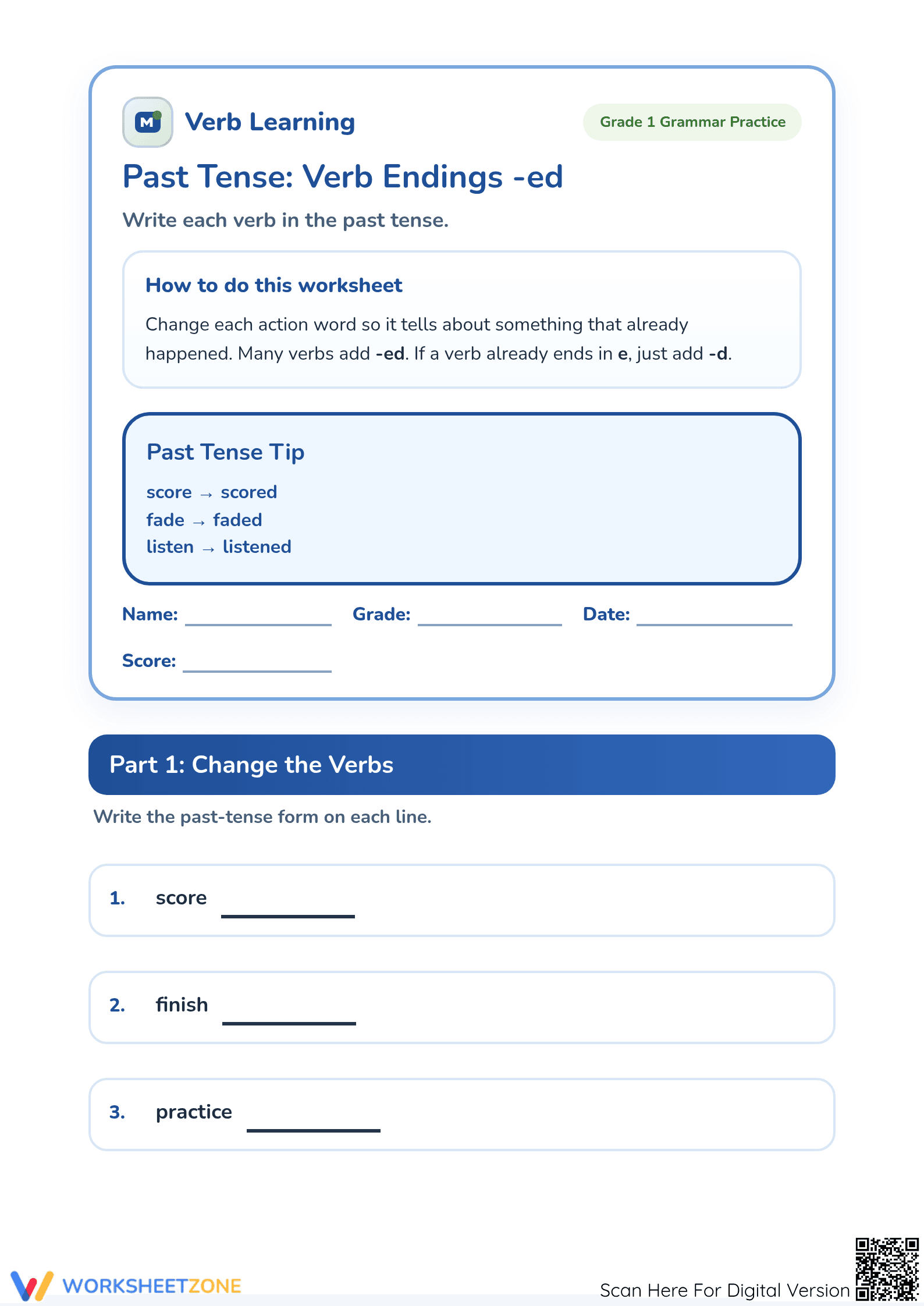
Mastering the past tense is a fundamental milestone for young writers. This Grade 1 past tense worksheet provides targeted practice for adding the -ed ending to regular verbs. Students learn how to transform action words to describe events that already happened, building the grammatical foundation necessary for clear storytelling and accurate sentence construction.
At a Glance
- Grade: 1 · Subject: English Language Arts
- Standard:
CCSS.ELA-LITERACY.L.1.1.E— Use verbs to convey a sense of past, present, and future actions- Skill Focus: Past tense verb endings (-ed)
- Format: 3 pages · 10 problems · Answer key included · PDF
- Best For: Individual grammar practice, homework, and morning work
- Time: 10–15 minutes
What's Inside
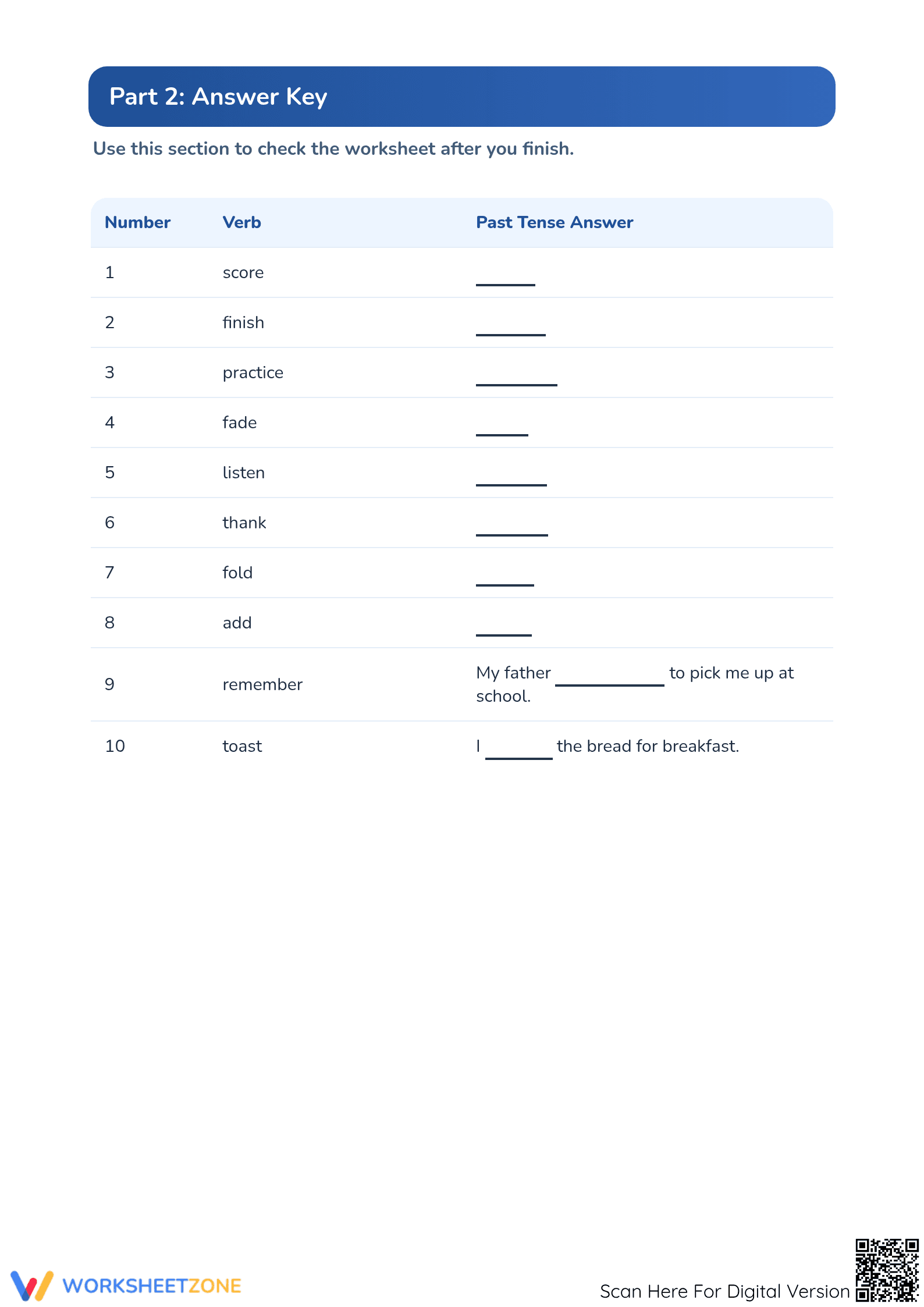
This three-page PDF package includes a comprehensive instructional header and two distinct sections of practice. The first page features a clear explanation of how to add -ed or just -d to verbs, supported by visual tips and worked examples. Page two provides 10 practice items, ranging from isolated verb transformations to context-rich sentence completion. A full answer key is included for immediate feedback.
Skill Progression
- Guided Practice: The header provides explicit rules and three "Past Tense Tip" examples to ground student understanding and model the -ed transformation.
- Supported Practice: Items 1 through 8 focus on direct conjugation of common verbs like "score," "finish," and "thank," allowing students to apply morphological rules in isolation.
- Independent Practice: Items 9 and 10 challenge students to apply their knowledge within narrative sentences, requiring them to choose the correct tense for a given context.
This structured approach follows the gradual-release model, transitioning students from teacher-supported instruction to independent grammar mastery.
Standards Alignment
Aligned to CCSS.ELA-LITERACY.L.1.1.E, this resource targets the specific skill of using verbs to convey a sense of past action. By focusing on the mechanics of regular verb conjugation, the worksheet ensures students meet foundational Grade 1 language requirements. This standard code can be copied directly into lesson plans, IEP goals, or district curriculum mapping tools.
How to Use It
Distribute this worksheet during the independent practice phase of a grammar lesson on tenses. It is an excellent tool for formative assessment; teachers should observe if students remember to drop the extra "e" when a verb already ends in one. The 15-minute completion time makes it ideal for literacy centers or a quiet transition activity after lunch.
Who It's For
This resource is designed for first-grade students but serves as an effective intervention for second graders needing a grammar refresher. It pairs naturally with a classroom anchor chart about the timeline of tenses. English Language Learners benefit from the sentence frames provided in the final section to see grammar applied in real-world communicative contexts.
According to the NAEP Framework for Writing, early mastery of grammatical conventions like verb tenses is a significant predictor of later narrative writing proficiency. This Grade 1 past tense worksheet aligns with these findings by providing structured repetition of the -ed ending, a core component of the CCSS.ELA-LITERACY.L.1.1.E standard. Research from Fisher & Frey (2014) emphasizes that "guided practice" with immediate feedback—supported here by the included answer key—is essential for moving linguistic skills from short-term memory to automaticity. By isolating the -ed transformation before integrating it into full sentences, this resource follows best practices for cognitive load management. This allows young learners to focus on the morphological change before tackling the complexities of syntax. This alignment with evidence-based instructional design ensures that the worksheet is not just a filler activity but a legitimate bridge to Grade 1 literacy mastery.


