


























Views
Downloads


Past Tense -ed Worksheet | Grade 1 Essential Printable
Paste this activity's link or code into your existing LMS (Google Classroom, Canvas, Teams, Schoology, Moodle, etc.).
Students can open and work on the activity right away, with no student login required.
You'll still be able to track student progress and results from your teacher account.
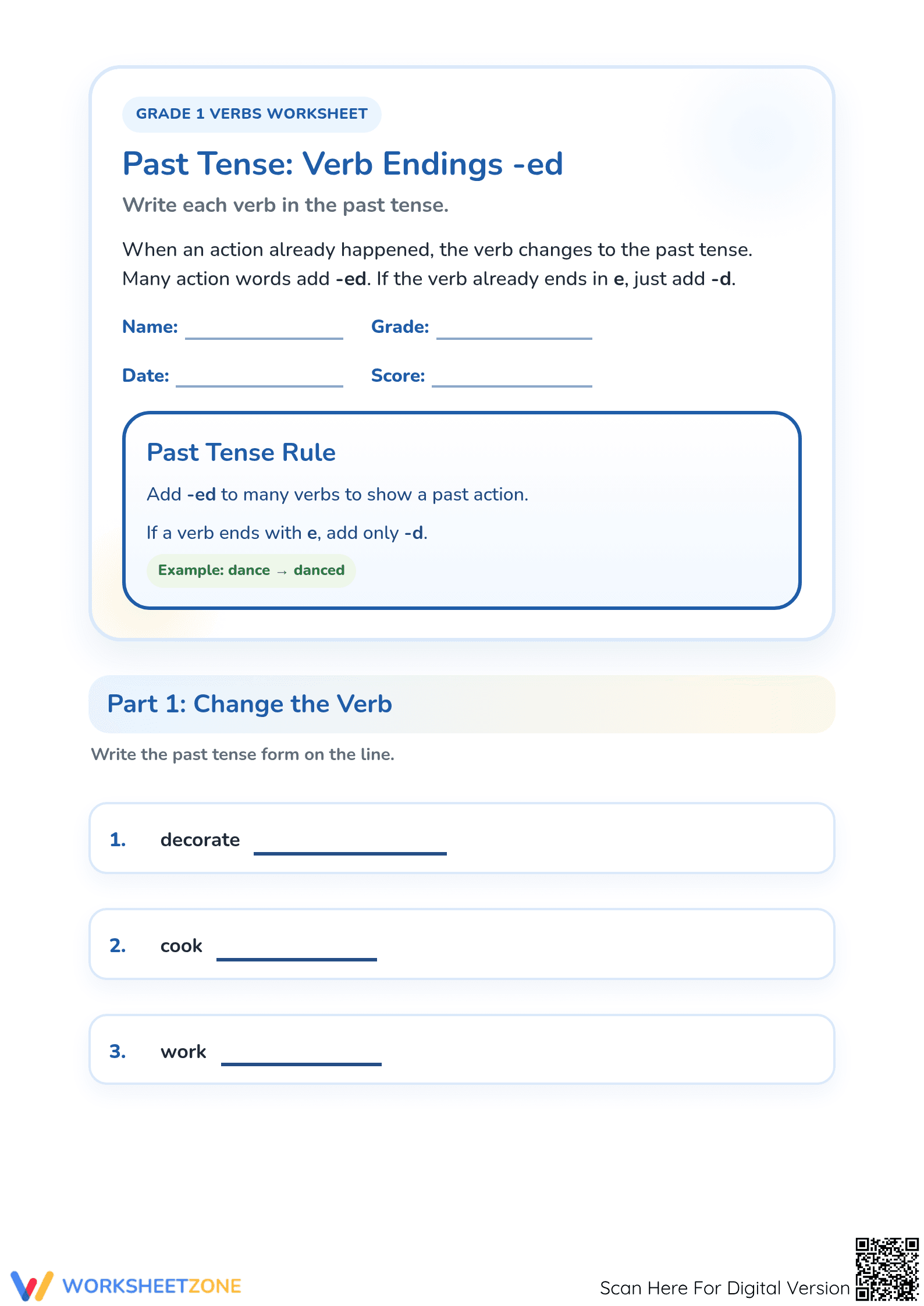
Master the fundamentals of regular verb conjugation with this Grade 1 English Language Arts worksheet. Students practice transforming base verbs into the past tense by applying the standard "-ed" and "-d" rules. This resource provides a clear structure for young learners to build grammatical accuracy and writing confidence during their early literacy development.
At a Glance
- Grade: 1 · Subject: English Language Arts
- Standard:
CCSS.ELA-LITERACY.L.1.1.E— Use verbs to convey a sense of past, present, and future actions- Skill Focus: Past tense verb endings (-ed and -d)
- Format: 3 pages · 14 problems · Answer key included · PDF
- Best For: Early grammar practice and writing reinforcement
- Time: 15–20 minutes
This comprehensive three-page packet includes 14 structured tasks across three distinct sections. Part 1 focuses on isolated word transformation, Part 2 introduces sentence-level application, and Part 3 provides extra practice for reinforcement. The layout features large writing lines for first-grade penmanship, a clear "Past Tense Rule" anchor box with examples, and a complete answer key for rapid grading and feedback.
Teachers can implement this resource in under two minutes with a simple three-step process. First, print the three-page PDF document for each student. Second, distribute the materials at the start of your grammar block or as a transition activity. Third, review the answers collectively using the provided key to provide immediate correction. This print-and-go design makes it an ideal choice for emergency substitute plans or independent morning work assignments.
This worksheet is primarily aligned with CCSS.ELA-LITERACY.L.1.1.E, which requires students to use verbs to convey a sense of past, present, and future. It specifically targets regular past tense formation, a foundational skill for meeting the ELA Language strand requirements. This standard code can be copied directly into lesson plans, IEP goals, or district curriculum mapping tools to ensure compliance with instructional mandates.
Use this as a formative assessment during direct instruction to gauge student understanding of the "-ed" rule. Alternatively, assign it as independent practice following a mini-lesson on verb tenses. For a formative observation tip, watch if students correctly identify when to only add "-d" (for verbs ending in "e") versus the full "-ed" suffix. Expected completion typically ranges from 15 to 20 minutes for most Grade 1 learners.
This resource is designed for first-grade students or older English Language Learners (ELLs) who need targeted practice with regular verb endings. It supports students with varying levels of motor control through wide-ruled response lines. It pairs naturally with a reading passage containing past-tense narrative text or a classroom anchor chart detailing common regular verbs used in daily writing exercises.
Research from Fisher & Frey (2014) emphasizes the importance of explicit instruction and structured practice in developing foundational grammar skills. This worksheet addresses CCSS.ELA-LITERACY.L.1.1.E by providing students with multiple opportunities to apply morphological rules to base verbs, a critical step in achieving writing fluency. By moving from word-level changes to sentence-level application, the resource scaffolds the cognitive load required to master past-tense conjugation. A 2024 analysis of educational materials highlights that repetitive, focused practice on specific linguistic structures significantly improves retention among Grade 1 learners. This self-contained module ensures that students not only memorize the rule but can accurately deploy it in varied contexts. Educators can cite this resource as a valid tool for measuring progress toward state and national literacy standards in early elementary environments.


