




























Views
Downloads
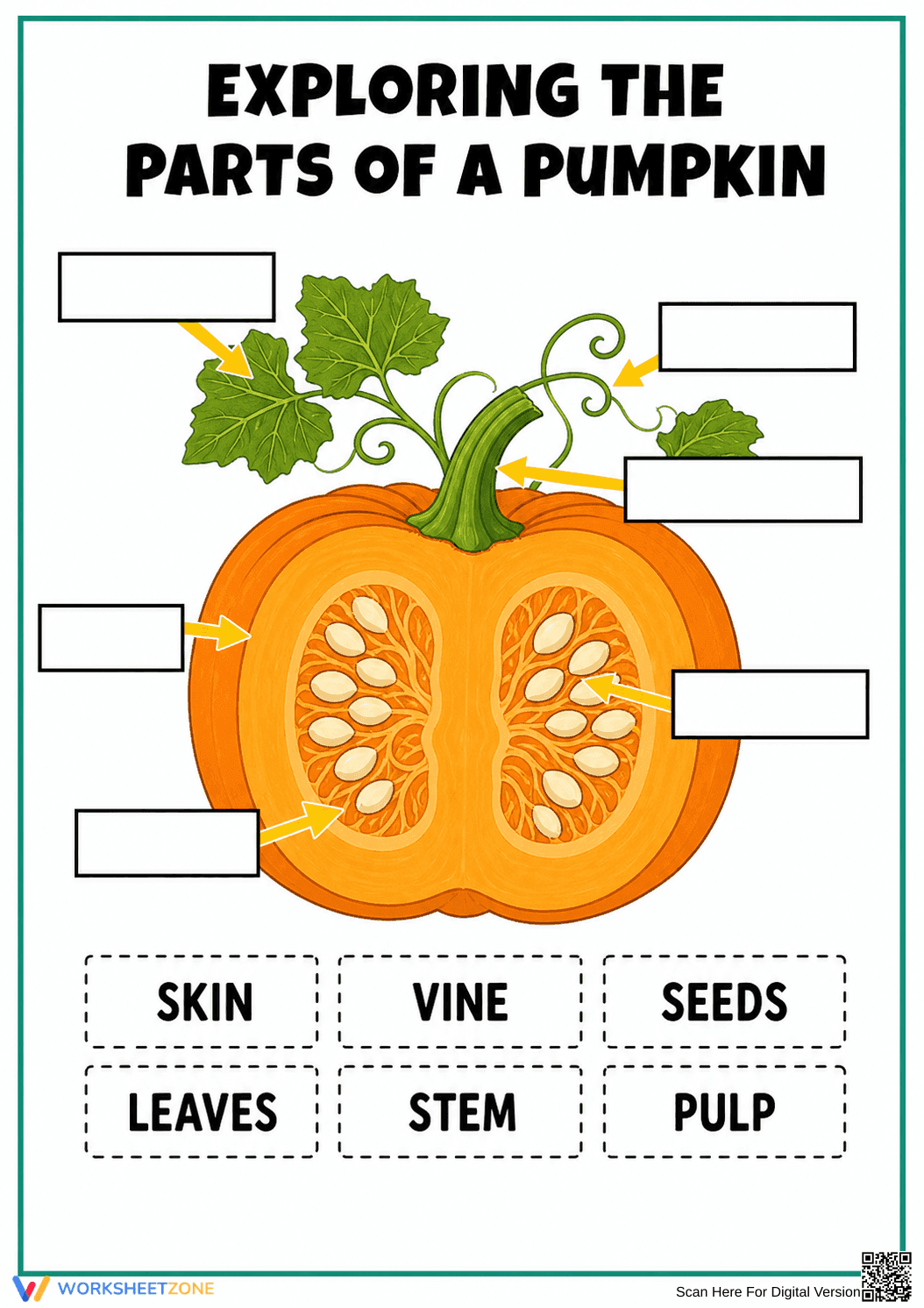

Grade 1 Pumpkin Parts — Printable No-Prep Worksheet

Paste this activity's link or code into your existing LMS (Google Classroom, Canvas, Teams, Schoology, Moodle, etc.).
Students can open and work on the activity right away, with no student login required.
You'll still be able to track student progress and results from your teacher account.
This Grade 1 science worksheet provides a hands-on approach to learning plant anatomy by requiring students to identify and label the external and internal structures of a pumpkin. By matching terms like pulp, seeds, and vine to a detailed diagram, students build essential biological vocabulary and observational skills. This activity ensures learners can accurately describe the physical characteristics of plants as part of their early life science curriculum.
At a Glance
- Grade: 1 · Subject: Science
- Standard:
1-LS1-1— Identify and label the external and internal structures of a plant- Skill Focus: Plant Anatomy & Labeling
- Format: 1 page · 6 problems · Answer key included · PDF
- Best For: Fall science units and sub plans
- Time: 15–20 minutes
What's Inside
The worksheet features a high-quality, cross-section illustration of a pumpkin with six clear directional arrows. At the bottom of the page, students will find a dedicated cut-out section containing six vocabulary labels: skin, leaves, vine, stem, seeds, and pulp. The layout is designed for clarity, with large font sizes and distinct borders for each label box. A full answer key is provided to facilitate quick grading or self-correction in a classroom setting.
Zero-Prep Workflow
- Print: Generate the single-page PDF for each student in your class (30 seconds).
- Distribute: Hand out the sheets along with scissors and glue sticks to your learners (1 minute).
- Review: Students work independently to identify the 6 parts, allowing you to circulate for formative observations (15 minutes).
Standards Alignment
This resource aligns with `1-LS1-1`, focusing on how plant parts help them survive and grow. By identifying the stem, leaves, and seeds, students explore the functional structures of living organisms. It also supports CCSS.ELA-LITERACY.RI.1.7 by using illustrations to describe key ideas. These standard codes can be copied directly into lesson plans or IEP goals.
How to Use It
Use this worksheet as a concluding activity after a hands-on pumpkin exploration or dissection experiment. It serves as an excellent formative assessment to check if students can transfer their real-world observations to a scientific diagram. Expected completion time is 15 to 20 minutes, depending on the students' fine motor skills with scissors. For a quick check, have students compare their finished diagrams with a partner before the final gluing.
Who It's For
This activity is tailored for Kindergarten through 2nd-grade students, particularly those developing fine motor skills and early reading fluency. It is highly effective for English Language Learners (ELLs) who benefit from the direct visual-to-word association. Pair this worksheet with a non-fiction read-aloud about plant life cycles or a physical pumpkin exploration to provide a multi-sensory learning experience that caters to diverse learning styles.
This resource aligns with the Next Generation Science Standards (NGSS) under the 1-LS1-1 framework, requiring students to identify how plant parts help them survive. By cutting and pasting labels like pulp, seeds, and stem, learners develop a concrete understanding of plant anatomy. Research suggests that scaffolded vocabulary instruction, paired with labeled diagrams, improves retention in early childhood science. This worksheet provides a structured environment for students to practice technical vocabulary in a seasonal context, bridging the gap between observation and academic language. The inclusion of six distinct parts ensures a comprehensive overview of the pumpkin's structure, making it an ideal tool for formative assessment. Educators can integrate this into curriculum mapping as evidence of student mastery in identifying plant structures.


