


























Views
Downloads

Essential Grade 2 Parts of the Face & Senses Worksheet
Paste this activity's link or code into your existing LMS (Google Classroom, Canvas, Teams, Schoology, Moodle, etc.).
Students can open and work on the activity right away, with no student login required.
You'll still be able to track student progress and results from your teacher account.
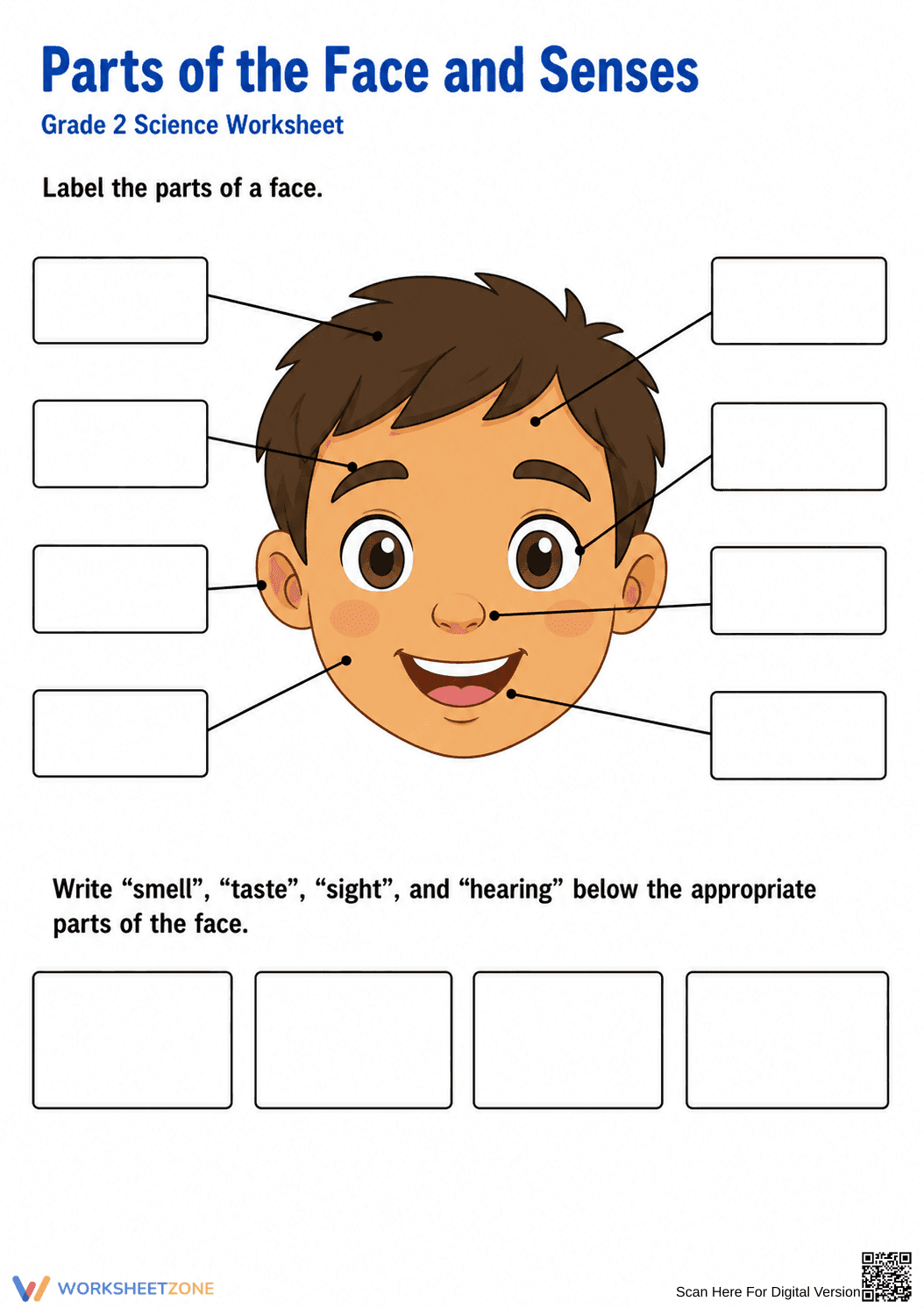
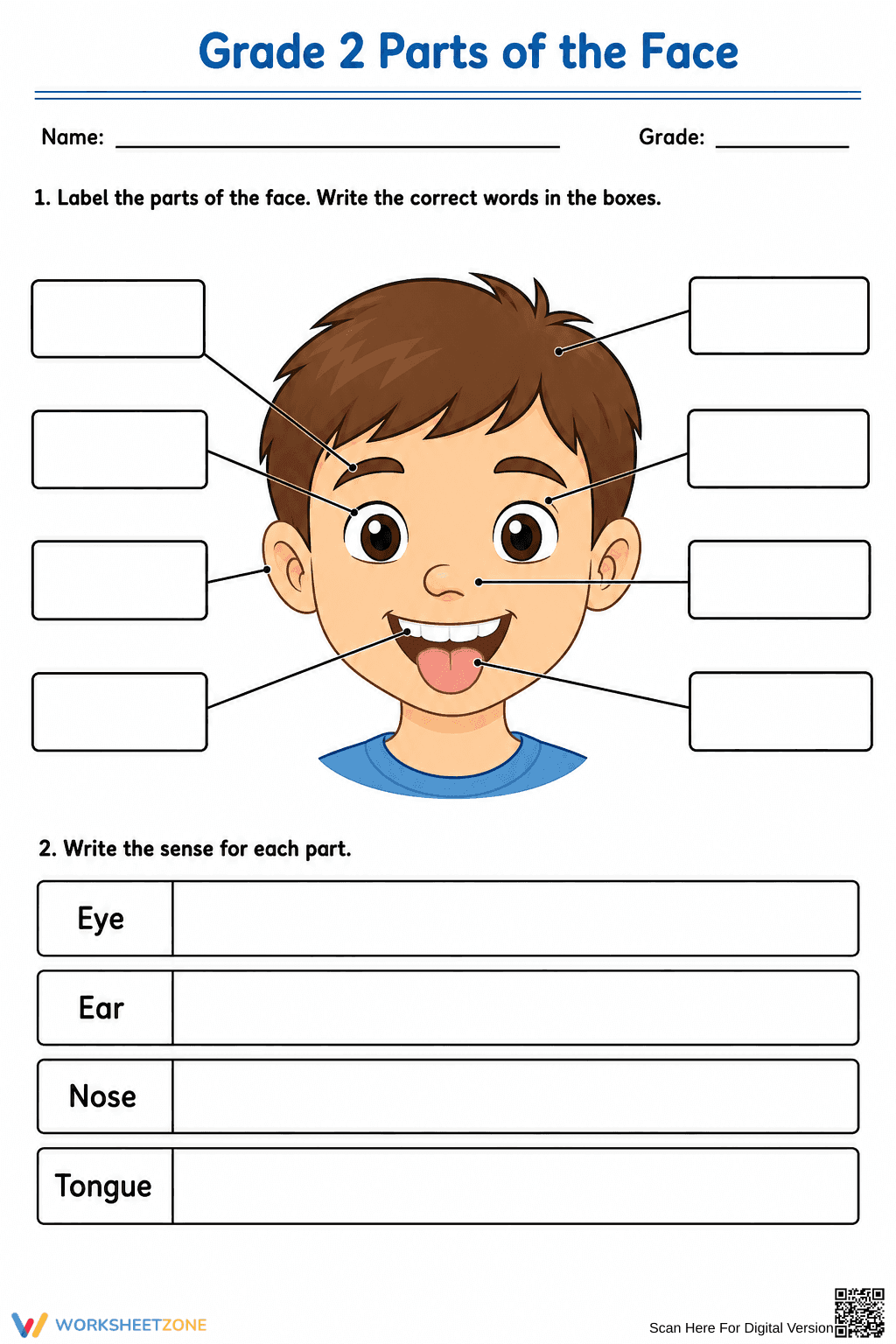
Strengthen early anatomy knowledge and sensory recognition with this focused labeling activity. Students identify eight facial features and link them to corresponding senses, reinforcing the connection between structure and function. This worksheet helps learners articulate how their bodies interact with the environment through precise vocabulary and visual mapping.
At a Glance
- Grade: 2 · Subject: Science
- Standard:
1-LS1-1— Use materials to design solutions mimicking how animals use their external parts to survive.- Skill Focus: Facial anatomy and five senses
- Format: 2 pages · 12 problems · Answer key included · PDF
- Best For: Early finishers or quick anatomy review
- Time: 10–15 minutes
This resource contains two primary worksheet pages featuring high-quality illustrations of a child's face with eight clear labeling boxes. Below the diagrams, students are prompted to categorize specific senses—smell, taste, sight, and hearing—by writing them under the correct anatomical features or matching them to specific organs. A comprehensive answer key is included to facilitate quick grading or student self-correction.
Zero-Prep Workflow
This resource is designed for efficient, zero-prep classroom integration. Step 1: Print the two-page worksheet (approx. 30 seconds). Step 2: Distribute to students for independent or small-group work (approx. 10-15 minutes). Step 3: Review using the included visual answer key (approx. 2 minutes). Total teacher preparation time is under two minutes, making this an ideal 'sub-tub' essential or a quick formative assessment following a lesson on the five senses.
Standards Alignment
Primary alignment is to 1-LS1-1, which focuses on how external parts help animals (including humans) meet their needs and survive. By identifying sensory organs, students begin to understand how structures facilitate the intake of information. This standard code can be copied directly into lesson plans, IEP goals, or district curriculum mapping tools.
How to Use It
Use this worksheet as a formative assessment during a 'My Body' unit to check for vocabulary retention. It is best assigned after direct instruction on the five senses to verify that students can correctly pair organs with functions. Tip: Observe if students struggle with the distinction between the physical part (e.g., eye) and the sense (e.g., sight) to identify needed reteaching.
Who It's For
This activity is tailored for Grade 2 students but is also appropriate for Grade 1 learners or ELD/ESL students needing basic anatomy vocabulary support. It pairs naturally with a tactile five-senses discovery station or a read-aloud about the human body. Differentiation can be achieved by providing a word bank for students who need additional spelling support.
The mastery of anatomical labeling and sensory categorization serves as a foundational milestone in early childhood science education. Research from ScienceDirect TpT Analysis indicates that visual-spatial tasks, such as diagram labeling, significantly enhance long-term memory retention of biological concepts in primary-grade learners. By requiring students to map abstract concepts like 'hearing' or 'taste' onto concrete physical structures (ears and tongue), the activity reinforces the 1-LS1-1 standard regarding structure and function. This alignment ensures that students are not merely memorizing names but are understanding the purpose of each external part. Furthermore, the exclusion of a word bank in this version promotes higher-order retrieval practice, a method proven by Fisher & Frey (2014) to be more effective than recognition-based tasks. This worksheet provides the structured practice necessary for students to achieve fluency in early life science terminology while maintaining a low-barrier, classroom-ready format.


