


























Views
Downloads
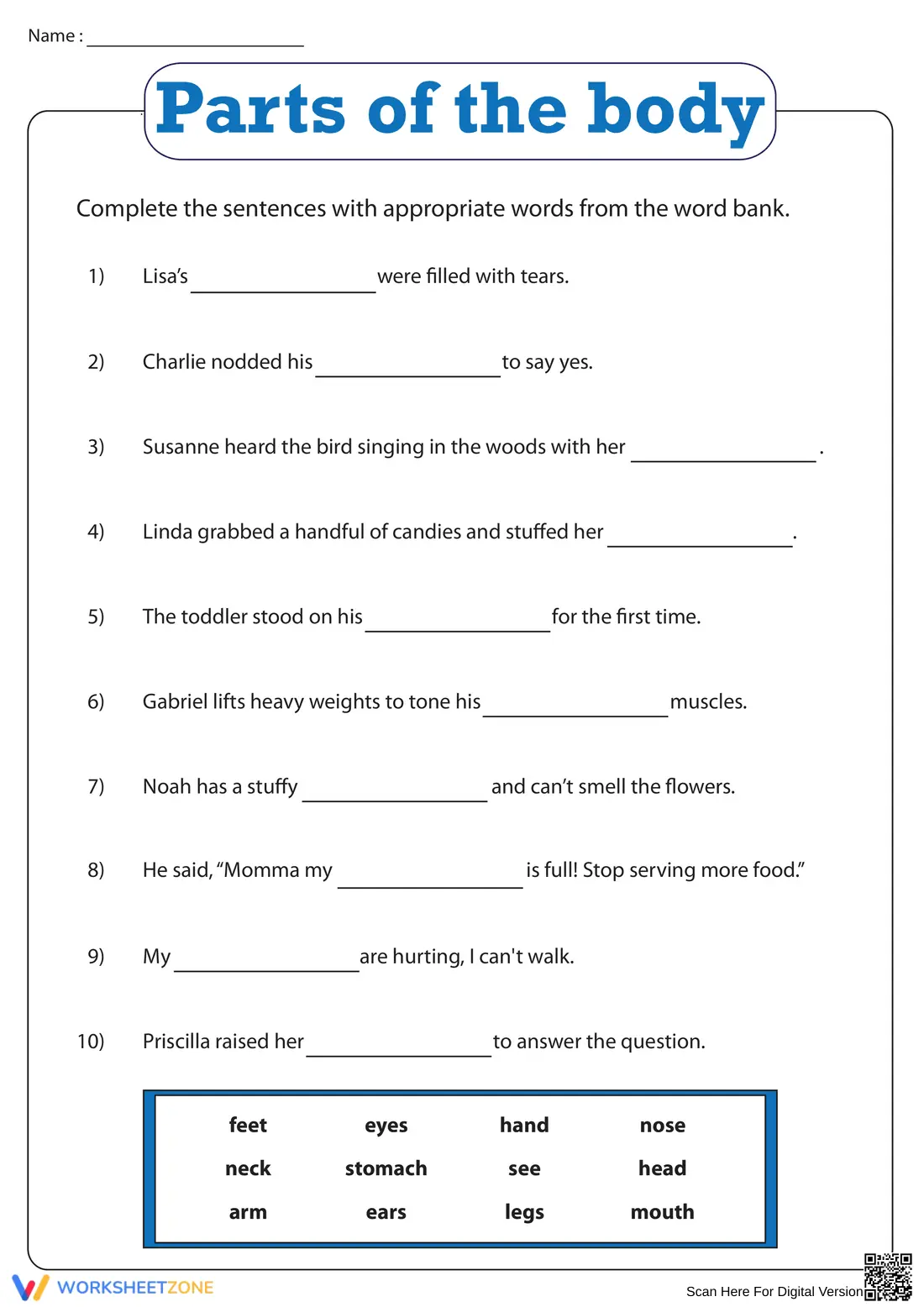

Essential Parts of the Body Worksheet | Grade 2 Science
Paste this activity's link or code into your existing LMS (Google Classroom, Canvas, Teams, Schoology, Moodle, etc.).
Students can open and work on the activity right away, with no student login required.
You'll still be able to track student progress and results from your teacher account.
This Grade 2 parts of the body worksheet helps students master anatomical vocabulary through context-clue identification. Students select the correct term from a word bank to complete ten descriptive sentences. This exercise bridges the gap between labeling and understanding the functional role each body part plays in everyday life.
At a Glance
- Grade: 2 · Subject: Science / ELA
- Standard:
CCSS.ELA-LITERACY.L.2.6— Use acquired vocabulary to complete sentences and describe human body functions- Skill Focus: Human anatomy vocabulary
- Format: 1 page · 10 problems · Answer key included · PDF
- Best For: Independent practice or quick formative assessment
- Time: 10–15 minutes
What's Inside
This single-page PDF features ten fill-in-the-blank sentences for second-grade readability. Each sentence describes a specific action—such as nodding a head to say yes or smelling flowers with a nose—to guide students toward the correct term. A clear word bank contains twelve body part terms, and a full answer key is provided for rapid grading and feedback.
Zero-Prep Workflow
This resource is designed for an immediate classroom transition. First, print the single-page document (30 seconds). Second, distribute the worksheets to students (1 minute). Third, review the completed sentences using the provided answer key (30 seconds). Total teacher preparation time is under two minutes, making it an ideal emergency sub plan or bell ringer activity for busy mornings.
Standards Alignment
The primary alignment is `CCSS.ELA-LITERACY.L.2.6`, requiring students to use words and phrases acquired through reading and responding to texts. By applying vocabulary like "stomach," "muscles," and "feet" within logical sentences, students demonstrate command of academic language. Both standard codes can be copied directly into lesson plans, IEP goals, or district curriculum mapping tools.
How to Use It
Use this as a concluding activity after direct instruction on the five senses or human body systems. It serves as an excellent formative assessment to check if students connect body parts to their specific functions. For a challenge, have students flip the page over and write two original sentences using body parts not featured in the word bank.
Who It's For
This resource is tailored for second-grade students and English Language Learners (ELLs) needing contextual support for body part terminology. It pairs naturally with a classroom anchor chart showing a labeled human diagram or a science read-aloud about how the human body moves and stays healthy.
According to the NAEP framework for science and literacy, the acquisition of domain-specific vocabulary in the early grades is a primary predictor of later reading comprehension success. This parts of the body worksheet leverages the "cloze" procedure, a proven instructional strategy that requires students to use semantic and syntactic clues to determine meaning. Research highlighted in the RAND AIRS 2024 report emphasizes that repetitive, context-based practice with basic anatomy terms strengthens the neural pathways associated with scientific categorization and verbal fluency. By requiring students to map the standard CCSS.ELA-LITERACY.L.2.6 to real-world biological functions, this activity ensures that Grade 2 learners move beyond rote memorization into applied knowledge. This structured approach to vocabulary development follows the Fisher & Frey (2014) gradual release of responsibility model, providing the necessary scaffolding through a word bank before students transition to more complex, open-ended writing tasks in later units.


