


























Views
Downloads

Grade 2 Parts of a Bean Seed — Printable No-Prep Worksheet
Paste this activity's link or code into your existing LMS (Google Classroom, Canvas, Teams, Schoology, Moodle, etc.).
Students can open and work on the activity right away, with no student login required.
You'll still be able to track student progress and results from your teacher account.
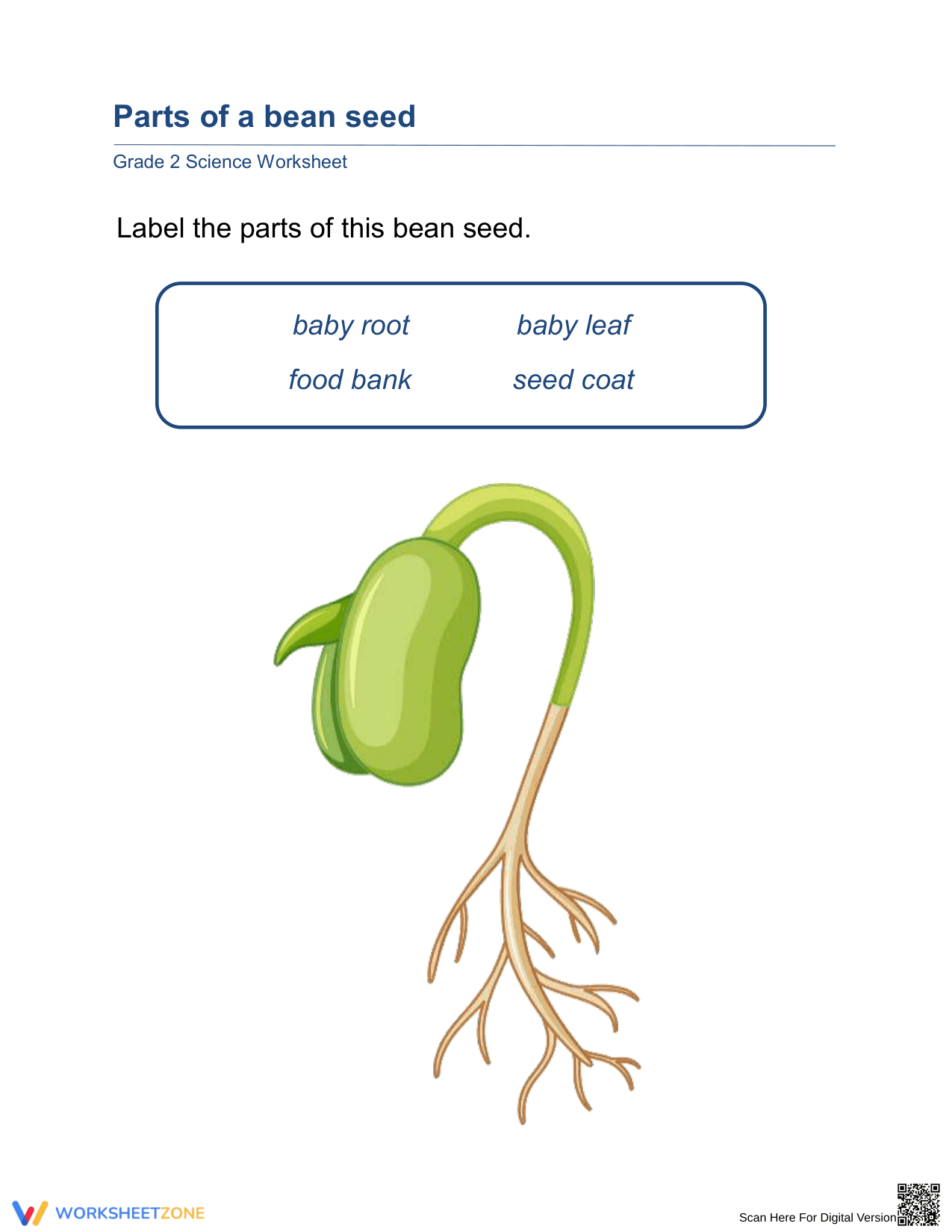
Identify the primary structures of a plant embryo with this focused Grade 2 science worksheet. Students analyze a clear diagram of a germinating bean and apply vocabulary from a provided word bank to label its essential components. This activity builds a foundational understanding of plant biology and the early stages of the life cycle.
At a Glance
- Grade: 2 · Subject: Living Things
- Standard:
2-LS2-1— Identify and describe the basic internal structures and developmental needs of growing plants- Skill Focus: Labeling seed anatomy
- Format: 1 page · 4 problems · Answer key included · PDF
- Best For: Independent science center rotation, homework, or a quick formative assessment review
- Time: 10–15 minutes
What's Inside
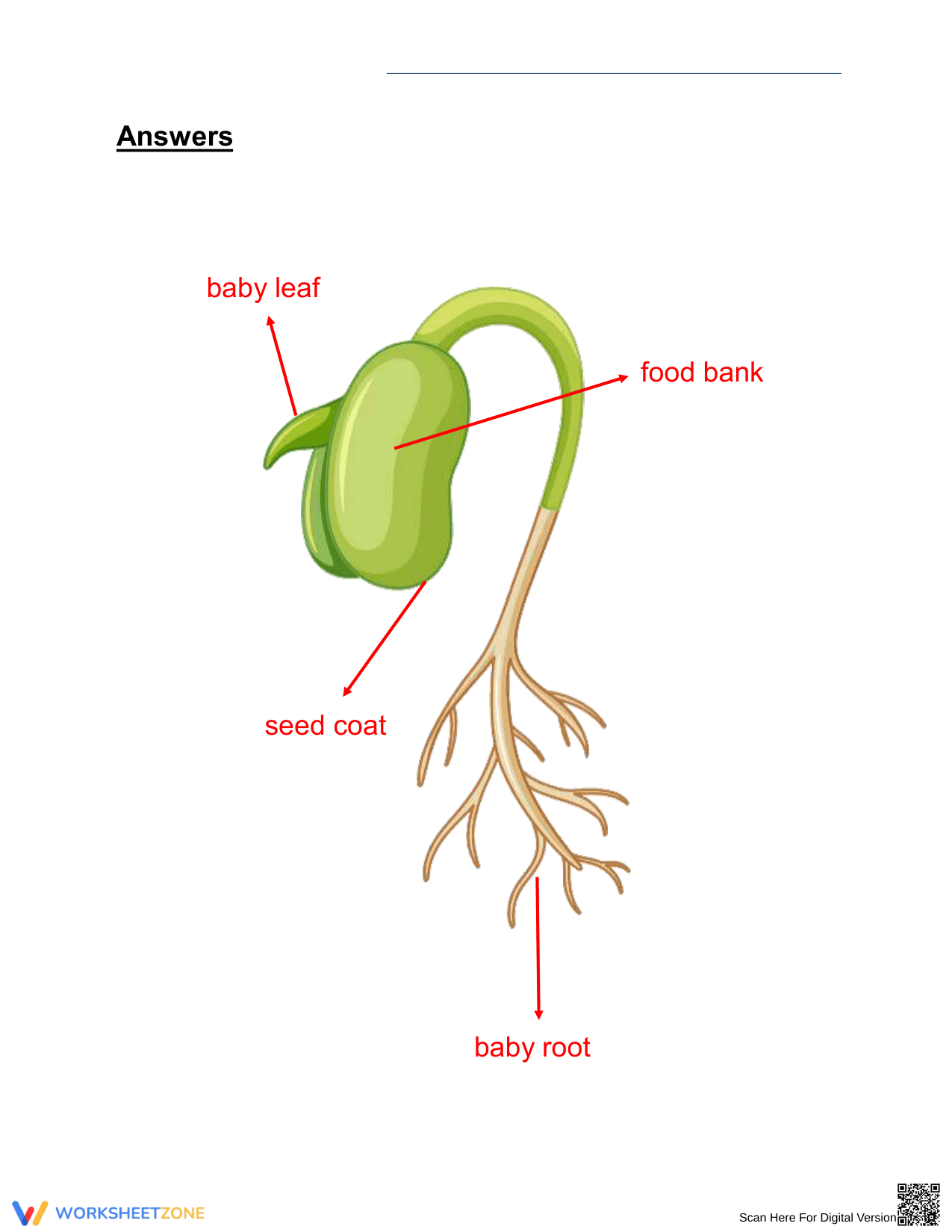
This single-page PDF features a high-quality illustration of a bean seed in the early stages of germination. It includes a specific word bank containing four key terms: baby root, baby leaf, food bank, and seed coat. The layout is clean and uncluttered, providing four clear labeling lines that point directly to the anatomical structures, ensuring students can work independently with minimal guidance.
Zero-Prep Workflow
The zero-prep design allows teachers to implement this lesson in under two minutes. Simply print the single-page document (30 seconds), distribute it to your class (60 seconds), and use the included answer key for a rapid verbal or visual check (30 seconds). Its self-explanatory nature makes it an ideal choice for emergency substitute plans or as a transition activity between science modules.
Standards Alignment
This resource is directly aligned with 2-LS2-1, focusing on the internal structures that allow plants to begin their growth cycle. By identifying parts like the seed coat and food bank, students demonstrate an understanding of LS1.A: Structure and Function. This standard code can be copied directly into lesson plans, IEP goals, or district curriculum mapping tools.
How to Use It
Use this worksheet during the "Explain" phase of a 5E lesson cycle after students have handled real bean seeds. It serves as an effective formative assessment to gauge vocabulary retention before moving to plant growth observations. Observe if students can correctly distinguish between the baby root and baby leaf based on the diagram's directional cues.
Who It's For
Designed for Grade 2 learners, this activity supports various learner profiles through visual cues and word bank scaffolding. It is a natural pairing for a classroom seed-planting project or a reading passage about plant life cycles. Teachers can differentiate by having students color the different parts of the seed to reinforce their functions.
Research from Fisher & Frey (2014) highlights that visual labeling tasks significantly enhance the acquisition of domain-specific vocabulary in early elementary science. This worksheet leverages a scaffolded approach where students map abstract terms like "seed coat" to concrete visual representations, a process shown to improve long-term retention of biological concepts. By focusing on 4 distinct tasks, the cognitive load remains optimal for 7-year-old learners, allowing them to achieve mastery within a 15-minute instructional window. Aligned to the 2-LS2-1 standard, this resource supports the development of scientific observation skills and the ability to communicate information about the natural world. Integrating this worksheet into a broader unit on Living Things ensures that students meet state requirements for identifying plant structures while building the prerequisite knowledge needed for more complex life cycle studies in upper elementary grades.


