


























Views
Downloads
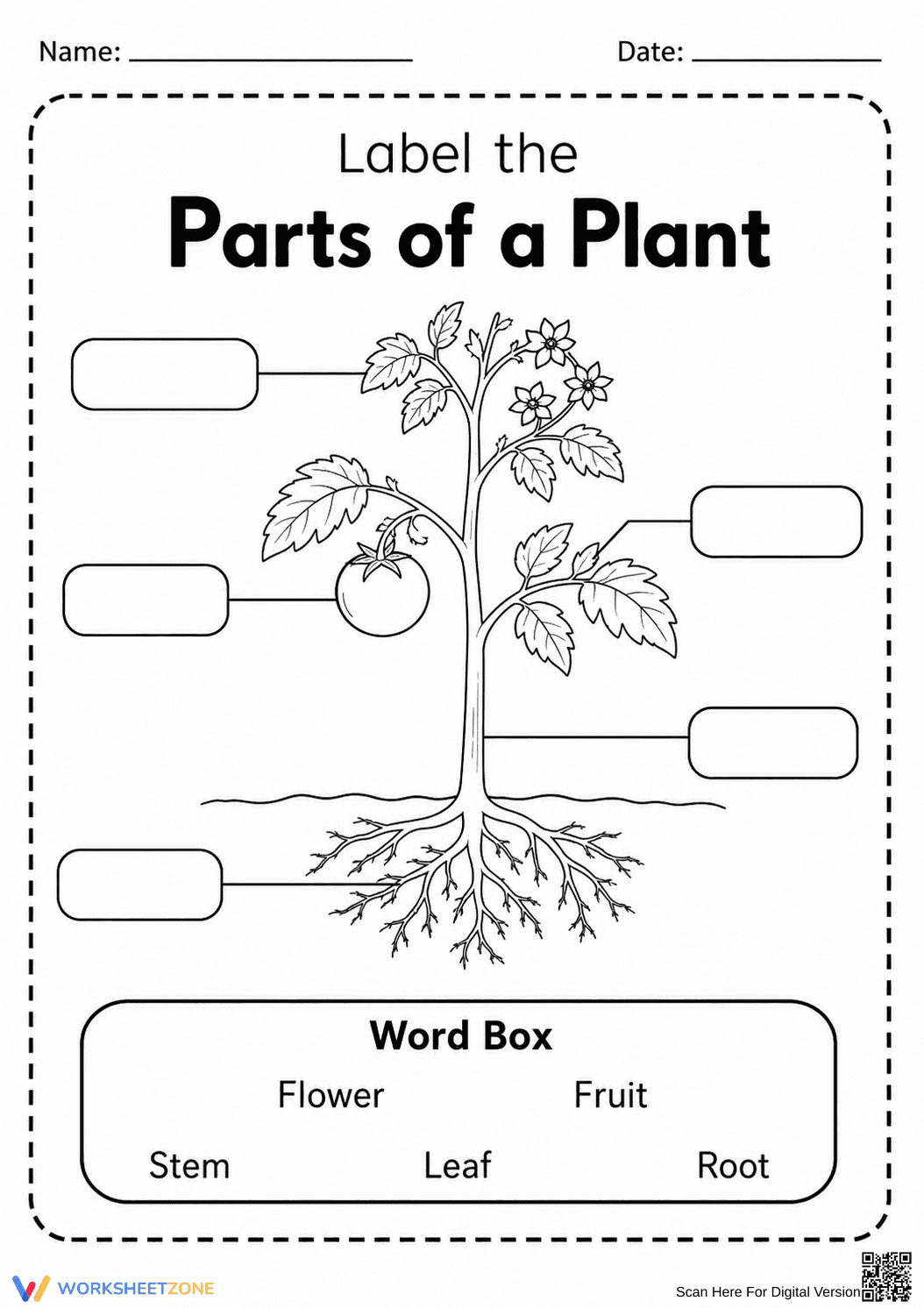

Grade 1 Parts of a Plant — Printable No-Prep Worksheet
Paste this activity's link or code into your existing LMS (Google Classroom, Canvas, Teams, Schoology, Moodle, etc.).
Students can open and work on the activity right away, with no student login required.
You'll still be able to track student progress and results from your teacher account.
This Grade 1 science worksheet helps students identify and label the basic external structures of a plant. By matching vocabulary words to a clear botanical diagram, young learners build foundational biology skills and reinforce their understanding of how stems, roots, leaves, flowers, and fruits function together to support plant life and growth.
At a Glance
- Grade: 1 · Subject: Science
- Standard:
1-LS1-1— Identify and label external plant parts to understand survival- Skill Focus: Plant anatomy and vocabulary
- Format: 1 page · 5 problems · Answer key included · PDF
- Best For: Independent practice or morning work
- Time: 10–15 minutes
This single-page resource features a detailed illustration of a tomato plant. Students get five blank labeling boxes connected to specific plant structures. A word box at the bottom contains the target vocabulary: Flower, Fruit, Stem, Leaf, and Root. The clear layout helps early readers focus on matching the correct scientific term to the plant part. An answer key is included.
Zero-Prep Workflow
This resource is designed for immediate classroom implementation with minimal teacher oversight:
- Print (1 min): Generate copies directly from the PDF.
- Distribute (1 min): Hand out the worksheets during your science block. The built-in word bank means students have everything they need to work independently.
- Review (2 mins): Check student responses using the provided answer key or project the image for a whole-class correction session.
With total teacher prep time under two minutes, this activity is excellent for any sub plan or unexpected schedule change.
Standards Alignment
This worksheet aligns with primary standard 1-LS1-1, asking students to understand how plants use external parts to survive and grow. Recognizing these structures is the first step in mastering this concept. Both standard codes can be copied directly into lesson plans, IEP goals, or district curriculum mapping tools.
How to Use It
Deploy this worksheet immediately following a direct instruction lesson on plant life cycles or basic botany. It serves as an effective independent practice activity while the teacher circulates the room. Alternatively, use it as a formative assessment tool at the end of a science unit. Expected completion time ranges from 10 to 15 minutes.
Who It's For
This resource is primarily designed for first-grade science students, though it is highly effective for kindergarteners needing an introduction to biology or second graders requiring a quick review. The inclusion of a word bank provides built-in differentiation, supporting English Language Learners and students who struggle with spelling from memory.
Mastering foundational science vocabulary through targeted visual aids significantly impacts long-term academic achievement. According to a recent EdReports 2024 analysis, early elementary students who engage with clearly labeled diagrams and structured word banks demonstrate higher retention rates of domain-specific terminology. This worksheet directly supports standard 1-LS1-1 by requiring learners to identify and label external plant parts, a critical prerequisite for understanding complex biological systems in later grades. By isolating the five core structures—roots, stems, leaves, flowers, and fruits—the activity reduces cognitive load while maximizing content acquisition. Providing students with immediate opportunities to apply new vocabulary to a concrete visual representation bridges the gap between abstract scientific concepts and observable natural phenomena. This evidence-based approach ensures that young learners build a robust framework for future scientific inquiry and environmental literacy, fostering a deeper connection to the natural world through structured academic practice.


