


























Views
Downloads
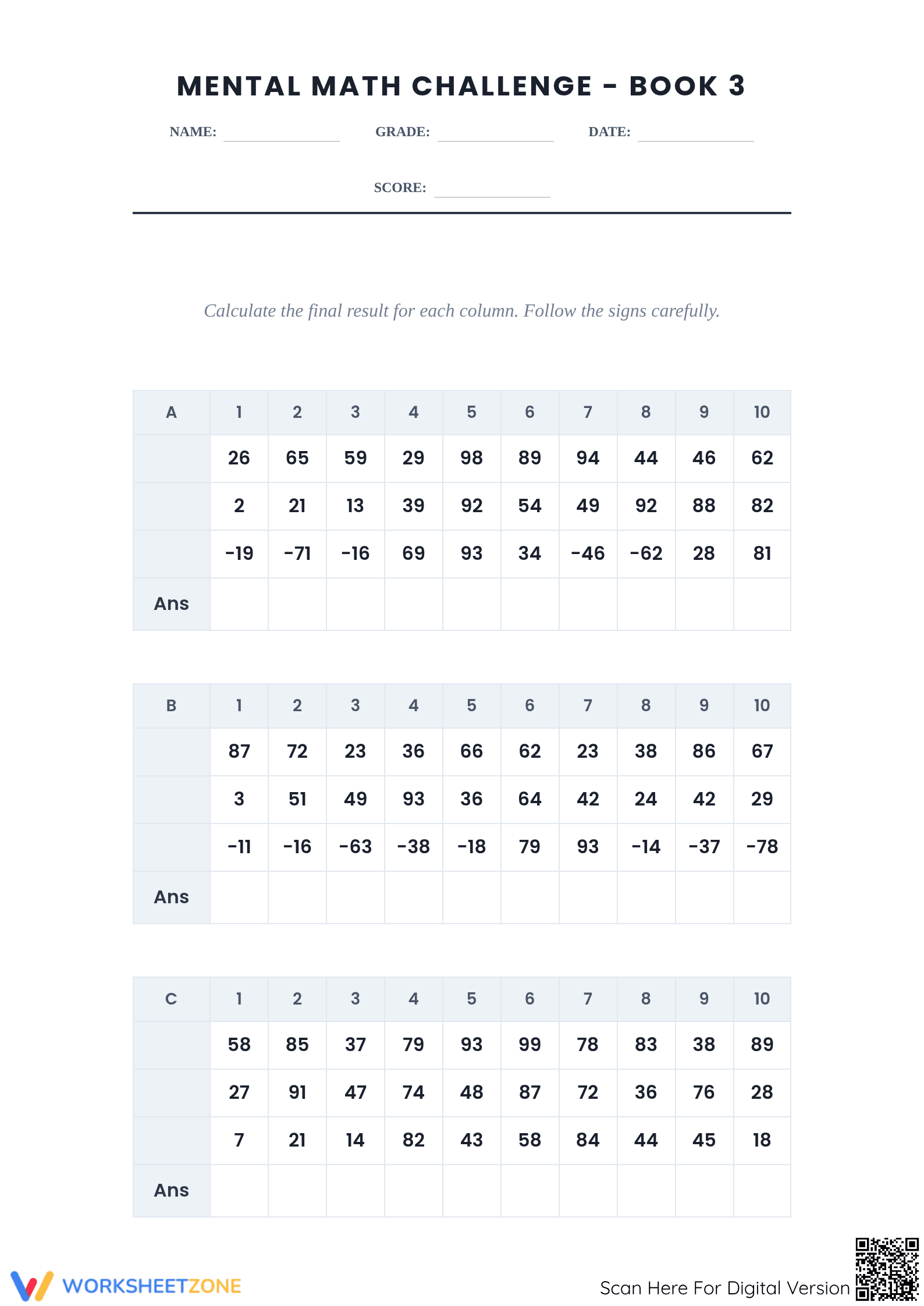



Grades 3-5 Mental Math — Printable No-Prep Worksheet
Paste this activity's link or code into your existing LMS (Google Classroom, Canvas, Teams, Schoology, Moodle, etc.).
Students can open and work on the activity right away, with no student login required.
You'll still be able to track student progress and results from your teacher account.
This robust mental math challenge helps students solidify mixed addition and subtraction of multi-digit numbers through high-repetition practice. By engaging with structured columns, learners develop the cognitive speed and numerical fluency required for complex problem-solving. This resource provides a direct path to arithmetic mastery for upper elementary students.
At a Glance
- Grade: 3–5 · Subject: Math
- Standard:
CCSS.MATH.CONTENT.3.NBT.A.2— Fluently add and subtract within 1000 using strategies based on place value- Skill Focus: Mental multi-step arithmetic
- Format: 3 pages · 80 problems · Answer key included · PDF
- Best For: Morning work or timed fluency drills
- Time: 15–25 minutes
This three-page PDF packet features 80 distinct mental math columns organized into eight lettered sections (A-H). Each column challenges students to process three or four numbers sequentially, following specific operation signs. The clean, grid-based layout prevents visual overwhelm while maximizing practice density. A full answer key is provided for rapid grading and student self-correction.
Zero-Prep Workflow
The zero-prep design allows teachers to implement this "Mental Math Challenge" in under two minutes. Step 1: Print the three-page packet (30s). Step 2: Distribute for independent work (30s). Step 3: Rapidly grade using the provided key (60s). This streamlined workflow makes it an ideal choice for substitute lesson plans, end-of-unit review, or daily fluency maintenance.
Standards Alignment
This resource is primary aligned to CCSS.MATH.CONTENT.3.NBT.A.2, which requires students to fluently add and subtract within 1000 using strategies based on place value and the properties of operations. The mixed operations also support progress toward fluently adding and subtracting multi-digit whole numbers using the standard algorithm. Standard codes can be copied directly into lesson plans or district curriculum mapping tools.
How to Use It
Implement this worksheet during the "independent practice" phase of a math lesson to solidify mental computation strategies. It serves as an effective formative assessment tool; observe students to identify those relying on finger-counting versus those using place-value decomposition. We recommend a 20-minute time limit to encourage speed, providing a "score" area at the top for students to track their personal growth.
Who It's For
This packet is designed for Grade 3-5 students who need to bridge the gap between basic facts and algorithmic fluency. It is particularly useful for RTI (Response to Intervention) groups or as an extension for Grade 2 students showing advanced proficiency. Pair this worksheet with an anchor chart demonstrating "partial sums" or "compensation" strategies to support diverse learners.
The "Mental Math Challenge" addresses the critical need for computational automaticity in the upper elementary grades. According to the RAND AIRS 2024 study, students who engage in regular, high-volume mental math drills demonstrate significantly higher performance on multi-step word problems because they can allocate more working memory to conceptual understanding rather than basic arithmetic. By practicing 80 targeted columns, learners internalize place-value relationships and operational logic, moving beyond rote memorization. This structured approach aligns with the science of math, which emphasizes that fluency is a prerequisite for higher-order mathematical reasoning. The inclusion of CCSS.MATH.CONTENT.3.NBT.A.2 ensures that practice remains focused on grade-level expectations while providing the scaffolding necessary for student success. Educators can rely on this packet as a research-backed tool for building the durable math foundations required for middle school success and beyond.


