




























Views
Downloads
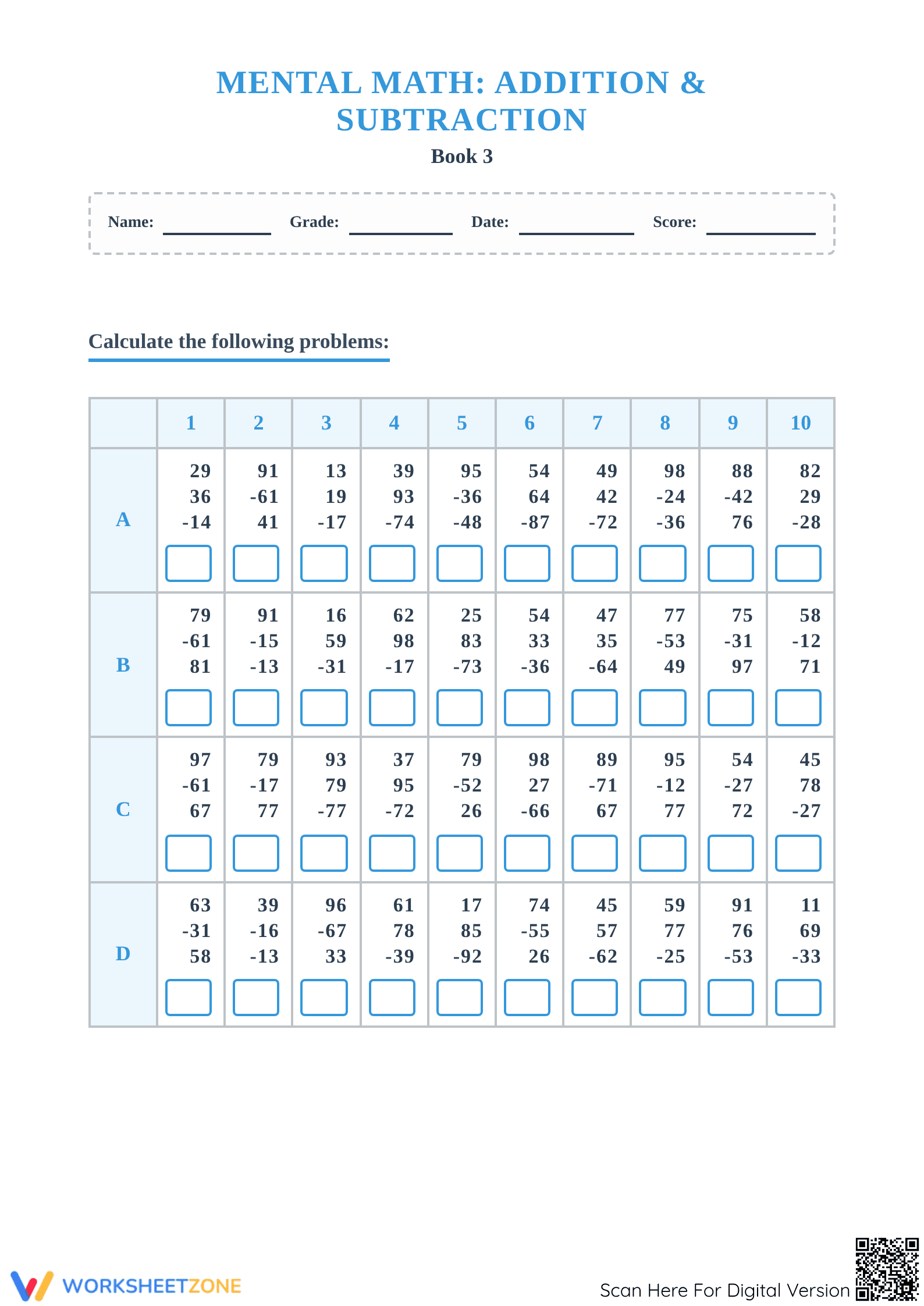


Mental Math Addition & Subtraction | Essential Grade 3

Paste this activity's link or code into your existing LMS (Google Classroom, Canvas, Teams, Schoology, Moodle, etc.).
Students can open and work on the activity right away, with no student login required.
You'll still be able to track student progress and results from your teacher account.
This Grade 3 mental math worksheet provides intensive practice in multi-step addition and subtraction. Students calculate 80 different problems involving three-term operations to build computational fluency and numerical confidence. By engaging with these structured grids, learners develop the speed and accuracy required for higher-level mathematics before moving into complex word problems.
At a Glance
- Grade: 3 · Subject: Math
- Standard:
CCSS.MATH.CONTENT.3.NBT.A.2— Fluently add and subtract within 1000 using strategies and algorithms- Skill Focus: 2-digit mental math
- Format: 2 pages · 80 problems · Answer key included · PDF
- Best For: Daily warm-ups or fluency drills
- Time: 15–25 minutes
The resource consists of two comprehensive pages, each featuring a 40-problem grid organized by rows (A-H) and columns (1-10). Each task requires students to process three distinct 2-digit numbers using a combination of addition and subtraction. This vertical format mirrors standard algorithmic presentation while encouraging mental regrouping. A full answer key is provided to facilitate rapid grading or student self-correction.
This worksheet is designed for immediate classroom implementation. Teachers can print the double-sided PDF in under 2 minutes, distribute it to the class for a 15-minute fluency block, and use the included answer key for a lightning review. It serves as an ideal sub-plan or "bell-ringer" activity requiring zero prior setup, ensuring that instructional time is maximized for student practice rather than teacher preparation.
Primary alignment is to `CCSS.MATH.CONTENT.3.NBT.A.2`, which focuses on fluently adding and subtracting within 1000. The worksheet specifically targets the sub-skill of managing multiple operations within a single calculation string, reinforcing the properties of operations. Both standard codes can be copied directly into lesson plans, IEP goals, or district curriculum mapping tools.
Use this as a "Mad Minute" style challenge during the first ten minutes of math block to activate prior knowledge. Alternatively, assign one row per day as a formative assessment to track progress in operational fluency. Expected completion time for a single page is approximately 10 to 15 minutes for most third-grade learners, making it a flexible tool for various instructional moments.
This resource is perfect for general education third graders, fourth-grade students needing remedial fluency support, or advanced second graders ready for multi-step challenges. It pairs naturally with place-value anchor charts or base-ten block manipulatives for students who still require visual scaffolding during mental calculation. The high task density makes it particularly effective for students who benefit from repetitive practice.
Research from RAND AIRS 2024 emphasizes that high-frequency, low-stakes fluency practice is essential for reducing cognitive load during complex problem-solving. This worksheet aligns with the CCSS.MATH.CONTENT.3.NBT.A.2 standard by providing the repetitive, structured engagement necessary to move 2-digit addition and subtraction from conscious effort to automaticity. By requiring students to process three terms per problem, the resource pushes beyond simple fact recall into active operational processing. According to Fisher & Frey (2014), this type of distributed practice supports long-term retention of arithmetic strategies. The clear grid layout minimizes visual distractions, allowing students to focus entirely on the numerical relationships. This 80-problem set ensures that learners encounter a wide variety of regrouping scenarios, reinforcing their understanding of place value and operational properties in a printable, ready-to-use format.


