




























Views
Downloads

Printable Addition and Subtraction Mastery Worksheet

Paste this activity's link or code into your existing LMS (Google Classroom, Canvas, Teams, Schoology, Moodle, etc.).
Students can open and work on the activity right away, with no student login required.
You'll still be able to track student progress and results from your teacher account.
This worksheet provides a comprehensive review of basic arithmetic operations through four distinct phases of engagement. Students build fluency with numbers within 20, solve for missing variables, and apply logic to complex multi-step word problems. It is designed to bridge the gap between abstract calculation and real-world mathematical application.
At a Glance
- Grade: 2 · Subject: Math
- Standard:
CCSS.MATH.CONTENT.2.OA.A.1— Use addition and subtraction within 100 to solve one- and two-step word problems- Skill Focus: Addition and Subtraction Fluency
- Format: 3 pages · 30 problems · Answer key included · PDF
- Best For: Homework, independent practice, or morning work
- Time: 20–30 minutes
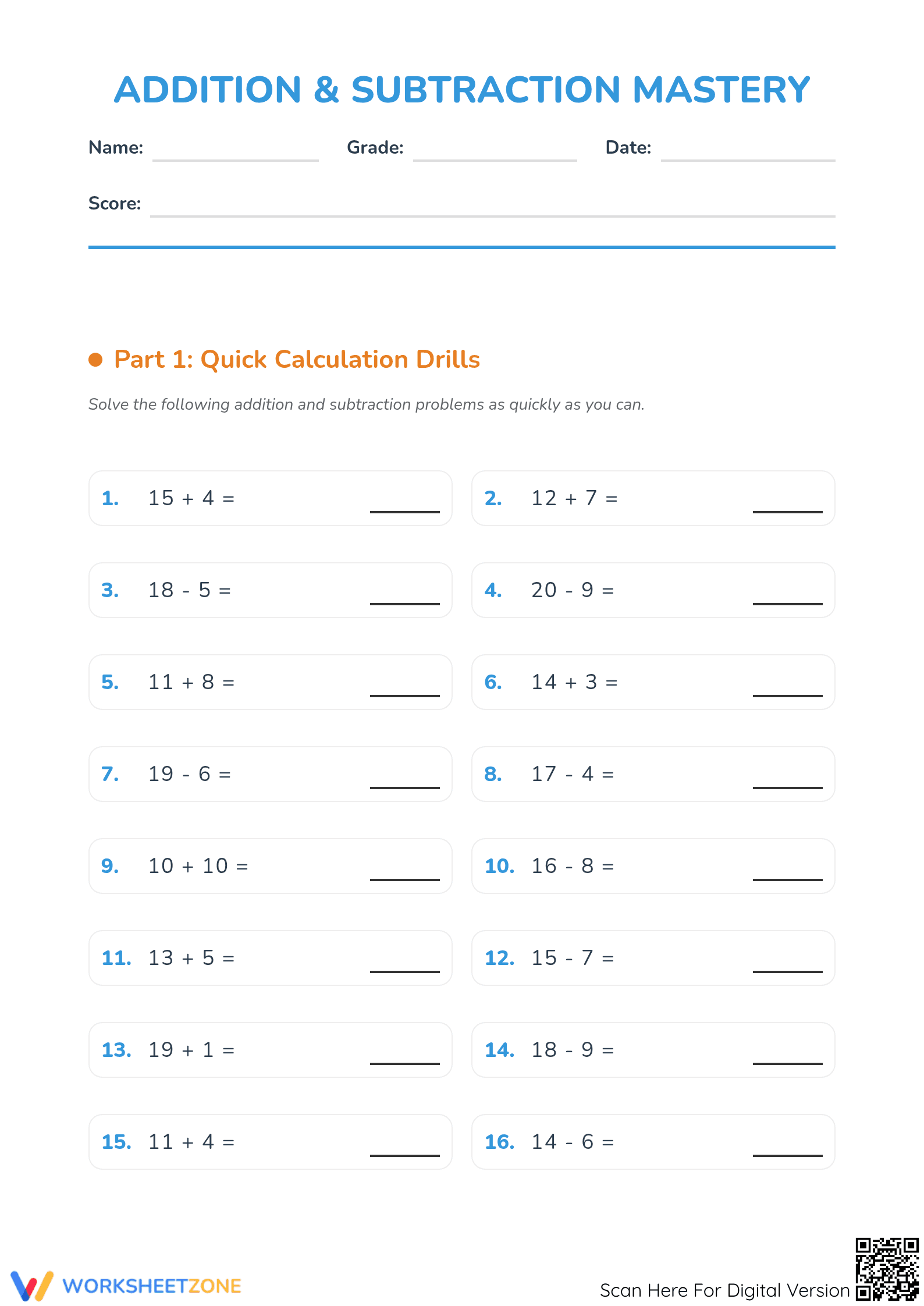
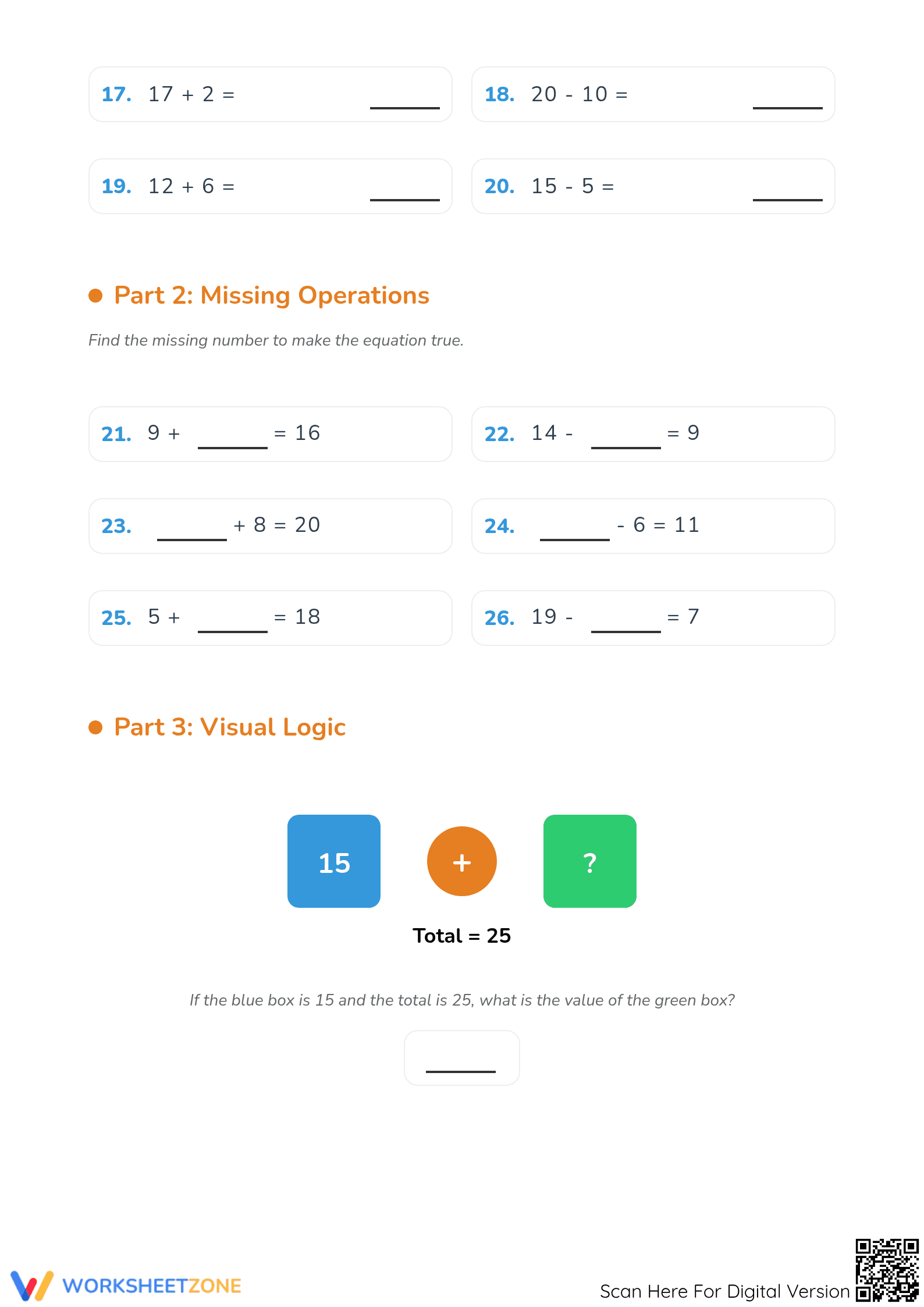
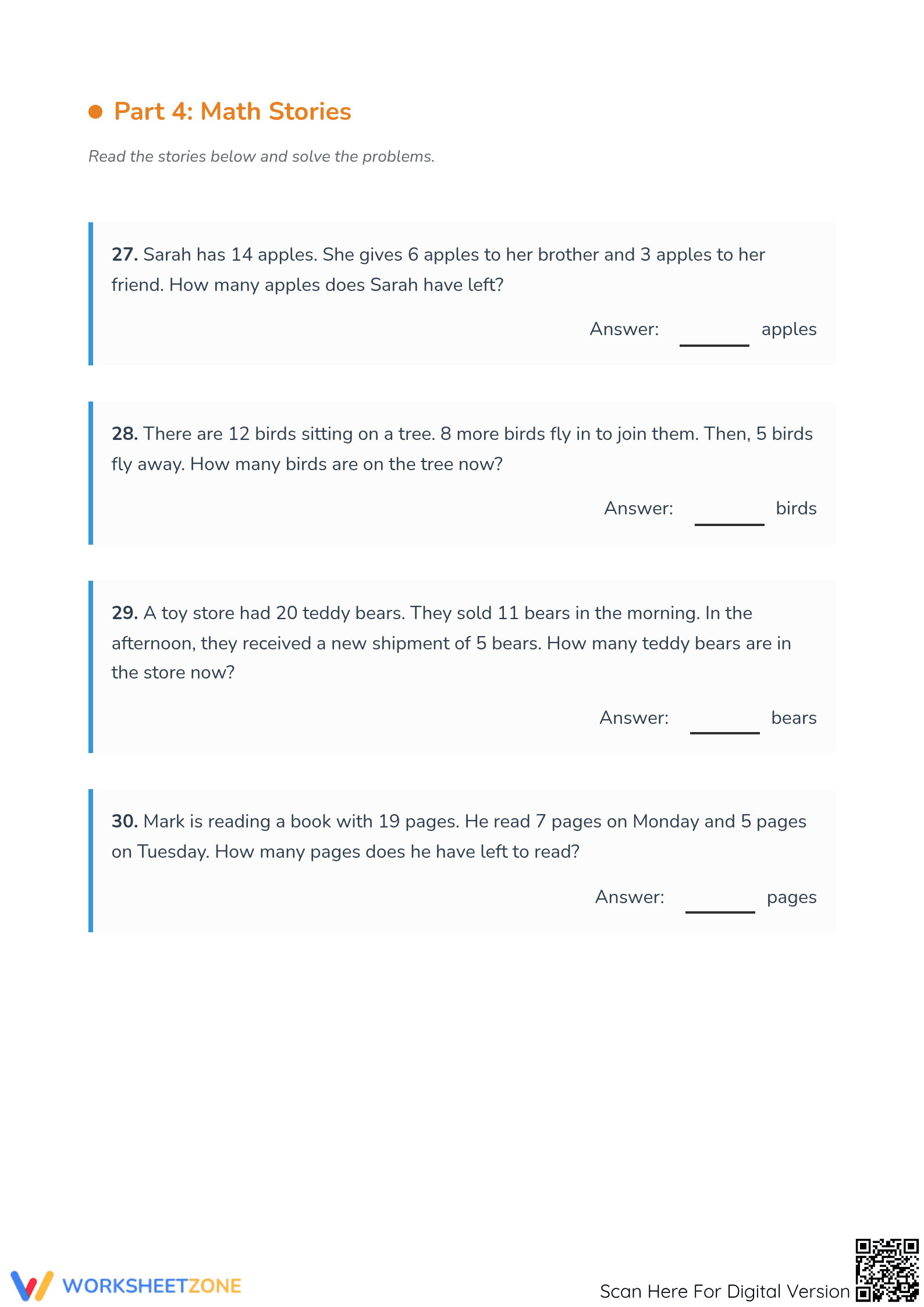
The three-page PDF includes thirty unique problems organized by complexity. Page one features twenty "Quick Calculation Drills" to reinforce mental math. Page two introduces "Missing Operations" and a "Visual Logic" puzzle involving a three-box algebraic representation. Page three concludes with four "Math Stories" that require students to parse multi-step addition and subtraction scenarios.
Zero-Prep Workflow
- Print: Send the three-page PDF to your printer in under 30 seconds.
- Distribute: Hand out the stapled packets to students during your math block.
- Review: Use the provided answer keys to grade the work or have students peer-edit their solutions.
Total teacher prep time is under two minutes, making this an ideal choice for substitute folders or last-minute lesson extensions.
Standards Alignment
This resource is primarily aligned with CCSS.MATH.CONTENT.2.OA.A.1, focusing on solving one- and two-step word problems involving situations of adding to, taking from, and comparing. It also supports CCSS.MATH.CONTENT.2.OA.B.2 by demanding fluency for addition and subtraction within 20. Both standard codes can be copied directly into lesson plans, IEP goals, or district curriculum mapping tools.
How to Use It
Deploy this worksheet as a summative assessment after a unit on basic operations or as a weekly maintenance task to prevent skill regression. Teachers should observe students during Part 3 (Visual Logic) to identify those struggling with the concept of equality versus operation. The expected completion time is thirty minutes, allowing for deep reading of the word problems in the final section.
Who It's For
This practice set is tailored for second and third-grade students mastering basic arithmetic. It provides necessary scaffolds for learners who need visual representations and structured drills. It pairs naturally with an anchor chart on keywords for word problems (like "left," "total," or "join") to help students navigate the "Math Stories" section effectively.
The shift from isolated calculation to contextual word problem solving is a critical milestone in early elementary mathematics. According to research from Fisher & Frey (2014), the gradual release of responsibility model—moving from guided calculation drills to independent application in "Math Stories"—is essential for building long-term mathematical retention. This worksheet follows that pedagogical structure by starting with simple drills and concluding with complex, multi-step scenarios that require high-level reading comprehension alongside numerical skill. Aligned to CCSS.MATH.CONTENT.2.OA.A.1, the tasks ensure students are not just memorizing facts but are instead understanding the underlying logic of addition and subtraction. By requiring students to solve for missing numbers and interpret visual logic puzzles, the resource addresses the foundational algebraic thinking necessary for success in higher grades. This structured approach provides the necessary evidence for progress monitoring in both general education and special education settings.


