


























Views
Plays
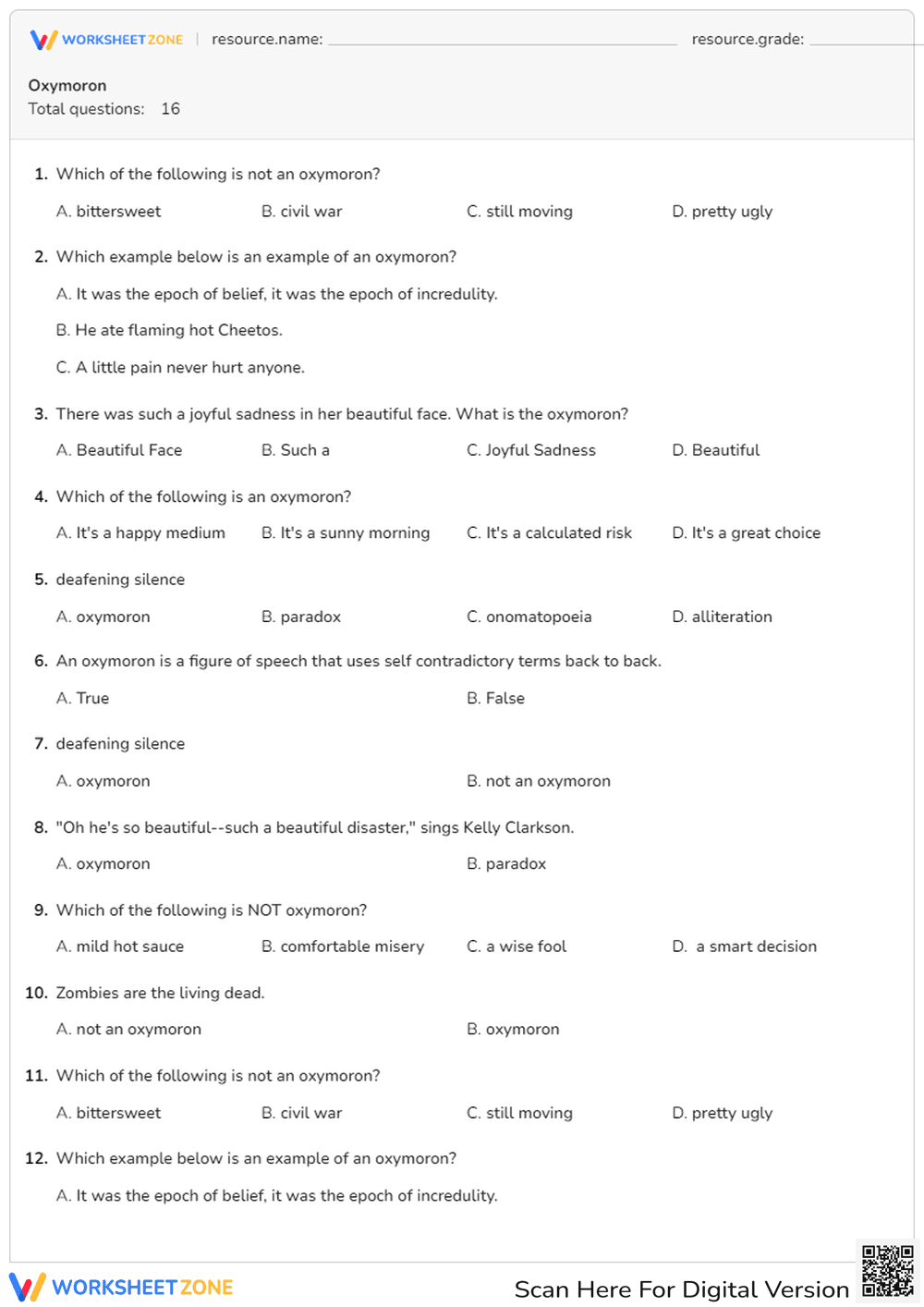


Essential Oxymoron Practice Worksheet | Grades 5-7
Paste this activity's link or code into your existing LMS (Google Classroom, Canvas, Teams, Schoology, Moodle, etc.).
Students can open and work on the activity right away, with no student login required.
You'll still be able to track student progress and results from your teacher account.
This Grade 5-7 figurative language worksheet provides targeted practice in identifying and interpreting oxymorons. Students analyze 16 specific examples to distinguish contradictory word pairs from other literary devices like paradox or alliteration. By the end of this activity, learners will confidently recognize how authors use opposing terms to create nuanced meaning in text.
At a Glance
- Grade: 5-7 · Subject: ELA
- Standard:
CCSS.ELA-LITERACY.L.6.5.A— Interpret figures of speech, including oxymorons, in context- Skill Focus: Identifying oxymorons
- Format: 2 pages · 16 problems · Answer key included · PDF
- Best For: Independent practice or quick assessment
- Time: 15–20 minutes
The resource contains 16 multiple-choice and true/false questions spread across two pages. It features a mix of classic examples like "deafening silence" and "bittersweet" alongside contextual sentences. The layout is clean and distraction-free, including a dedicated space for student names and grades. A full answer key is provided for rapid grading and immediate student feedback.
This worksheet is designed for a zero-prep workflow. Teachers can print the two-page PDF in under 30 seconds. Distribution takes less than a minute, and because the questions are self-explanatory, students can begin immediately. Reviewing the 16 answers as a whole class takes approximately 5 minutes, making this an ideal sub plan or bell-ringer activity for busy classrooms.
Standards Alignment
This resource aligns with `CCSS.ELA-LITERACY.L.6.5.A`, which requires students to interpret figures of speech in context. It also supports `CCSS.ELA-LITERACY.L.5.5.A` by building the foundational knowledge of word relationships and nuances in word meanings. Both standard codes can be copied directly into lesson plans, IEP goals, or district curriculum mapping tools.
How to Use It
Use this as a formative assessment after a direct instruction lesson on figurative language. It works well as a "check for understanding" to ensure students are not confusing oxymorons with paradoxes. Expect students to complete the 16 items in 15 to 20 minutes. Observe if students struggle with the "not an oxymoron" questions to identify common misconceptions.
Who It's For
This is designed for middle school ELA students, including English Language Learners who benefit from seeing contradictory terms paired together. It pairs naturally with a poetry unit or a short story analysis where complex imagery is present. It is a perfect companion to an anchor chart on literary devices or figurative language.
According to Fisher & Frey (2014), the gradual release of responsibility in literacy instruction requires high-quality independent practice materials that isolate specific linguistic nuances. This worksheet addresses that need by focusing exclusively on the oxymoron, a figure of speech often overlooked in broader figurative language units. By providing 16 distinct opportunities for identification, the resource ensures students move beyond rote memorization toward conceptual mastery. Research from EdReports 2024 emphasizes that standards-aligned materials must provide clear evidence of student understanding through varied task types. This resource meets that criteria by utilizing both identification and differentiation tasks. The inclusion of the CCSS.ELA-LITERACY.L.6.5.A standard ensures that the content remains rigorous and grade-appropriate for the middle school level. Teachers can use the data from these 16 questions to inform future small-group instruction or to document progress toward specific ELA mastery goals.


