


























Views
Downloads

Ovid Quotes Handwriting Worksheet | Grade 3 Printable
Paste this activity's link or code into your existing LMS (Google Classroom, Canvas, Teams, Schoology, Moodle, etc.).
Students can open and work on the activity right away, with no student login required.
You'll still be able to track student progress and results from your teacher account.
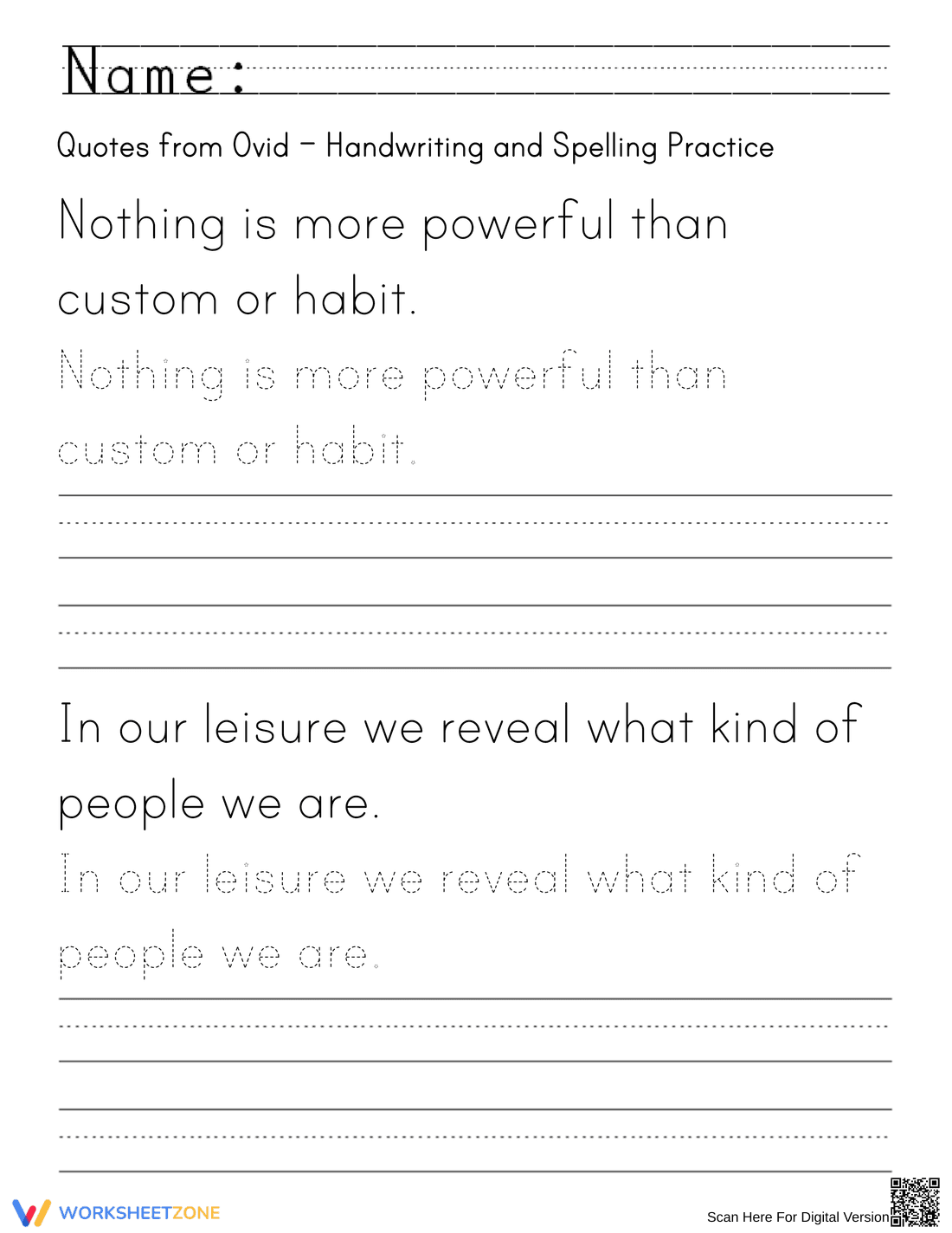
This printable handwriting worksheet helps third and fourth-grade students practice clear, legible print writing while reinforcing spelling and punctuation conventions. By tracing and copying classic quotes from the Roman poet Ovid, learners develop fine motor control and muscle memory required for fluent written communication.
At a Glance
- Grade: 3 · Subject: English
- Standard:
CCSS.ELA-LITERACY.L.3.2— Demonstrate command of capitalization, punctuation, and spelling.- Skill Focus: Print Handwriting
- Format: 1 page · 2 problems · No answer key required · PDF
- Best For: Morning work or independent practice
- Time: 10–15 minutes
Inside this single-page resource, educators will find two distinct handwriting tasks featuring inspirational quotes from Ovid. Each section provides the quote in a clear, solid primary font, followed by a dotted tracing version, and finally, blank primary-lined space for independent copying. The structured layout includes top, middle, and bottom guidelines to help students maintain proper letter height, spacing, and alignment throughout their practice.
This resource is designed for immediate classroom implementation with a zero-prep workflow:
- Print (1 minute): Generate copies directly from the PDF file without needing to adjust margins or formatting.
- Distribute (1 minute): Hand out the sheets during morning routines or literacy centers. The instructions are self-evident.
- Review (1 minute): Quickly scan completed pages to check for letter formation and line adherence.
Total teacher preparation time is under two minutes, making this an excellent addition to any emergency substitute plan or fast-finisher folder.
This activity aligns with CCSS.ELA-LITERACY.L.3.2, requiring students to demonstrate command of the conventions of standard English capitalization, punctuation, and spelling when writing. By copying accurately, students practice these essential conventions in context. It also supports general fine motor development necessary for sustained writing tasks. Both standard codes can be copied directly into lesson plans, IEP goals, or district curriculum mapping tools.
Teachers can utilize this worksheet as a calming morning work activity before direct instruction begins, allowing students to settle into the academic day. Alternatively, it serves well as an independent literacy center station. While students work, teachers can conduct formative assessments by observing pencil grip, posture, and the directionality of letter strokes. Expect students to complete the tracing and copying tasks within 10 to 15 minutes.
This resource is primarily designed for third and fourth-grade students refining their print handwriting skills. It offers built-in differentiation through the tracing step, which provides necessary scaffolding for students struggling with letter formation or fine motor control. This worksheet pairs naturally with a brief direct instruction lesson on classical history or a broader unit on poetry and famous historical figures.
Developing fluent handwriting is a critical component of early literacy that directly impacts a student's ability to express complex ideas. According to a 2024 report by EdReports, explicit instruction and consistent practice in letter formation reduce the cognitive load required for transcription, allowing young writers to focus their mental energy on content generation and vocabulary selection. This worksheet targets CCSS.ELA-LITERACY.L.3.2, helping students demonstrate command of capitalization, punctuation, and spelling through guided repetition. By tracing and independently copying structured text, learners build the muscle memory necessary for automaticity. The plain-English skill of accurately reproducing standard English conventions is reinforced through the careful transcription of Ovid's quotes. Consistent engagement with structured handwriting tasks ensures that mechanical writing difficulties do not impede broader academic achievement across all subject areas.


