


























Views
Downloads
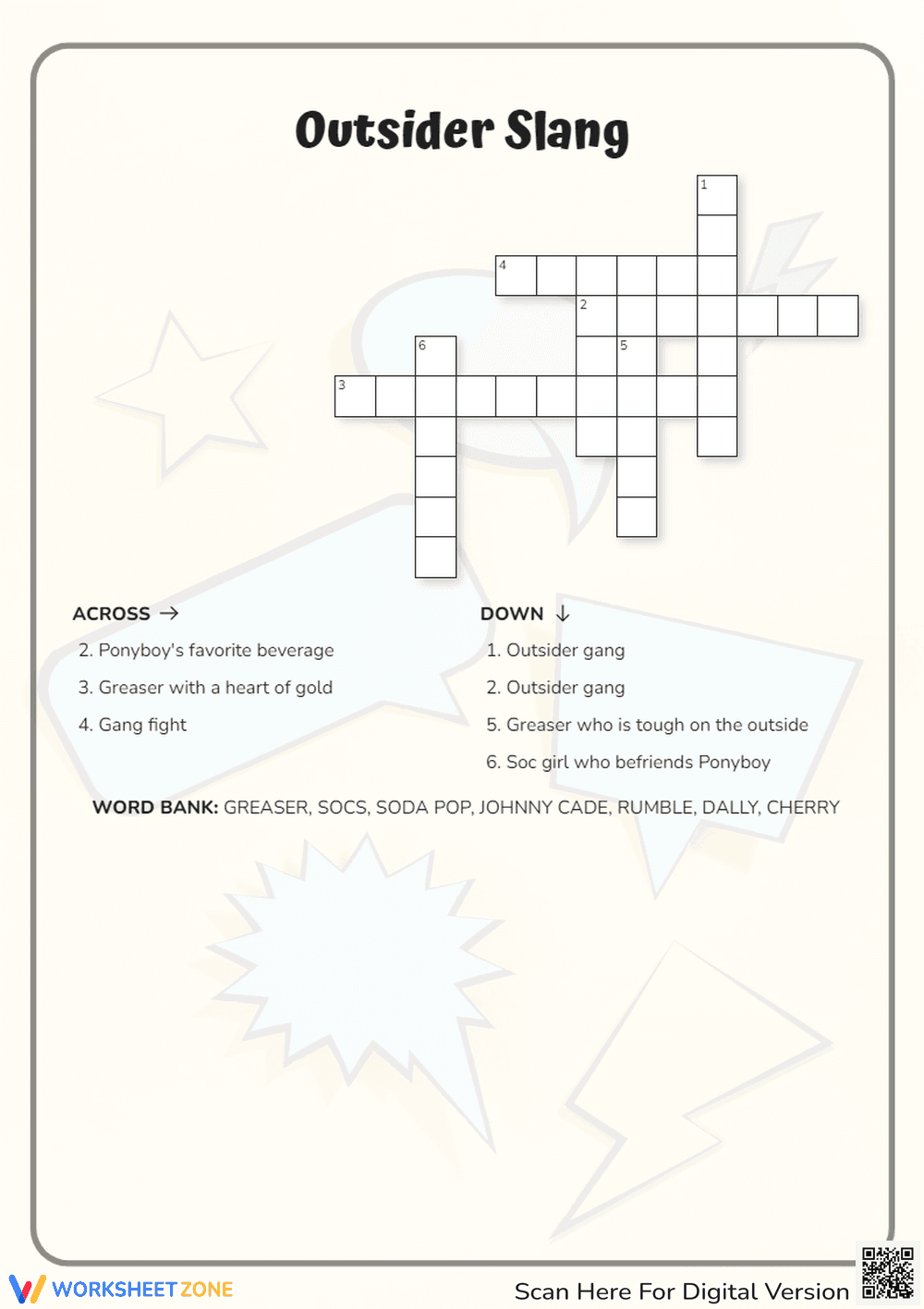

Outsider Slang Crossword | Essential Grade 4 ELA
Paste this activity's link or code into your existing LMS (Google Classroom, Canvas, Teams, Schoology, Moodle, etc.).
Students can open and work on the activity right away, with no student login required.
You'll still be able to track student progress and results from your teacher account.
This Grade 4 ELA worksheet provides a focused vocabulary review for S.E. Hinton's classic novel, The Outsiders. Students use context clues and character knowledge to complete a 7-word crossword puzzle. By identifying key terms like "rumble" and "greaser," learners solidify their understanding of the text's unique social dynamics and setting.
At a Glance
- Grade: Grade 4 · Subject: ELA
- Standard:
CCSS.ELA-LITERACY.RL.4.1— Refer to details and examples in a text to explain explicit meanings- Skill Focus: Vocabulary and Character Identification
- Format: 1 page · 7 problems · Answer key included · PDF
- Best For: Post-reading character and vocabulary review
- Time: 10–15 minutes
The worksheet features a clean, one-page layout containing a crossword grid with seven specific clues. To support diverse learners, a word bank is provided at the bottom, including terms such as Johnny Cade, Cherry, and Soda Pop. This structure ensures students can focus on matching definitions to terms without the frustration of spelling hurdles.
This resource follows a zero-prep workflow designed for busy educators. First, print the single-page PDF (30 seconds). Next, distribute the sheets to students as a bell-ringer or exit ticket (1 minute). Finally, review the answers as a whole group to clarify character motivations and plot points (5 minutes). Total teacher preparation time is under 2 minutes.
Aligned with CCSS.ELA-LITERACY.RL.4.1, this activity requires students to refer to details and examples in a text when explaining what the text says explicitly. By connecting clues like "Soc girl who befriends Ponyboy" to the character Cherry, students demonstrate literal comprehension and evidence-based recall. This standard code can be copied directly into lesson plans, IEP goals, or district curriculum mapping tools.
Use this worksheet during the middle of a novel study to check for basic comprehension of the "Greaser" versus "Soc" conflict. It works best after students have finished the first three chapters. As a formative assessment, observe if students can identify characters without the word bank first; this reveals who has mastered the character list. Completion typically takes 10–15 minutes.
This resource is designed for Grade 4 students, though it remains accessible for Grade 3 learners or English Language Learners needing scaffolded vocabulary support. It pairs naturally with a character anchor chart or a plot timeline. The inclusion of the word bank provides necessary differentiation for students.
According to Fisher & Frey (2014), the use of word banks and crossword puzzles in literacy instruction supports the gradual release of responsibility model by providing a scaffolded environment for vocabulary acquisition. This worksheet specifically targets CCSS.ELA-LITERACY.RL.4.1 by requiring students to synthesize textual clues into specific character and setting identifiers. Research indicates that structured word play improves long-term retention of literary terms compared to rote memorization. By engaging with 7 high-frequency terms from the novel, students build the foundational schema necessary for higher-order analysis of themes and motifs. This approach ensures that Grade 4 learners develop the literal comprehension skills required by the NAEP framework for reading proficiency. The combination of visual puzzles and textual evidence creates a multi-modal learning experience that bridges the gap between simple reading and active literary engagement.


