


























Views
Downloads

Organ System Functions Worksheet | Grade 6 Complete
Paste this activity's link or code into your existing LMS (Google Classroom, Canvas, Teams, Schoology, Moodle, etc.).
Students can open and work on the activity right away, with no student login required.
You'll still be able to track student progress and results from your teacher account.
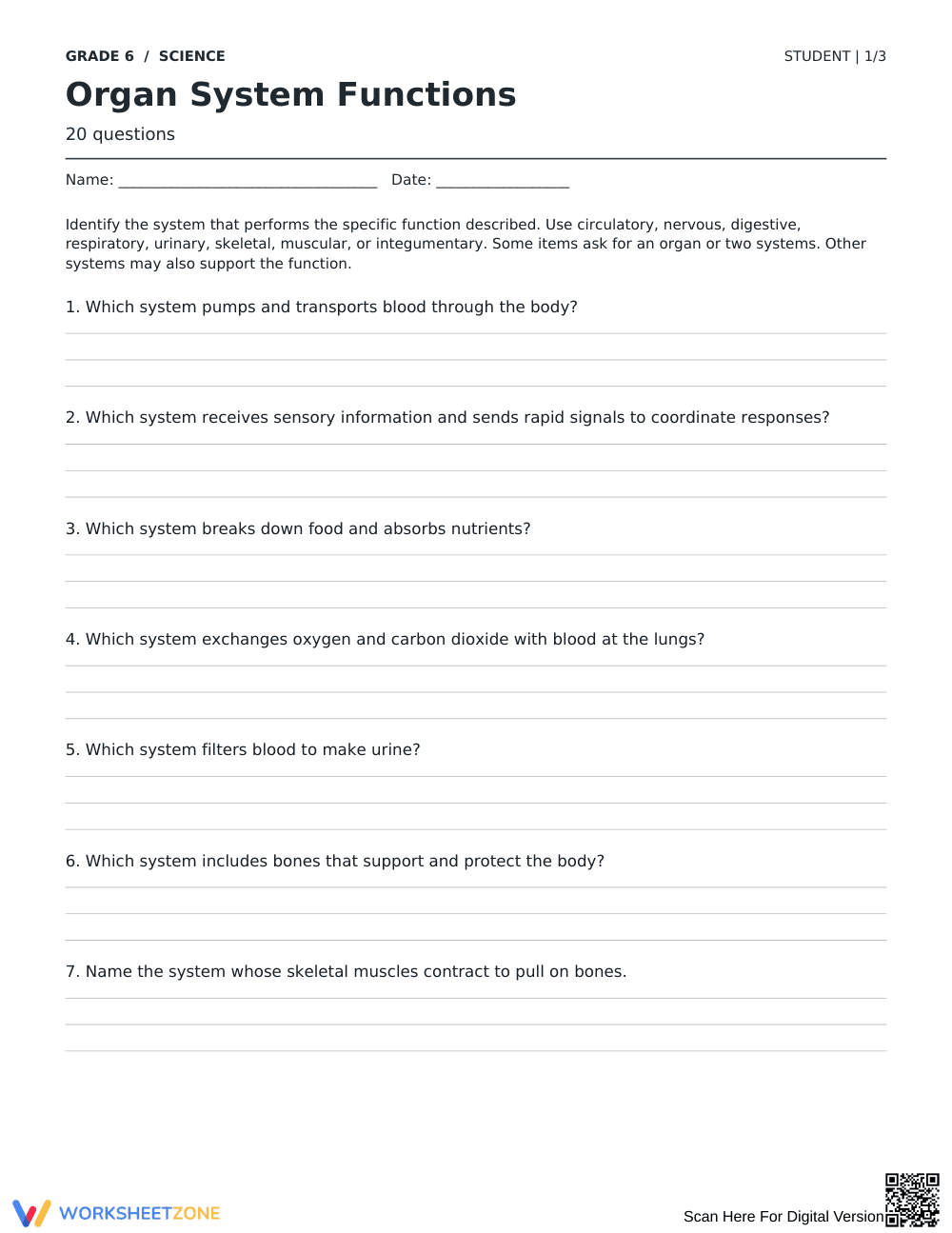
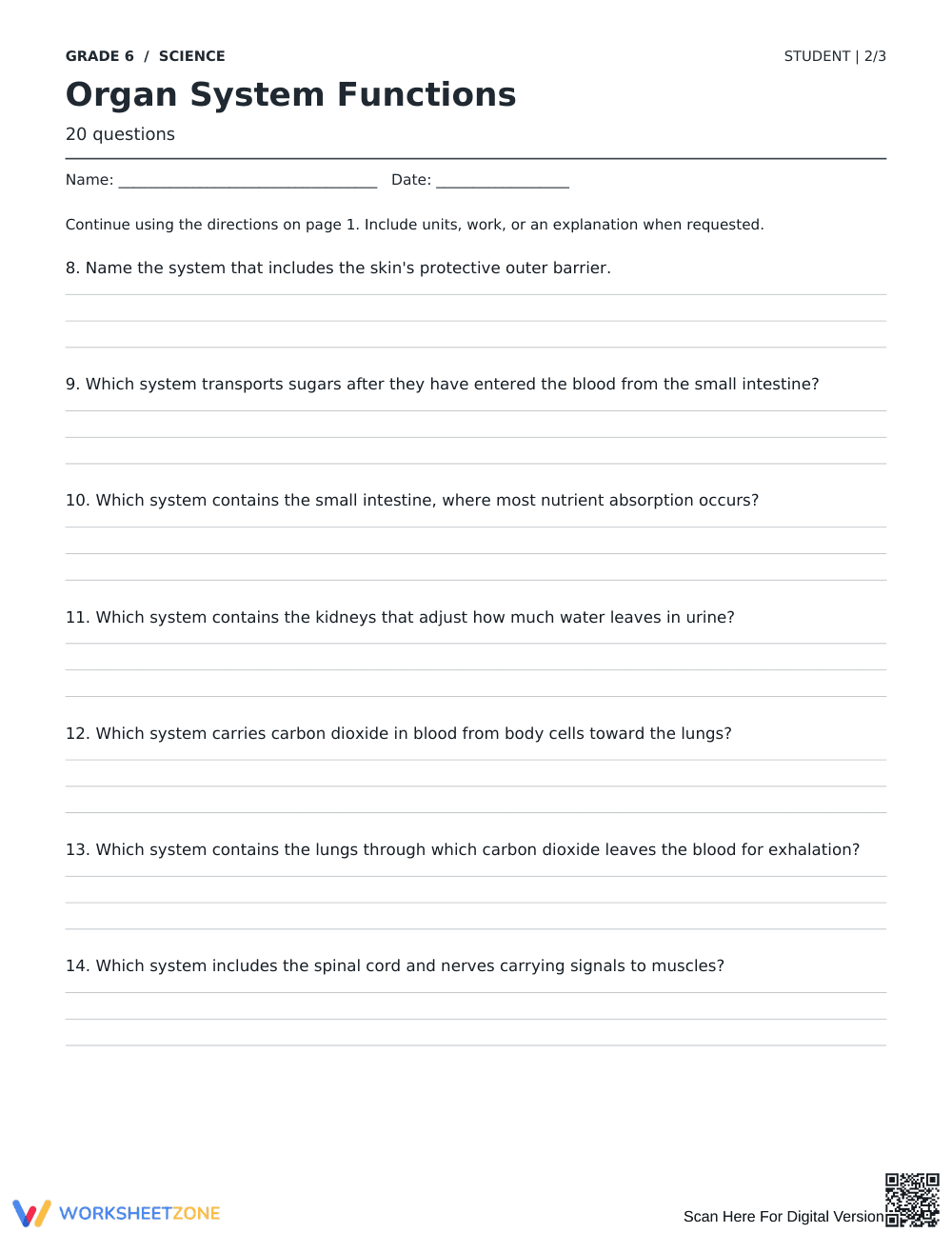
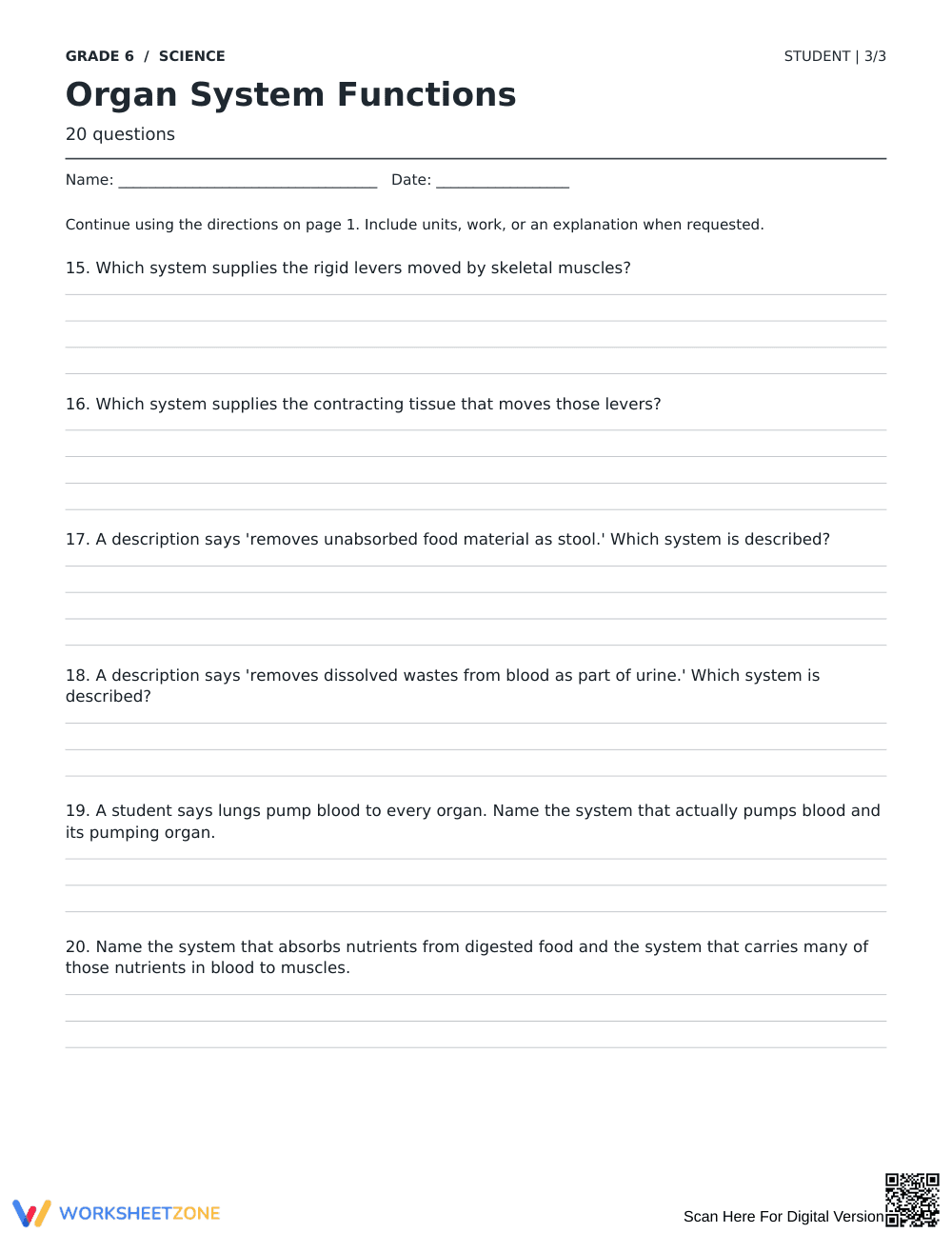
This Grade 6 science worksheet trains students to identify human organ system functions and analyze subsystem interactions. Through 20 targeted questions, learners connect core physiological roles—such as gas exchange, waste filtration, and nutrient transport—to specific anatomical structures, establishing a firm conceptual bridge toward middle school life science mastery.
At a Glance
- Grade: 6 · Subject: Science
- Standard:
MS-LS1-3— Explain how body systems interact to carry out life functions- Skill Focus: Human organ system functions
- Format: 3 pages · 20 problems · Answer key included · PDF
- Best For: Life science review and assessment
- Time: 25–40 minutes
Across 3 student pages, learners answer 20 identification prompts supported by a word bank of 8 systems. Tasks cover circulatory, nervous, digestive, respiratory, urinary, skeletal, muscular, and integumentary systems. Later questions challenge students to distinguish between overlapping organs and evaluate system partnerships. A 2-page answer key provides model responses and scoring notes.
Skill Progression
- Guided practice (Questions 1–7): Students match primary functions, like nutrient absorption, to systems using the introductory word bank.
- Supported practice (Questions 8–14): Prompts isolate specific organs, such as kidneys, requiring students to name the parent subsystem.
- Independent practice (Questions 15–20): Multi-part items ask students to contrast related systems and explain dual-system collaborations.
This sequence implements the I Do, We Do, You Do gradual-release model, advancing students from recall to integrated system analysis.
Standards Alignment
This resource aligns to `MS-LS1-3`: Use argument supported by evidence for how the body is a system of interacting subsystems composed of groups of cells. It also supports `MS-LS1-8` regarding nervous signal transmission. Both standard codes can be copied directly into lesson plans, IEP goals, or district curriculum mapping tools.
How to Use It
Administer this worksheet after direct instruction on human anatomy as an independent check or during review stations. As a formative assessment tip, check Questions 17 and 18; mixing up urinary filtration and digestive elimination signals a need for reteaching. Students typically complete the 20 items in 25 to 40 minutes.
Who It's For
This activity supports Grade 6 students developing life science literacy. Teachers can provide visual diagrams for striving readers or challenge advanced learners to map the dual-system pathway in Question 20. It pairs effectively with an interactive human body anchor chart or cell organization lesson.
According to Fisher & Frey (2014), purposeful instructional scaffolding enables middle school students to connect isolated technical terms into functional mental frameworks. This Grade 6 practice set targets standard `MS-LS1-3` by developing the plain-English skill of identifying human body systems and explaining how subsystems interact to maintain life. Across 20 focused items, students examine the roles of the circulatory, respiratory, digestive, and nervous systems under varying conditions. Rather than encouraging rote memorization, the prompts require learners to discern boundaries between organ tasks and analyze collaborative biological functions. Empirical studies emphasize that systematic retrieval practice deepens conceptual retention and prepares young scientists for advanced inquiry. This targeted worksheet provides an accessible, evidence-based format that solidifies foundational life science knowledge for all learners before they tackle complex multi-organ interactions and cellular respiration models in subsequent units.


