


























1 / 3
0
Views
0
Downloads

0.0
0
Save
0 Likes
Share
Ordinal Numbers Worksheet: Learn Positions
0 Views
0 Downloads
Paste this activity's link or code into your existing LMS (Google Classroom, Canvas, Teams, Schoology, Moodle, etc.).
Students can open and work on the activity right away, with no student login required.
You'll still be able to track student progress and results from your teacher account.
Information
Description
What It Is:
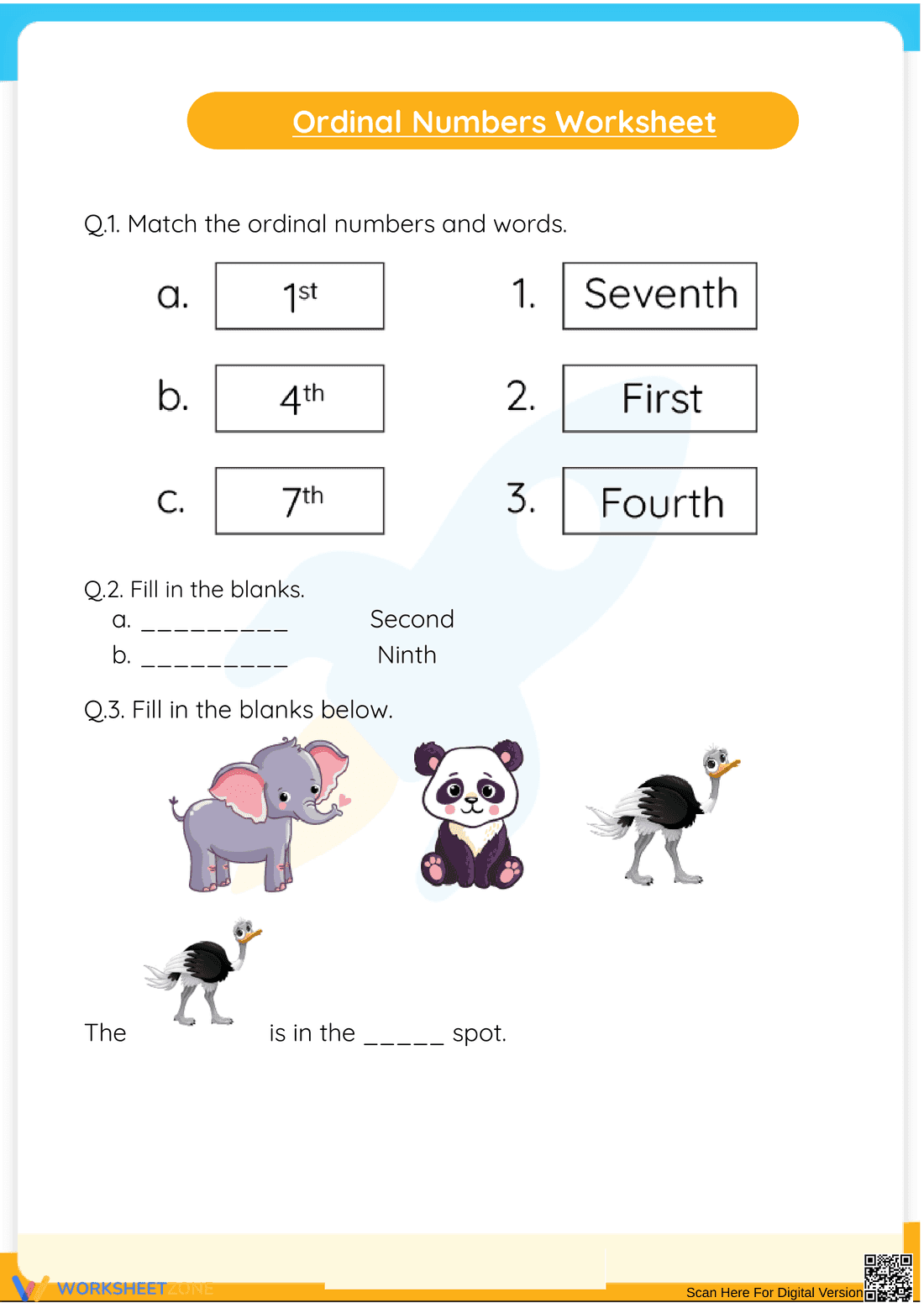
This is an ordinal numbers worksheet. It contains three exercises. The first exercise requires the student to match ordinal numbers (1st, 4th, 7th) with their corresponding words (Seventh, First, Fourth). The second exercise requires the student to fill in the blanks with the ordinal numbers 'Second' and 'Ninth.' The third exercise uses pictures of animals (elephant, panda, ostrich) and asks the student to identify the ordinal position of a second ostrich.
Grade Level Suitability:
This worksheet is suitable for Kindergarten and 1st grade. The activities focus on basic ordinal number recognition and sequencing, which are foundational skills taught at these grade levels. The use of pictures makes it engaging for younger learners.
Why Use It:
This worksheet helps students learn and practice ordinal numbers. It reinforces the understanding of the relationship between numerical representation and written words for ordinal positions. The animal illustration activity helps to solidify the concept of ordinality in a visual context.
How to Use It:
For the first section, students should draw lines connecting the ordinal numbers to the matching words. In the second section, students should write the appropriate ordinal numbers in the blanks provided. For the third section, the student needs to determine the ordinal position of the second ostrich in the sequence and write the corresponding ordinal number in the blank.
Target Users:
This worksheet is ideal for kindergarten and first-grade students learning about ordinal numbers. It's also useful for students who need extra practice with number recognition and sequencing skills. It can be used in the classroom or at home for supplemental learning.
This is an ordinal numbers worksheet. It contains three exercises. The first exercise requires the student to match ordinal numbers (1st, 4th, 7th) with their corresponding words (Seventh, First, Fourth). The second exercise requires the student to fill in the blanks with the ordinal numbers 'Second' and 'Ninth.' The third exercise uses pictures of animals (elephant, panda, ostrich) and asks the student to identify the ordinal position of a second ostrich.
Grade Level Suitability:
This worksheet is suitable for Kindergarten and 1st grade. The activities focus on basic ordinal number recognition and sequencing, which are foundational skills taught at these grade levels. The use of pictures makes it engaging for younger learners.
Why Use It:
This worksheet helps students learn and practice ordinal numbers. It reinforces the understanding of the relationship between numerical representation and written words for ordinal positions. The animal illustration activity helps to solidify the concept of ordinality in a visual context.
How to Use It:
For the first section, students should draw lines connecting the ordinal numbers to the matching words. In the second section, students should write the appropriate ordinal numbers in the blanks provided. For the third section, the student needs to determine the ordinal position of the second ostrich in the sequence and write the corresponding ordinal number in the blank.
Target Users:
This worksheet is ideal for kindergarten and first-grade students learning about ordinal numbers. It's also useful for students who need extra practice with number recognition and sequencing skills. It can be used in the classroom or at home for supplemental learning.


