


























Views
Downloads

Essential Ordering Fractions on a Number Line | Grade 6
Paste this activity's link or code into your existing LMS (Google Classroom, Canvas, Teams, Schoology, Moodle, etc.).
Students can open and work on the activity right away, with no student login required.
You'll still be able to track student progress and results from your teacher account.
This comprehensive Grade 6 math worksheet focuses on the critical skill of ordering rational numbers. Students will practice placing positive and negative fractions, along with mixed numbers, on a structured number line ranging from -2 to 2. This resource ensures students develop a deep conceptual understanding of value and magnitude in a visual format.
At a Glance
- Grade: 6 · Subject: Math
- Standard:
6.NS.C.7— Interpret statements of inequality as relative positions on a number line diagram- Skill Focus: Ordering Rational Numbers
- Format: 2 pages · 6 problems · Answer key included · PDF
- Best For: Independent practice and formative assessment
- Time: 25–35 minutes
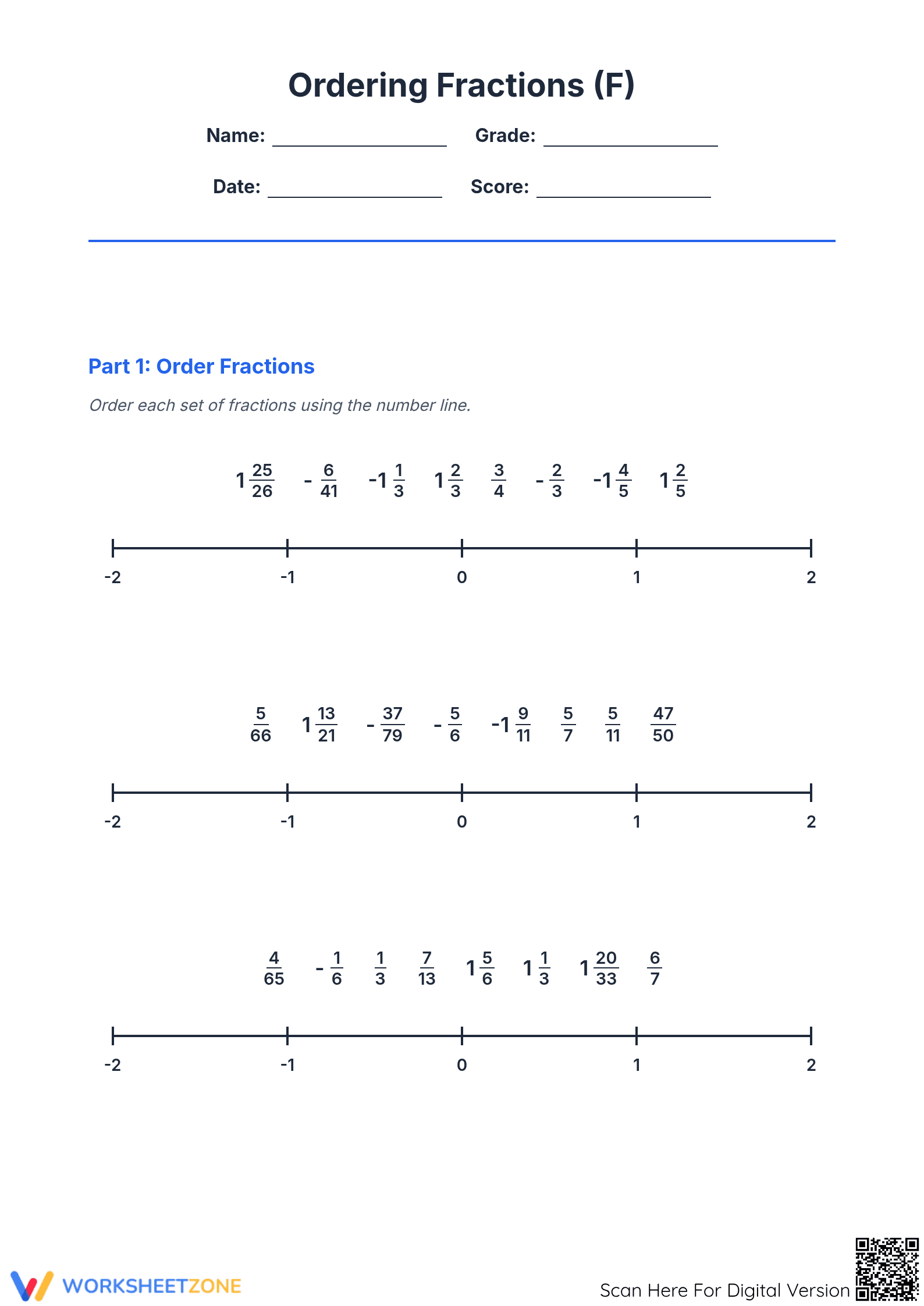
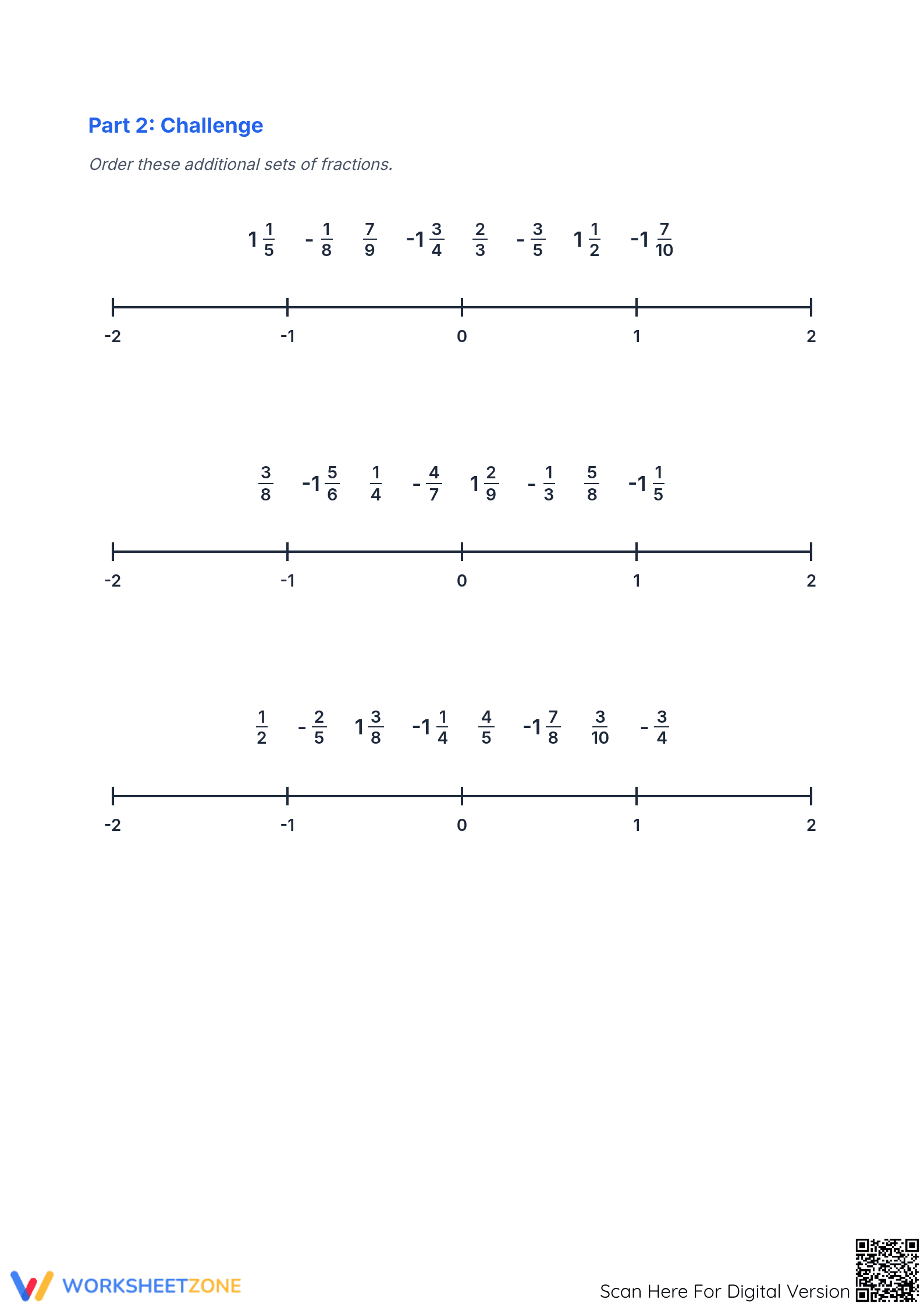
The PDF contains two full pages of rigorous math practice. There are 6 distinct number line problems, each featuring a set of 8 different fractions or mixed numbers. The collection includes a mix of proper fractions, improper fractions, and mixed numbers, with a heavy emphasis on comparing positive and negative values. A full answer key is provided for quick grading.
Skill Progression
- Guided Practice: The first page introduces Part 1, where students work with denominators like 3, 4, and 6, allowing them to establish a baseline for fractional placement between -2 and 2.
- Supported Practice: Problems transition to more complex denominators (e.g., 26, 41, 65, 79) requiring students to estimate positions based on fractional magnitude relative to whole numbers and halves.
- Independent Practice: The "Challenge" section on the second page removes scaffolds, requiring students to order eight diverse rational numbers per line, solidifying their mastery of rational number density.
This progression follows the gradual-release model, moving from familiar fractional units to complex rational number comparisons.
Standards Alignment
6.NS.C.7: Understand ordering and absolute value of rational numbers. Students demonstrate mastery by interpreting the relative position of fractions on a horizontal number line. This standard code can be copied directly into lesson plans, IEP goals, or district curriculum mapping tools.
How to Use It
This worksheet is ideal for use after a direct instruction lesson on negative fractions. Use it as a mid-unit check to identify students who struggle with the "negative side" of the zero. Watch for students who mistakenly place -1 1/3 closer to zero than -1—this common misconception is easily caught using this visual tool.
Who It's For
Designed for Grade 6 students meeting Common Core requirements, this resource also supports Grade 7 and 8 students who need remedial help with the number system. It pairs naturally with a vertical number line anchor chart or a lesson on absolute value.
According to the RAND AIRS 2024 report on mathematics instructional materials, the use of number lines is a high-leverage practice that significantly improves student outcomes in rational number comprehension. This worksheet adheres to the 6.NS.C.7 standard, which requires students to interpret statements of inequality as statements about the relative position of two numbers on a number line diagram. By engaging with 48 unique placement tasks, students move beyond rote memorization of rules and instead develop a spatial and conceptual model of number magnitude. Research by Fisher & Frey (2014) emphasizes that "gradual release of responsibility" through scaffolded number line tasks helps students bridge the gap between concrete and abstract mathematical reasoning. This resource provides that necessary bridge by mixing simple and complex denominators across two pages. It is a vital tool for any middle school curriculum focused on the number system and rational number density.


