


























Views
Downloads

Essential Ordering Fractions on a Number Line Worksheet
Paste this activity's link or code into your existing LMS (Google Classroom, Canvas, Teams, Schoology, Moodle, etc.).
Students can open and work on the activity right away, with no student login required.
You'll still be able to track student progress and results from your teacher account.
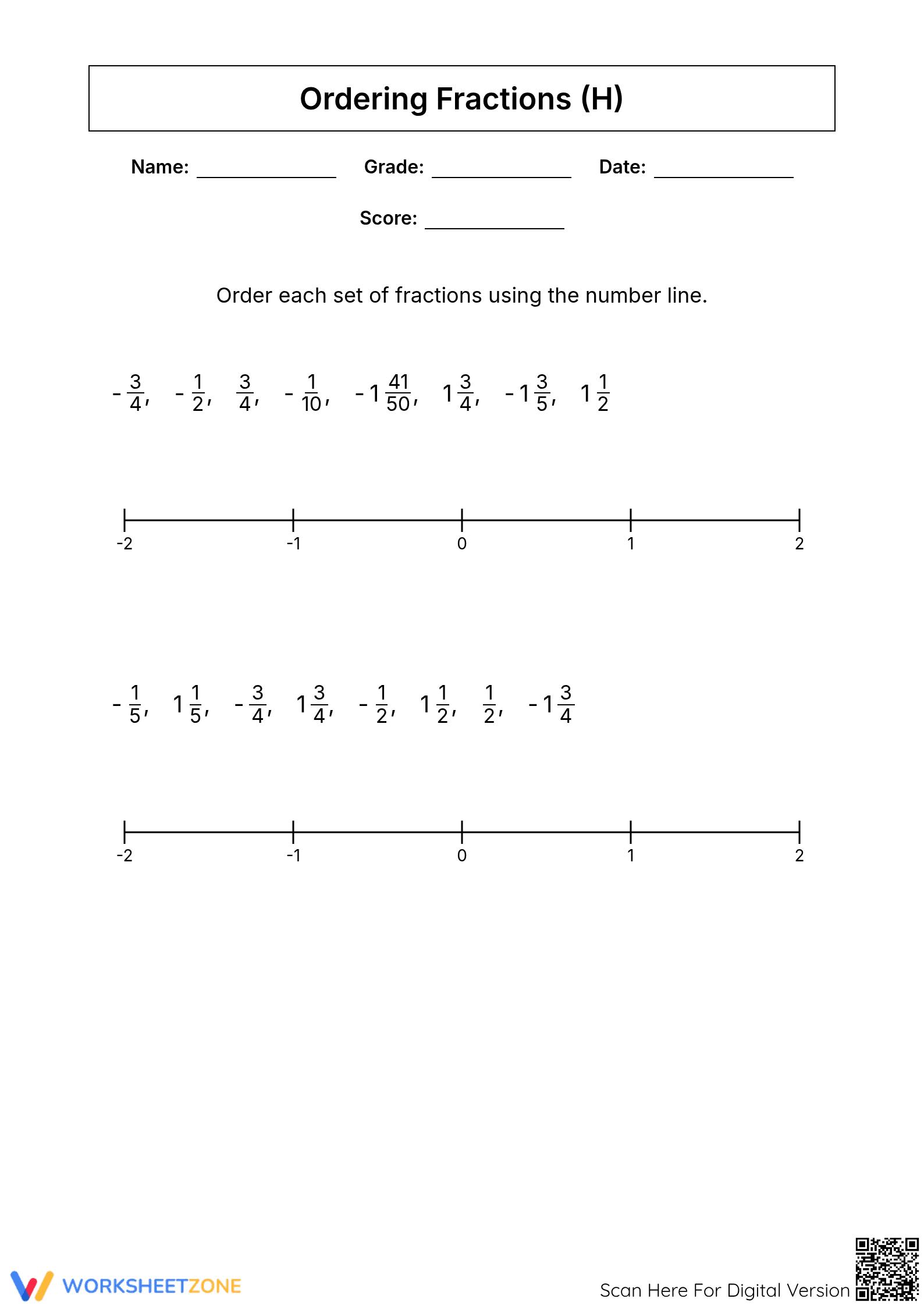
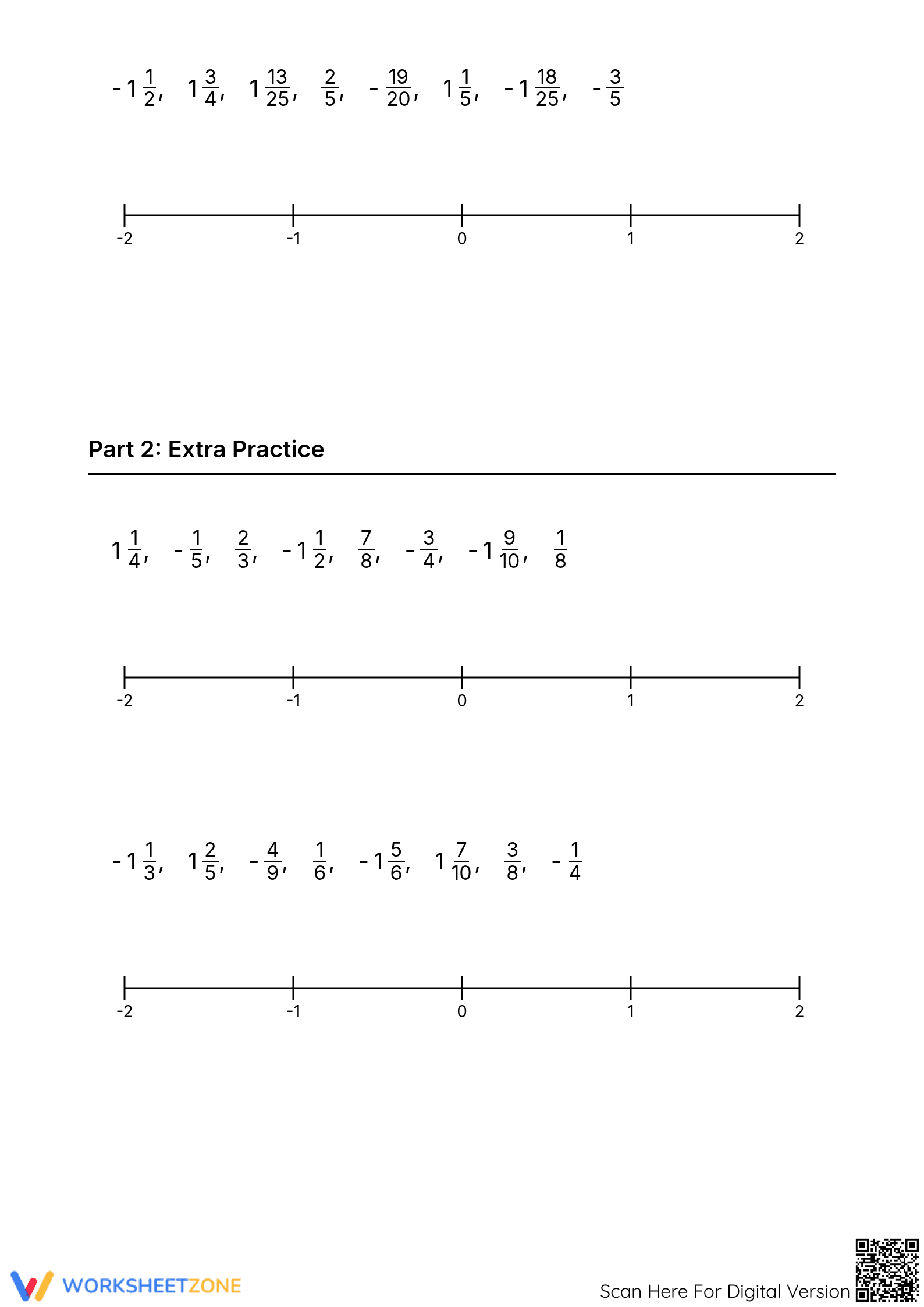
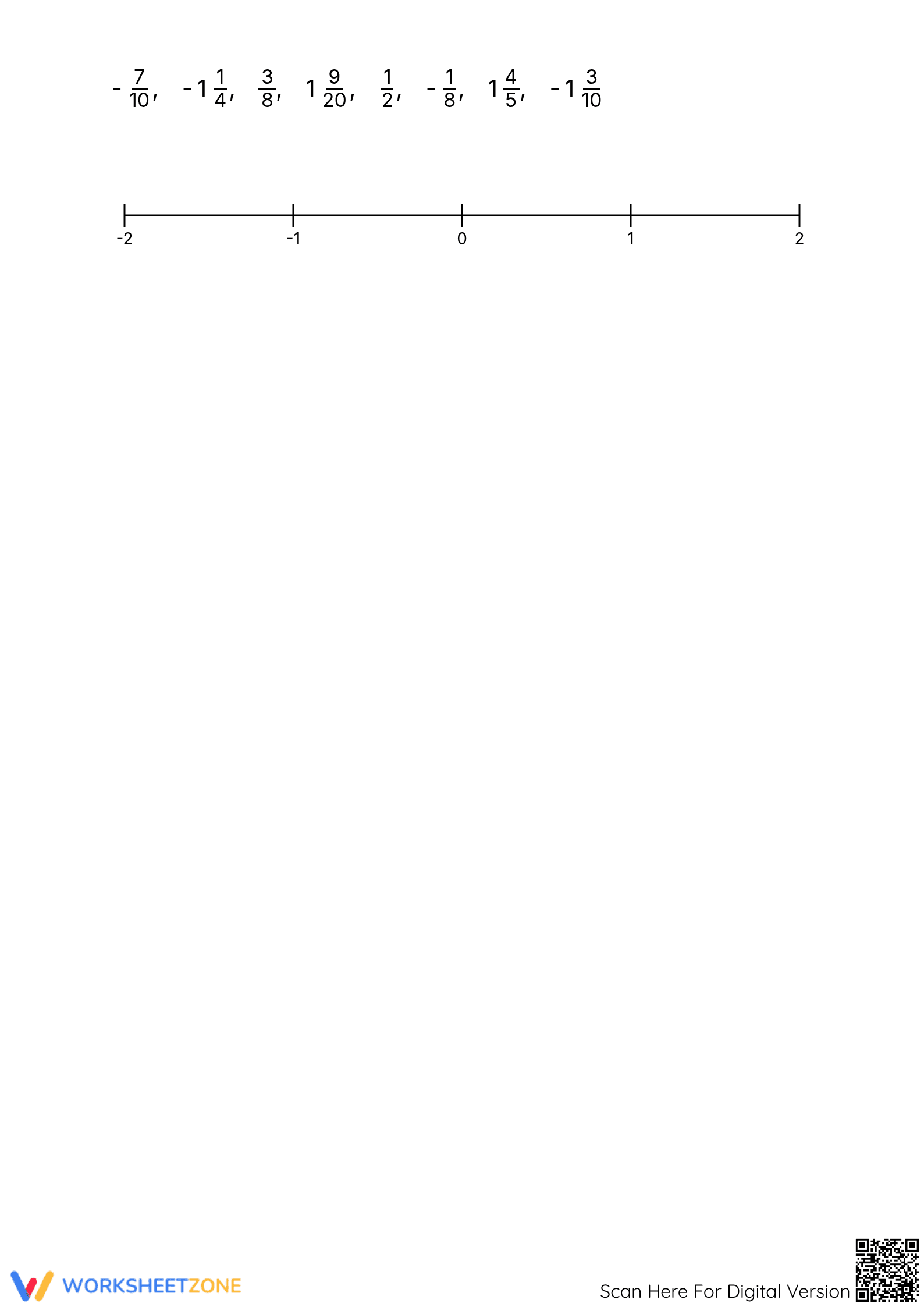
This Grade 6 math worksheet helps students master the spatial relationship between rational numbers by ordering positive and negative fractions and mixed numbers on a horizontal number line. By visualizing values between -2 and 2, learners develop a concrete understanding of magnitude and direction. This printable resource ensures students achieve fluency in comparing complex fractional values.
At a Glance
- Grade: 6 · Subject: Math
- Standard:
6.NS.C.6.C— Find and position rational numbers on a horizontal number line diagram- Skill Focus: Ordering fractions and mixed numbers
- Format: 3 pages · 48 problems · Answer key included · PDF
- Best For: Rational number system introduction or review
- Time: 25–35 minutes
What's Inside
This comprehensive 3-page PDF features six distinct problem sets, each containing eight unique rational numbers to be placed on a provided number line spanning from -2 to 2. The worksheet incorporates a rigorous mix of proper fractions, improper fractions, and mixed numbers, including both positive and negative values. A clear layout ensures students have ample space for marking, while a full answer key is provided for immediate feedback and grading.
Skill Progression
- Guided Practice: The initial sets feature common denominators and simple mixed numbers to build student confidence in basic placement along the horizontal axis.
- Supported Practice: Mid-range problems introduce negative rational numbers and varying denominators, requiring students to calculate relative positions between integers like -1 and 0.
- Independent Practice: The final sets challenge learners with complex fractions and mixed numbers, demanding precise estimation and comparison skills for mastery.
The layout follows a gradual-release model, moving from familiar fractional values to challenging rational number comparisons.
Standards Alignment
This resource aligns with the primary standard 6.NS.C.6.C: "Find and position integers and other rational numbers on a horizontal or vertical number line diagram; find and position pairs of integers and other rational numbers on a coordinate plane." This standard is fundamental for developing a deep understanding of the rational number system. Both standard codes can be copied directly into lesson plans, IEP goals, or district curriculum mapping tools.
How to Use It
Use this worksheet as a primary independent practice activity after a lesson on negative rational numbers. It serves as an excellent formative assessment tool; teachers should observe if students correctly place negative values relative to zero. Expected completion time is 30 minutes, making it suitable for a full class period or a focused homework assignment.
Who It's For
Designed for Grade 6 students entering the rational number system, this resource is also suitable for Grade 7-8 remediation. It pairs naturally with a fraction-to-decimal conversion chart or a giant classroom number line for interactive demonstration during direct instruction.
According to the RAND AIRS 2024 report on mathematical literacy, the ability to visualize the magnitude of rational numbers on a linear scale is a critical precursor to success in early algebra and coordinate geometry. This worksheet targets standard 6.NS.C.6.C by requiring students to accurately position 48 unique fractions and mixed numbers across a horizontal axis. Research by Fisher & Frey (2014) emphasizes that "gradual release of responsibility" through repeated, scaffolded practice on number lines helps bridge the gap between abstract symbolic representation and conceptual spatial understanding. By engaging with both positive and negative values in a consistent format, students reinforce their grasp of the number system's symmetry and the properties of rational numbers. This resource provides the high-repetition, low-distraction environment necessary for students to move from procedural plotting to conceptual mastery of fraction ordering and comparison.


