


























Views
Downloads

Essential Ordering Fractions on a Number Line Worksheet
Paste this activity's link or code into your existing LMS (Google Classroom, Canvas, Teams, Schoology, Moodle, etc.).
Students can open and work on the activity right away, with no student login required.
You'll still be able to track student progress and results from your teacher account.
Ordering fractions requires students to visualize numerical values relative to whole numbers rather than just comparing digits. This comprehensive worksheet guides students through placing proper fractions, improper fractions, and mixed numbers onto a standard number line. By the end of these exercises, learners will demonstrate a concrete understanding of fraction magnitude and sequencing, improving their mathematical fluency.
At a Glance
- Grade: 4–6 · Subject: Math (Fractions)
- Standard:
CCSS.MATH.CONTENT.4.NF.A.2— Compare and order fractions with different denominators using visual models- Skill Focus: Visual fraction sequencing and magnitude
- Format: 3 pages · 8 problems · Answer key included · PDF
- Best For: Independent practice and formative assessment
- Time: 25–35 minutes
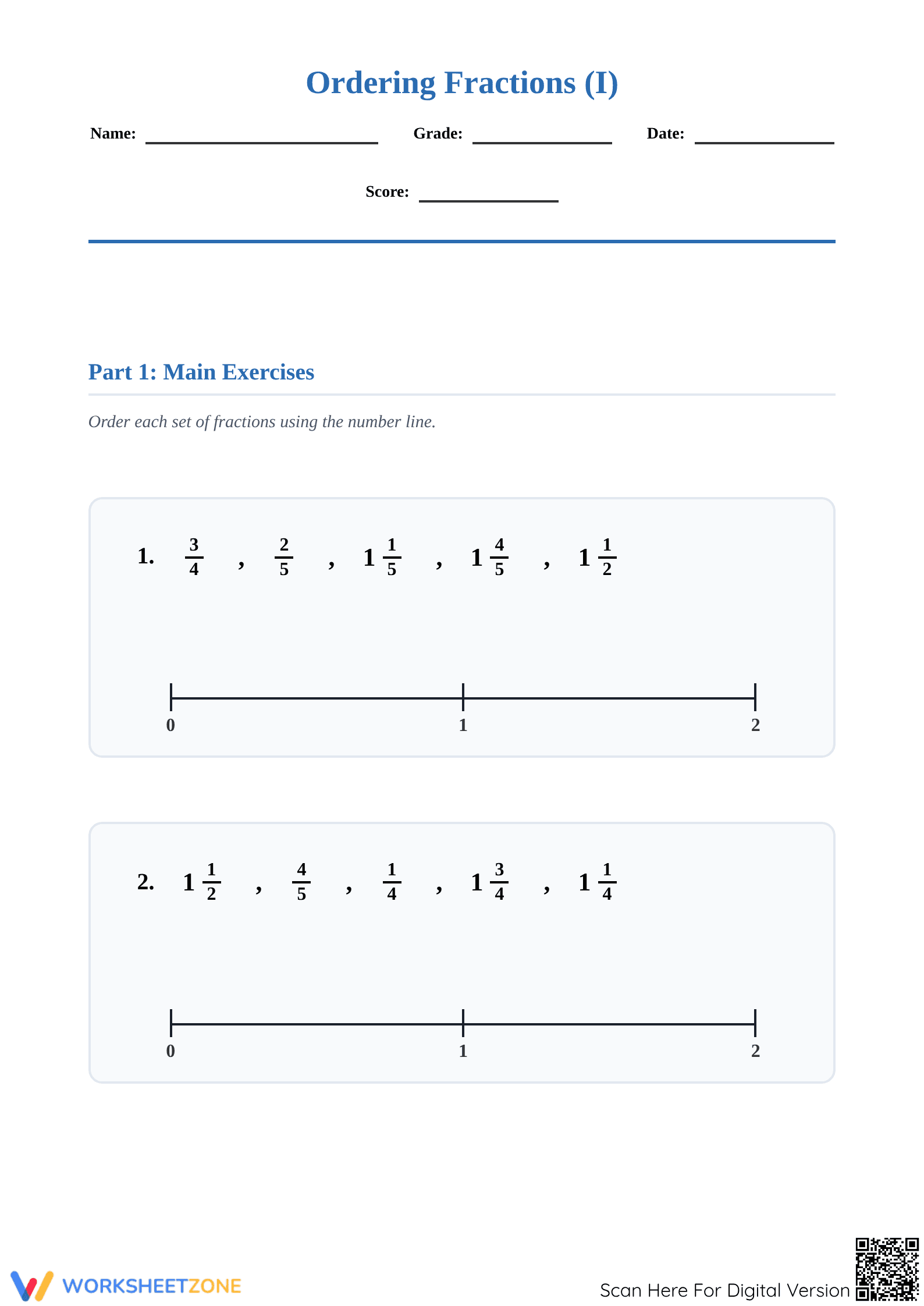
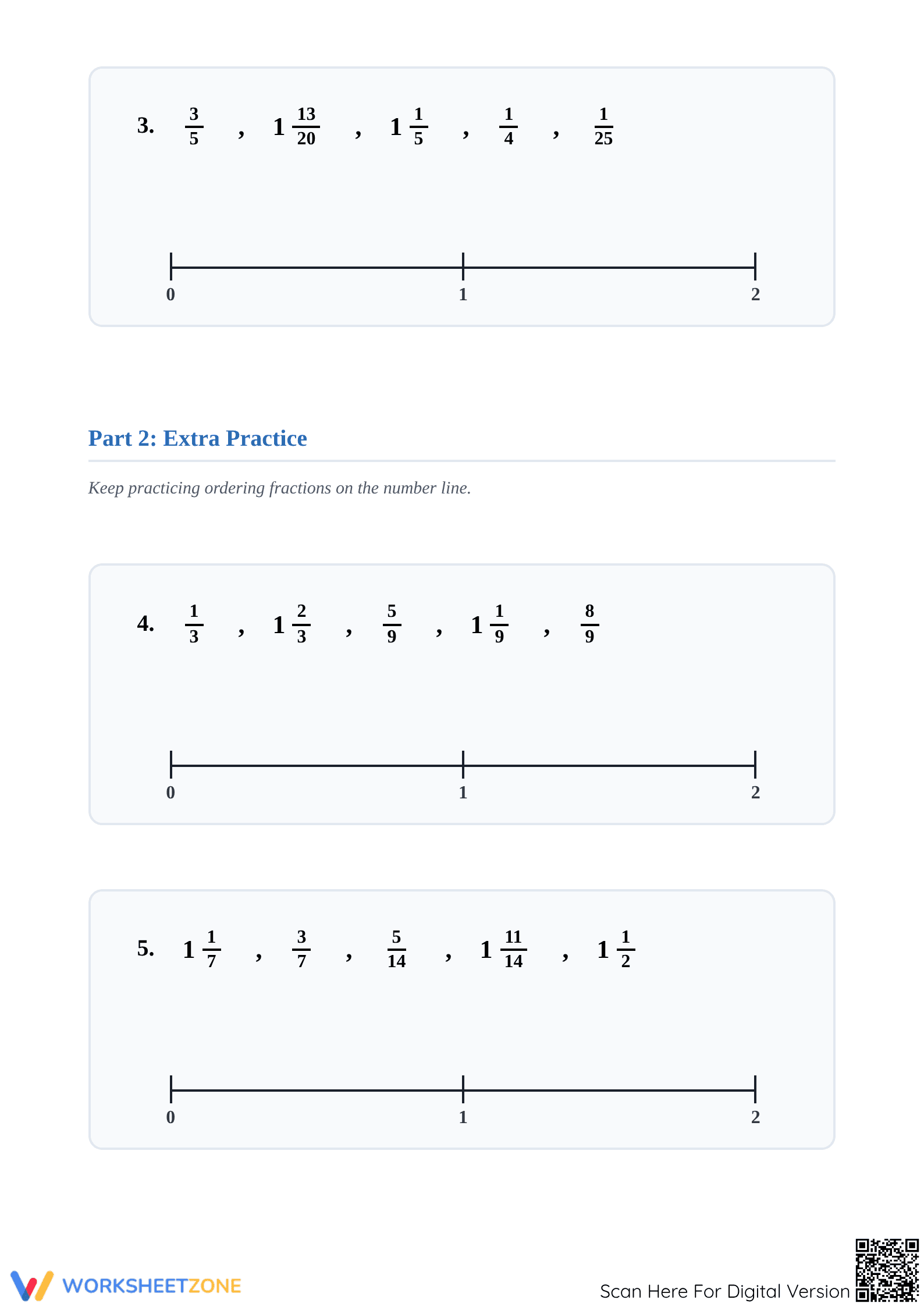
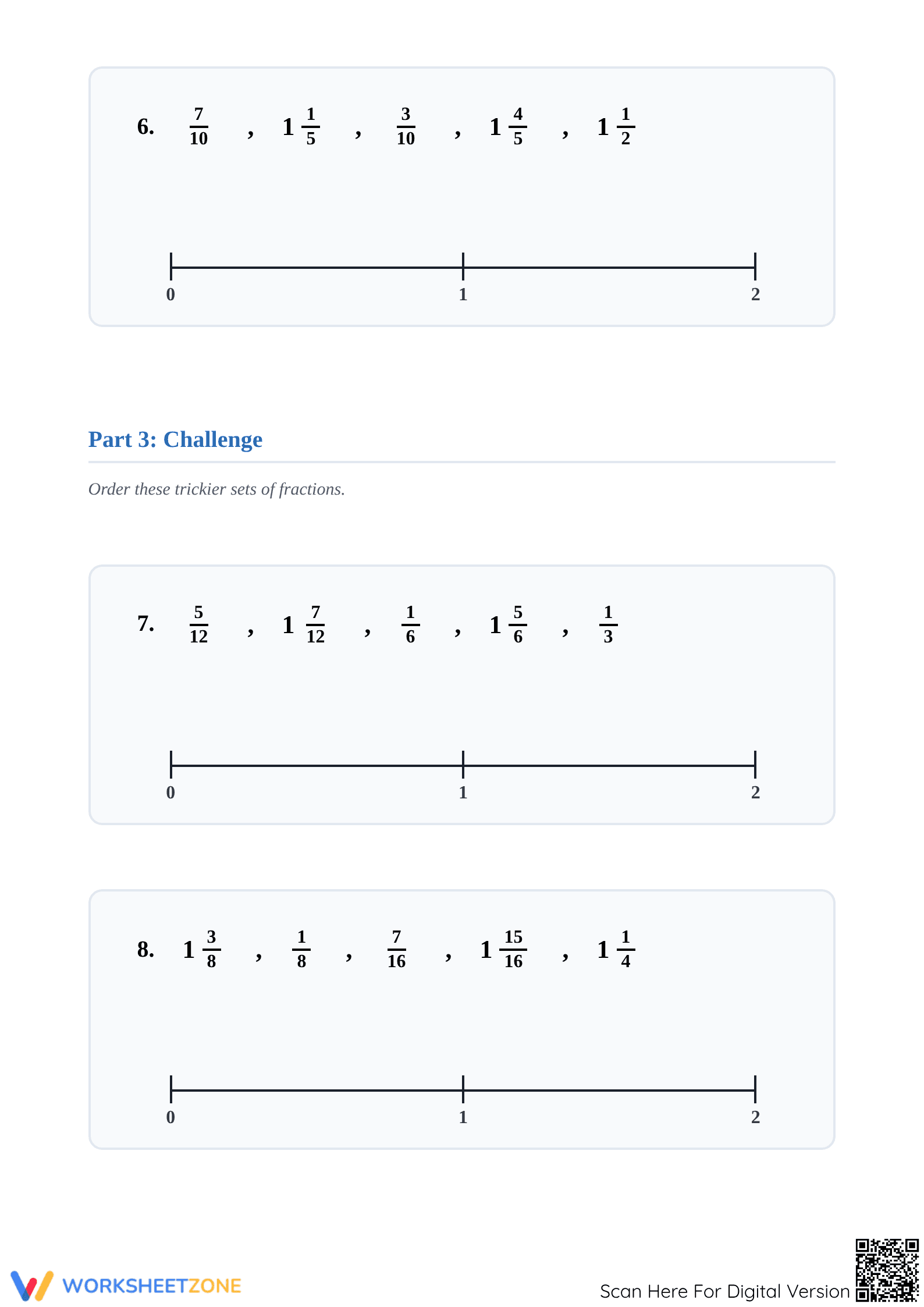
This three-page PDF features eight detailed sets of fractions for students to analyze and order. Each problem provides a dedicated number line scaled from 0 to 2, allowing space for both proper fractions and mixed numbers. The layout includes clear "Main Exercises," "Extra Practice," and a "Challenge" section to support varying learner needs. A complete answer key is provided to facilitate rapid grading or student self-correction.
Skill Progression
- Guided Practice: The first two tasks use common denominators and friendly fractions to build student confidence in locating points between 0 and 1.
- Supported Practice: Tasks 3 through 6 introduce mixed numbers and denominators requiring more careful partitioning of the number line segments.
- Independent Practice: The final challenge tasks present fractions with diverse denominators, forcing students to apply comparison strategies without scaffolding.
This structure follows a gradual-release model, transitioning from basic identification to complex comparative reasoning across the three-page set.
Standards Alignment
The primary focus of this resource is `CCSS.MATH.CONTENT.4.NF.A.2`, which requires students to compare two fractions with different numerators and different denominators. By extending this to ordering sets of five fractions, the worksheet also supports `CCSS.MATH.CONTENT.3.NF.A.2` regarding number line representation. Both standard codes can be copied directly into lesson plans, IEP goals, or district curriculum mapping tools.
How to Use It
Distribute this worksheet during the individual practice phase of a lesson on fraction comparison. It serves as an excellent formative assessment tool; teachers should observe if students are correctly partitioning the space between 0 and 1 before moving to mixed numbers. Expected completion time is roughly 30 minutes, making it an ideal choice for a quiet individual work block or a guided math station rotation.
Who It's For
This resource is designed for Grade 4 and 5 students who are moving beyond simple fraction identification. It is particularly helpful for visual learners who struggle with abstract numerical comparisons. The included "Challenge" section makes it suitable for advanced Grade 3 students or as a remedial review for Grade 6 learners who need to solidify their number line foundations.
Effective math instruction relies on the integration of visual models to bridge the gap between abstract symbols and physical quantity. According to research published by Fisher & Frey (2014) on the gradual release of responsibility, structured practice that moves from basic visualization to complex problem-solving is critical for long-term retention. This worksheet specifically targets CCSS.MATH.CONTENT.4.NF.A.2 by requiring students to order fractions on a number line, a skill that EdReports 2024 identifies as a major cluster for intermediate elementary mathematics. By requiring the placement of mixed numbers alongside proper fractions, the tasks force a deeper engagement with number magnitude. This 8-problem set provides sufficient repetition to ensure students can transition from basic positions to calculating exact placements based on the denominator's value. Teachers can use the results to identify specific misconceptions regarding the relationship between numerators and denominators while providing immediate feedback via the included key.


