


























Views
Downloads


Printable Ordering Fractions on a Number Line Worksheet
Paste this activity's link or code into your existing LMS (Google Classroom, Canvas, Teams, Schoology, Moodle, etc.).
Students can open and work on the activity right away, with no student login required.
You'll still be able to track student progress and results from your teacher account.
This comprehensive 5-page worksheet provides essential practice for students mastering the ordering of rational numbers. By placing diverse fractions, mixed numbers, and negative values on a visual number line, learners build a concrete understanding of numerical magnitude and direction. This resource is designed to bridge the gap between basic fraction concepts and middle-school algebra.
At a Glance
- Grade: 6 · Subject: Math
- Standard:
CCSS.MATH.CONTENT.6.NS.C.7— Understand ordering and absolute value of rational numbers- Skill Focus: Ordering fractions and negatives
- Format: 5 pages · 20 problems · Answer key included · PDF
- Best For: Rational number system unit and review
- Time: 40–50 minutes
What's Inside
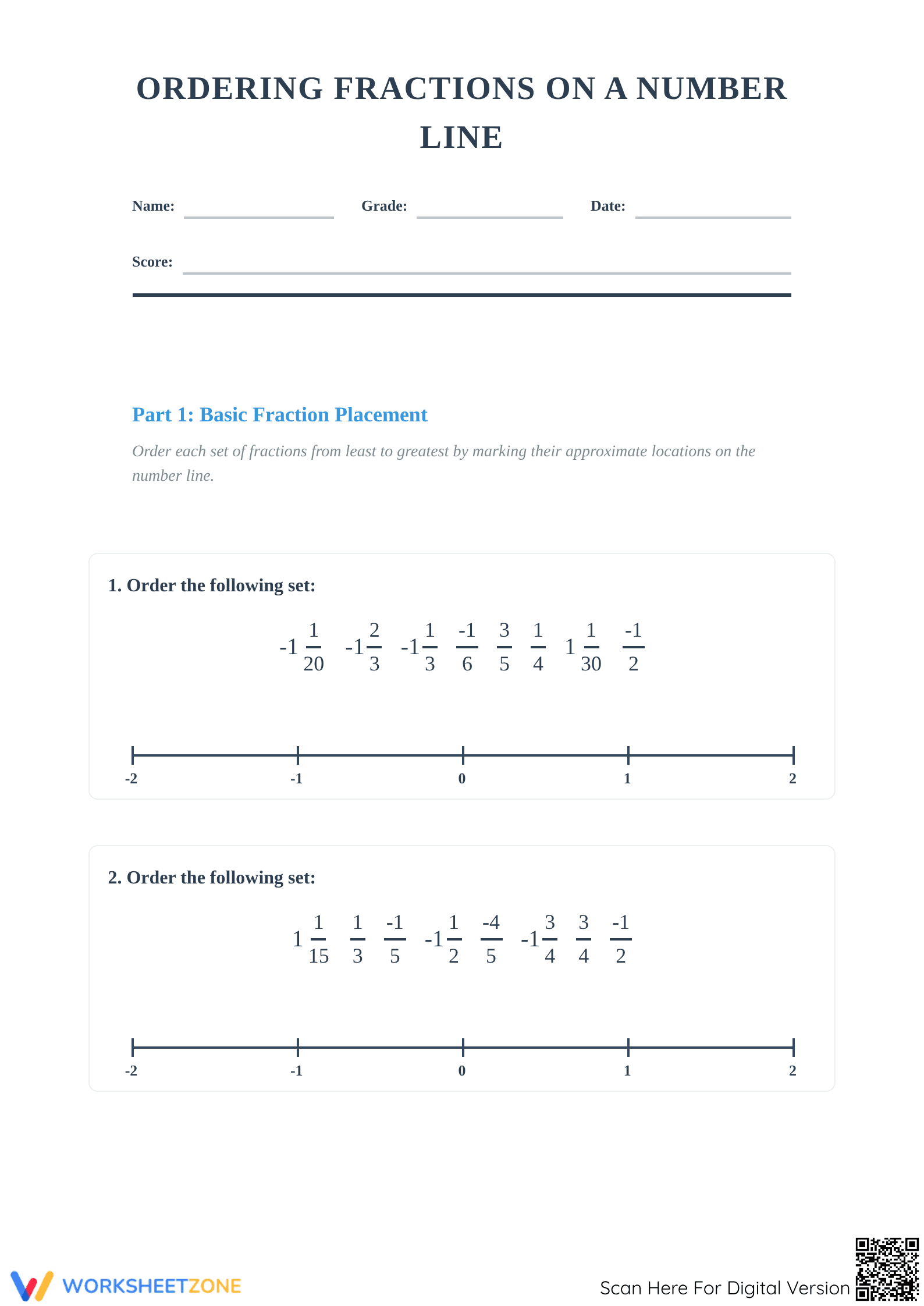
This set contains 20 multi-part problems spread across five printable pages. The content is organized into four distinct sections: Basic Fraction Placement, Mixed Numbers and Improper Fractions, Advanced Challenges, and Word Problems. Each problem includes a clear number line with intervals from -2 to 2 or 0 to 1, ensuring students have the visual support necessary to plot complex coordinates. A full answer key is provided for immediate feedback.
Skill Progression
- Guided Practice: The initial 4 problems provide structured sets of 8 fractions each, encouraging students to compare values and mark approximate locations on a pre-labeled number line.
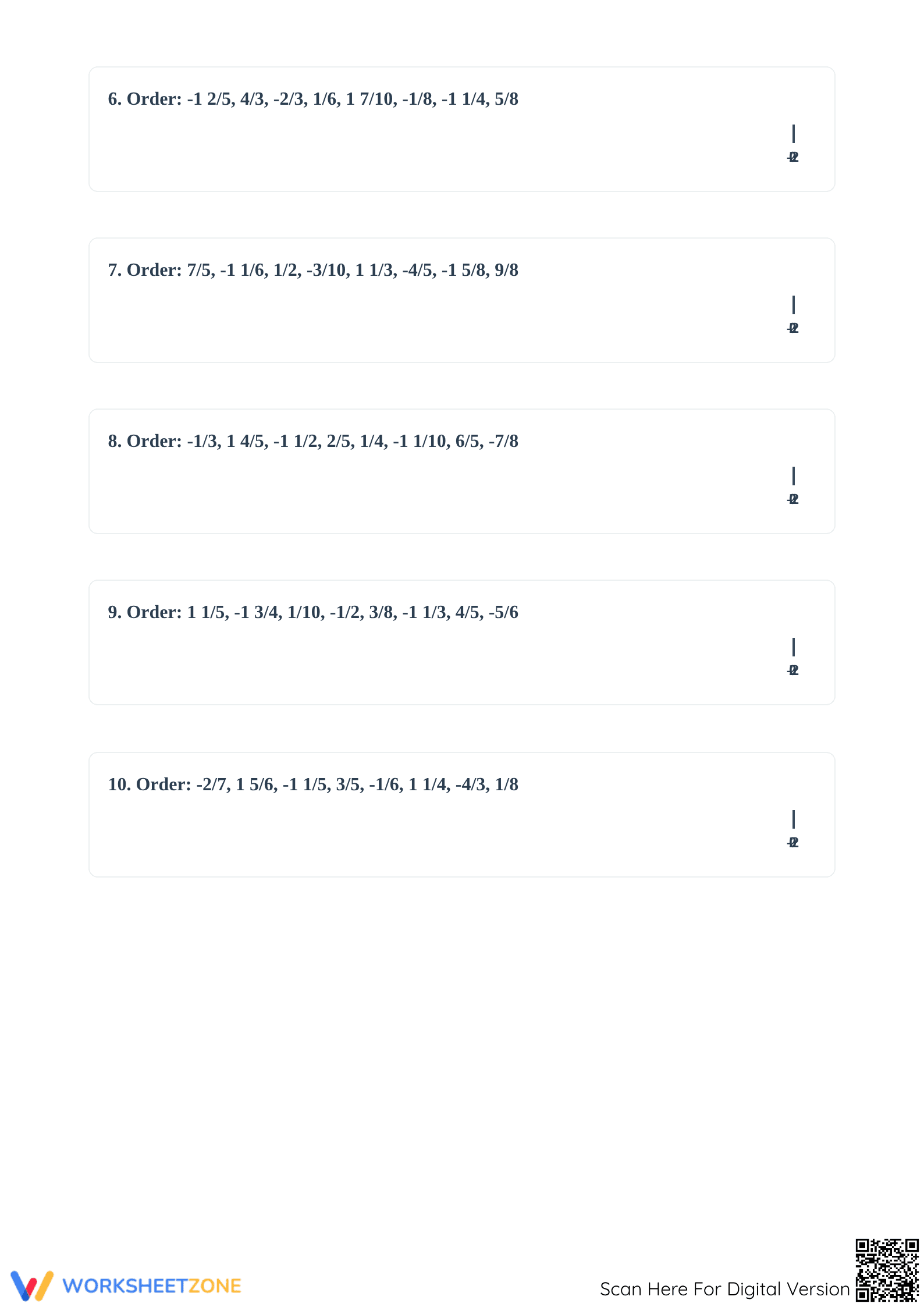
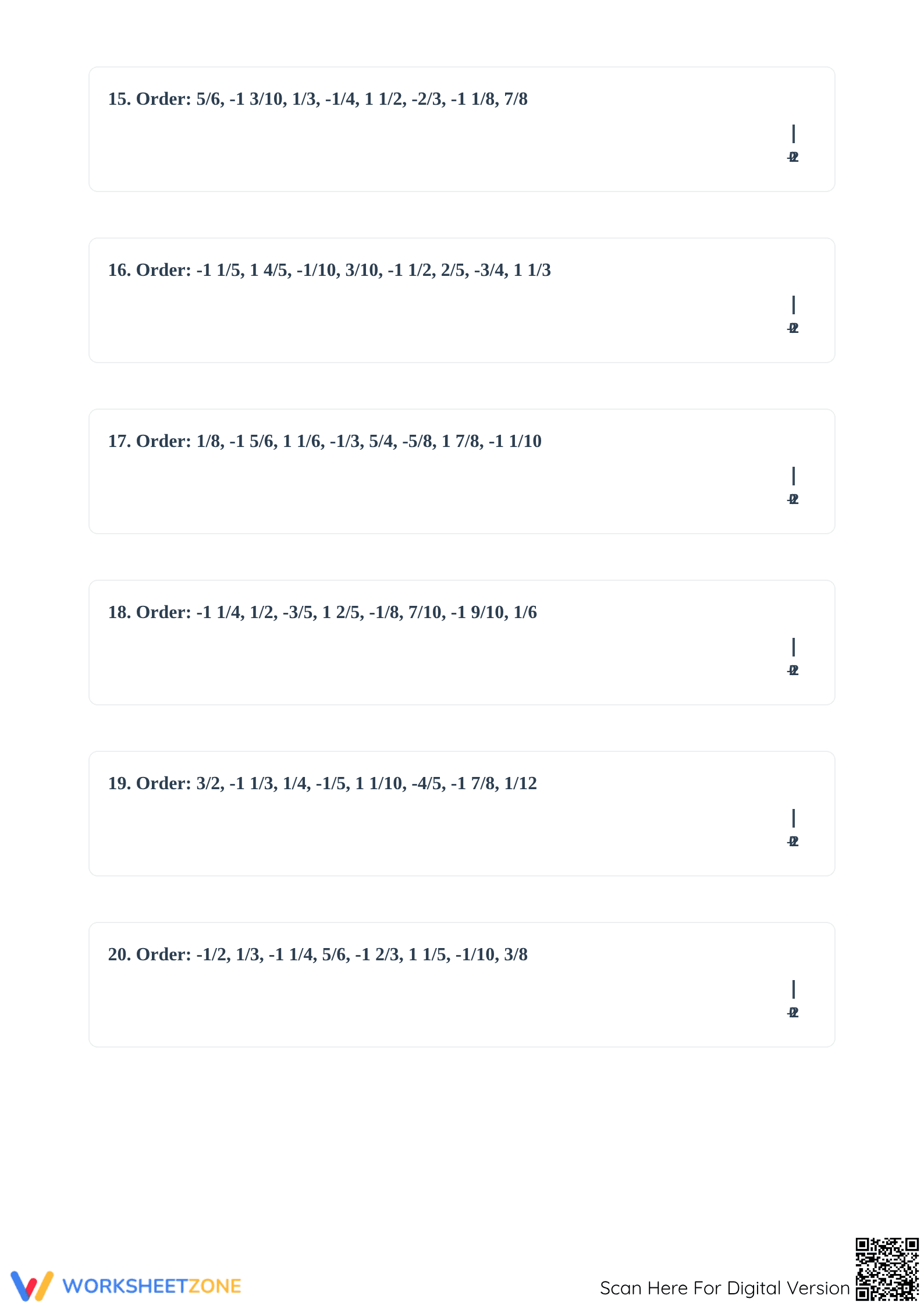
- Supported Practice: Problems 5 through 10 transition to list-based ordering without explicit plotting cues, requiring students to determine relative positions independently across a -2 to 2 range.
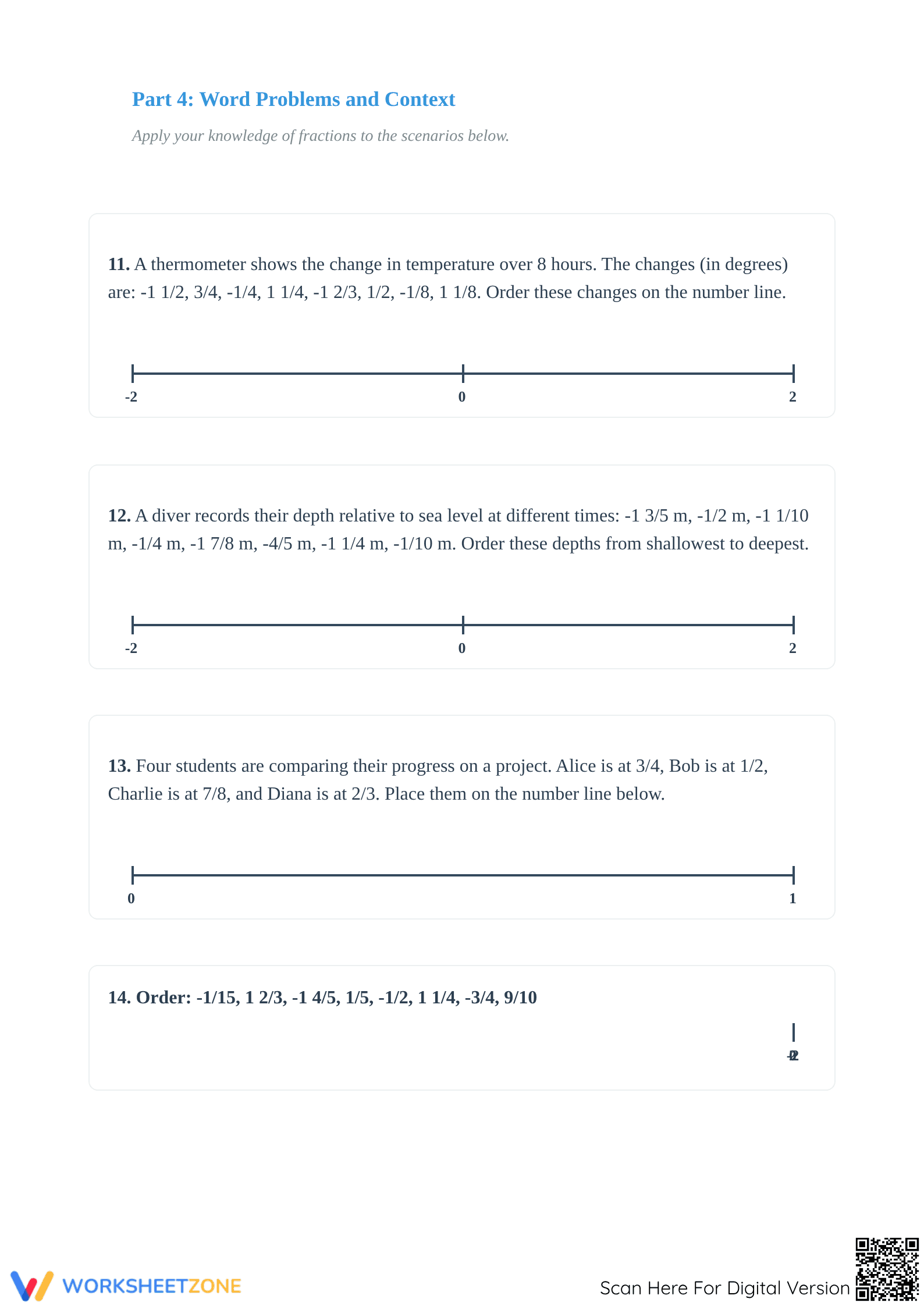
- Independent Practice: The final section integrates 10 high-order word problems and "Advanced Challenges" that ask students to apply ordering logic to real-world scenarios, such as temperature changes and sea-level depths.
This gradual release model ensures learners move from visualization to abstract reasoning through a sequence of increasingly complex tasks.
Standards Alignment
The primary focus of this worksheet is CCSS.MATH.CONTENT.6.NS.C.7, which requires students to understand ordering and absolute value of rational numbers. It also supports 3.NF.A.2 by extending the concept of fractions on a number line to the negative coordinate system. Both standard codes can be copied directly into lesson plans, IEP goals, or district curriculum mapping tools.
How to Use It
Deploy this worksheet as a summative assessment at the conclusion of a rational numbers unit or as a focused intervention for students struggling with the concept of negative magnitude. During direct instruction, teachers can use the first page to model benchmark placements, such as -1/2 or 1 1/2. As a formative assessment, observe if students consistently struggle with placing negatives correctly relative to zero. Expected completion time is 40 to 50 minutes.
Who It's For
This resource is ideal for Grade 6 math students, though it serves as an excellent challenge for advanced Grade 5 learners or a critical review for Grade 7. The inclusion of word problems makes it particularly effective for English Language Learners and students requiring visual scaffolds to process abstract math concepts during direct instruction.
Mastering the ordering of rational numbers on a horizontal number line is a foundational competency for middle school mathematics, specifically aligned with CCSS.MATH.CONTENT.6.NS.C.7. Research from RAND AIRS 2024 emphasizes that visual-spatial representations, such as the number line used in these 20 problems, are critical for students to reconcile the relative values of positive and negative fractions. This worksheet facilitates the conceptual leap from simple whole-number ordering to complex rational number placement by incorporating mixed numbers and improper fractions. By requiring students to approximate locations for values like -1 2/3 and 1 1/15, the resource reinforces the density of rational numbers and the symmetry of values around zero. Fisher & Frey (2014) highlight that such scaffolds are essential for moving students toward independent mastery of absolute value and coordinate geometry. This resource provides the rigorous practice needed to ensure students can accurately translate abstract numerical symbols into concrete spatial positions, a prerequisite for advanced algebraic reasoning and data analysis.


