


























Views
Downloads

Ordering Fractions on a Number Line Printable Worksheet
Paste this activity's link or code into your existing LMS (Google Classroom, Canvas, Teams, Schoology, Moodle, etc.).
Students can open and work on the activity right away, with no student login required.
You'll still be able to track student progress and results from your teacher account.
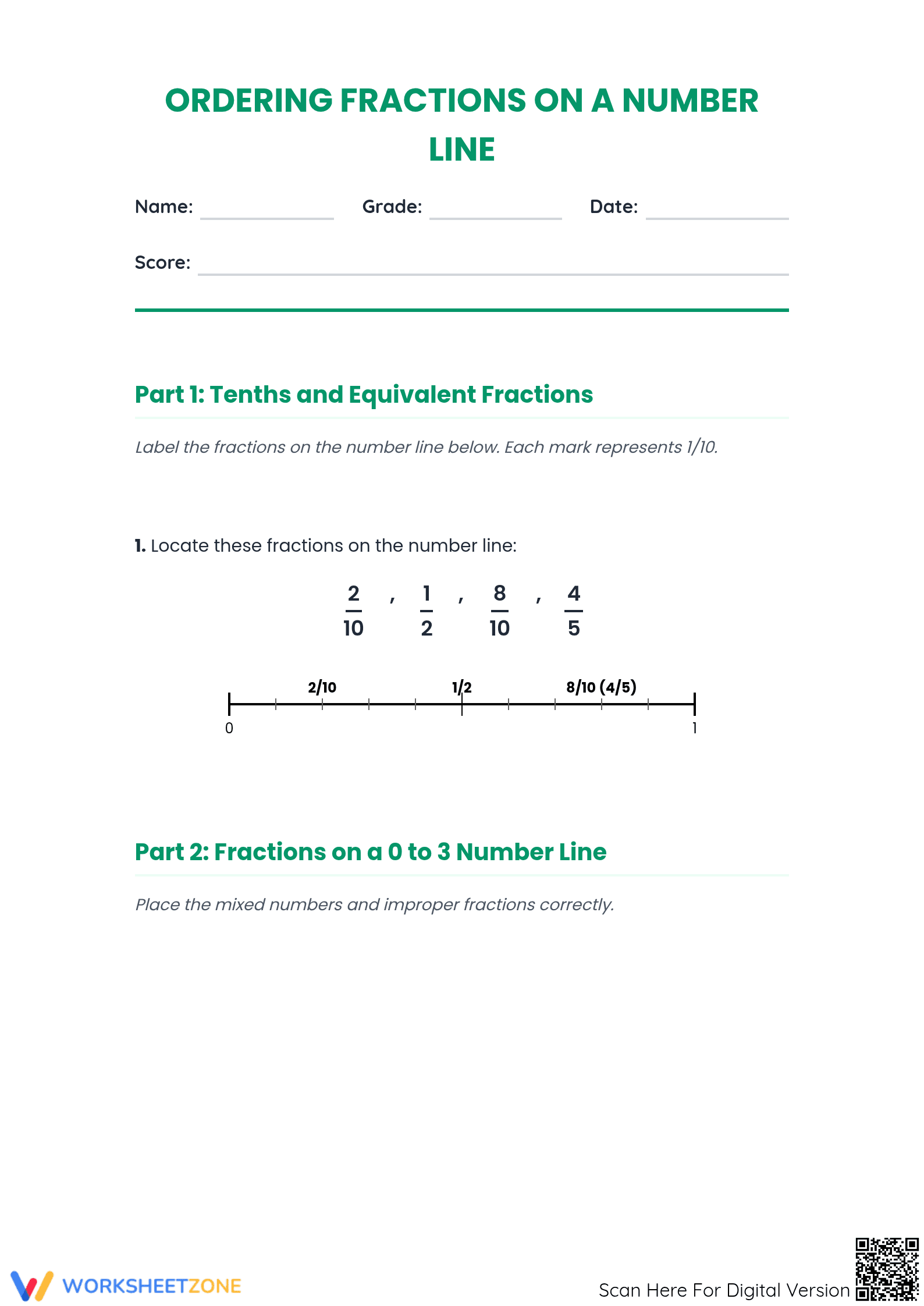
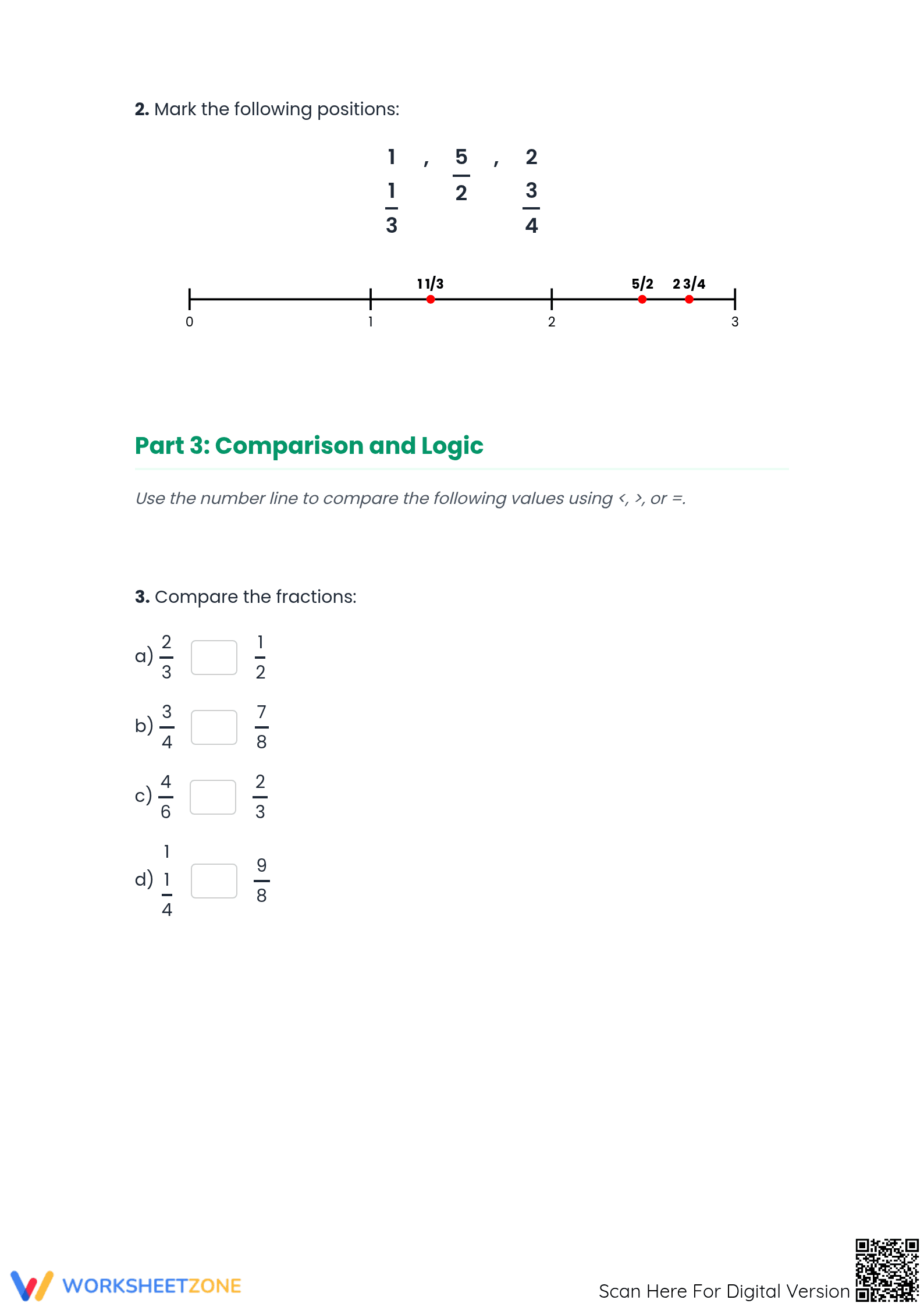
This comprehensive Math worksheet helps Grade 4-6 students master ordering and comparing fractions using visual number lines. Students progress from labeling tenths to placing mixed numbers and solving real-world word challenges. By visualizing fraction magnitude on a coordinate-style line, learners build a concrete understanding of numerical relationships and equivalence.
At a Glance
- Grade: 4–6 · Subject: Math (Fractions)
- Standard:
CCSS.MATH.CONTENT.4.NF.A.2— Compare and order fractions with different denominators by creating common denominators or comparing to a benchmark- Skill Focus: Ordering fractions, mixed numbers, and improper fractions on a visual scale
- Format: 4 comprehensive pages · 8 multi-part problems · Full answer key included · PDF
- Best For: Small group intervention, independent practice, or a detailed sub plan
- Time: 30–45 minutes of instructional engagement
What's Inside
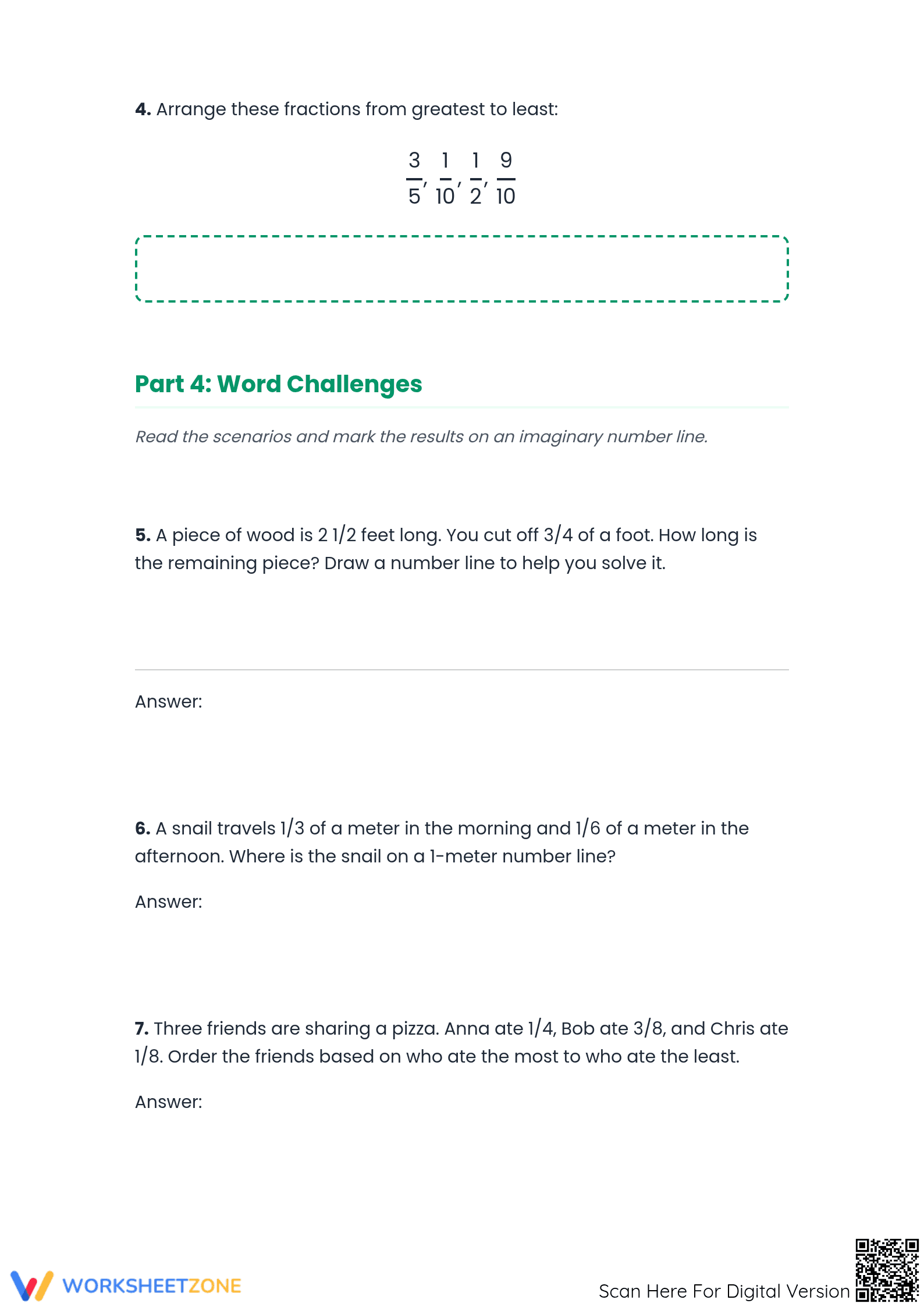
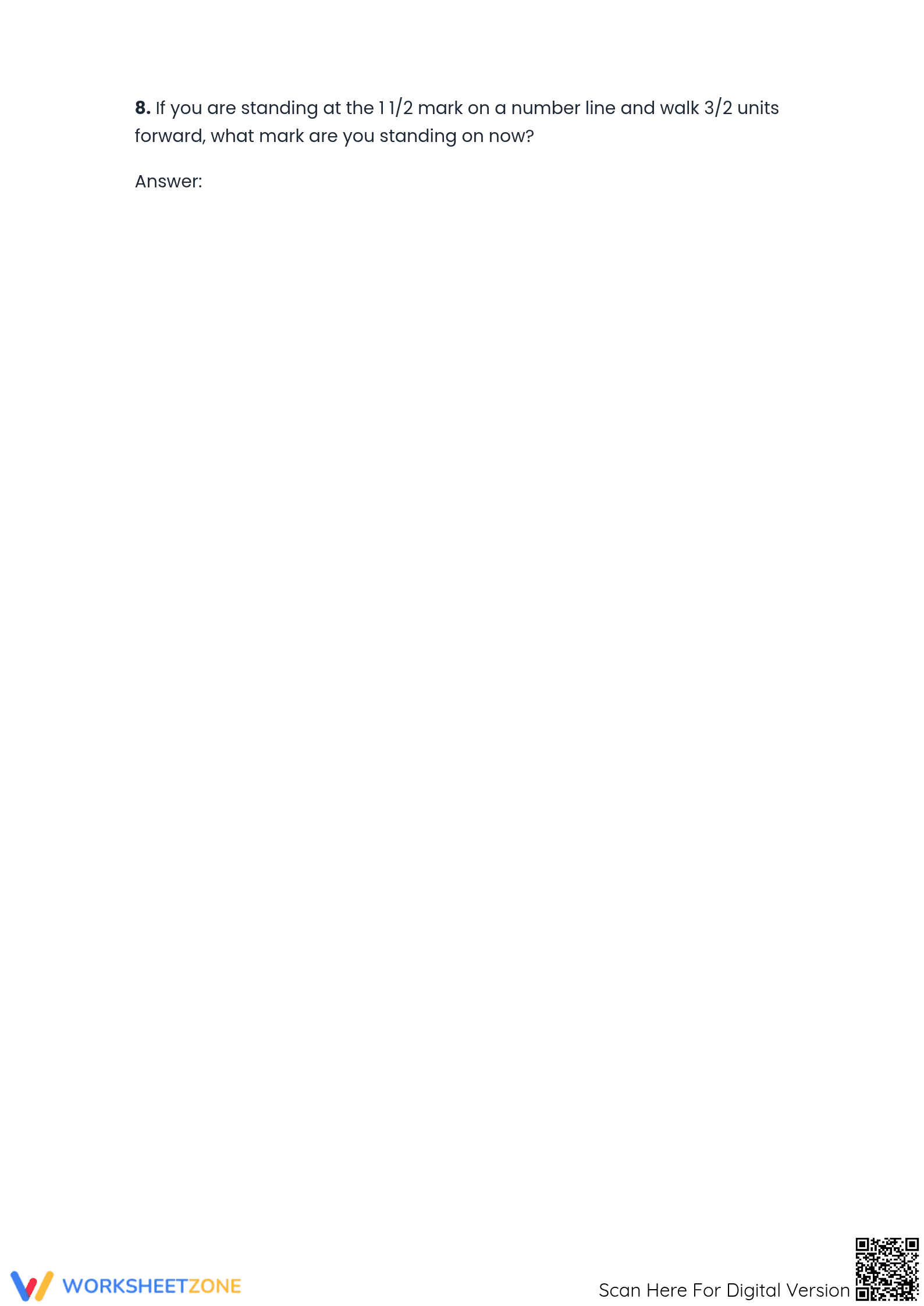
This 4-page PDF packet contains 8 multi-part problems divided into four logical sections. It features 0-1 and 0-3 number lines with marked intervals, comparison boxes for inequality symbols, and dedicated workspace for four conceptual word problems. A full answer key is included to facilitate quick grading or student self-correction.
Zero-Prep Workflow
The zero-prep workflow for this resource is designed for maximum efficiency:
- Print (30 seconds): Generate enough copies for your class or upload the PDF to a digital whiteboard for whole-group instruction.
- Distribute (1 minute): Hand out the packet as a morning bell-ringer, a comprehensive sub plan, or a targeted intervention for students struggling with fraction magnitude.
- Review (5 minutes): Use the included answer key to check for common misconceptions, such as incorrectly placing improper fractions between whole numbers.
Total teacher preparation time is under two minutes, making it ideal for busy classroom environments.
Standards Alignment
The primary focus is CCSS.MATH.CONTENT.4.NF.A.2, which requires students to compare and order fractions with different numerators and denominators. It also supports CCSS.MATH.CONTENT.3.NF.A.2 by emphasizing the representation of fractions on a number line diagram. Both standard codes can be copied directly into lesson plans, IEP goals, or district curriculum mapping tools.
How to Use It
Assign this worksheet during the independent practice phase of a gradual release model to solidify the connection between abstract fractions and visual distance. It is also an excellent formative assessment tool; observe if students correctly identify the midpoint (1/2) as a benchmark when placing values like 4/5 or 2/10. Completion typically takes 30 to 45 minutes depending on grade level.
Who It's For
This resource is ideal for upper elementary students (Grades 4-5) and middle schoolers requiring remediation. It serves as a natural pairing for an introductory lesson on fraction equivalence or as a follow-up to a hands-on activity using fraction strips and physical number lines.
According to RAND AIRS 2024, visual representations like number lines are critical for developing the "number-sense" required for future algebraic success. This worksheet aligns with Fisher & Frey (2014) recommendations for instructional scaffolds that move students from concrete visualization to abstract application. By requiring students to place tenths, mixed numbers, and improper fractions on a single visual scale, the resource directly addresses common student misconceptions regarding the density of rational numbers and the relative value of fractions greater than one. The inclusion of complex word challenges ensures that students can translate abstract mathematical symbols into situational logic, which is a key indicator of mastery in the CCSS.MATH.CONTENT.4.NF.A.2 domain. This sequence of 8 tasks provides the structural rigor and logical progression needed for Grade 4-6 students to demonstrate proficiency in identifying fraction magnitudes, equivalent values, and spatial numerical reasoning across multiple standard-aligned representations.


