


























Views
Downloads



Printable Ordering Fractions on a Number Line Worksheet
Paste this activity's link or code into your existing LMS (Google Classroom, Canvas, Teams, Schoology, Moodle, etc.).
Students can open and work on the activity right away, with no student login required.
You'll still be able to track student progress and results from your teacher account.
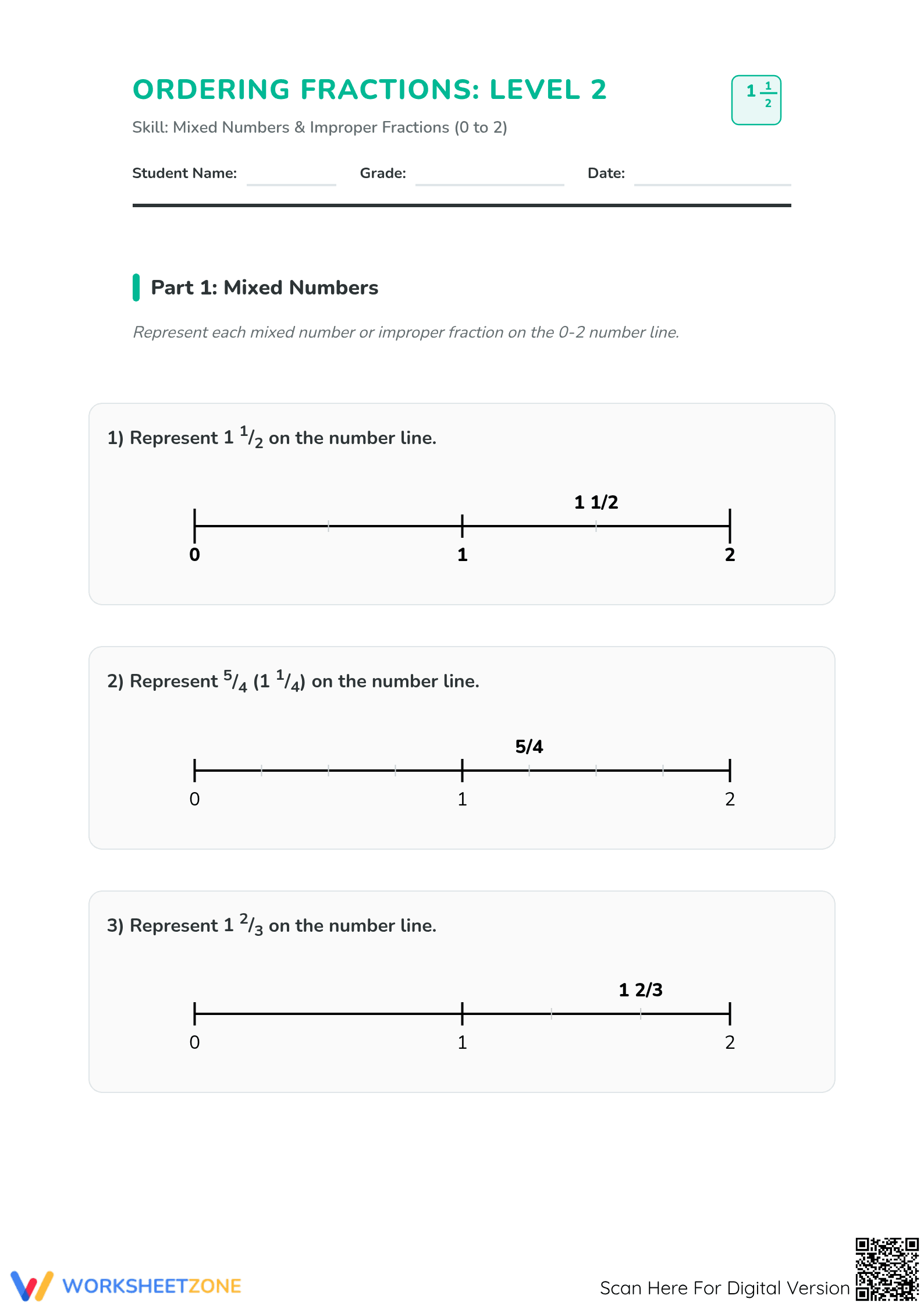
Visualizing fractions on a number line is a critical bridge from concrete to abstract math. This 4-page worksheet packet guides Grade 4 students through the process of locating, comparing, and ordering proper fractions, improper fractions, and mixed numbers. By using a 0-2 scale, students move beyond the basics of part-whole relationships to understand magnitude.
At a Glance
- Grade: 4 · Subject: Math
- Standard:
CCSS.MATH.CONTENT.4.NF.A.2— Compare two fractions with different numerators and denominators and record results with symbols- Skill Focus: Ordering fractions and mixed numbers (0-2 range)
- Format: 4 pages · 14 problems · Answer key included · PDF
- Best For: Independent practice or small group remediation
- Time: 25–35 minutes
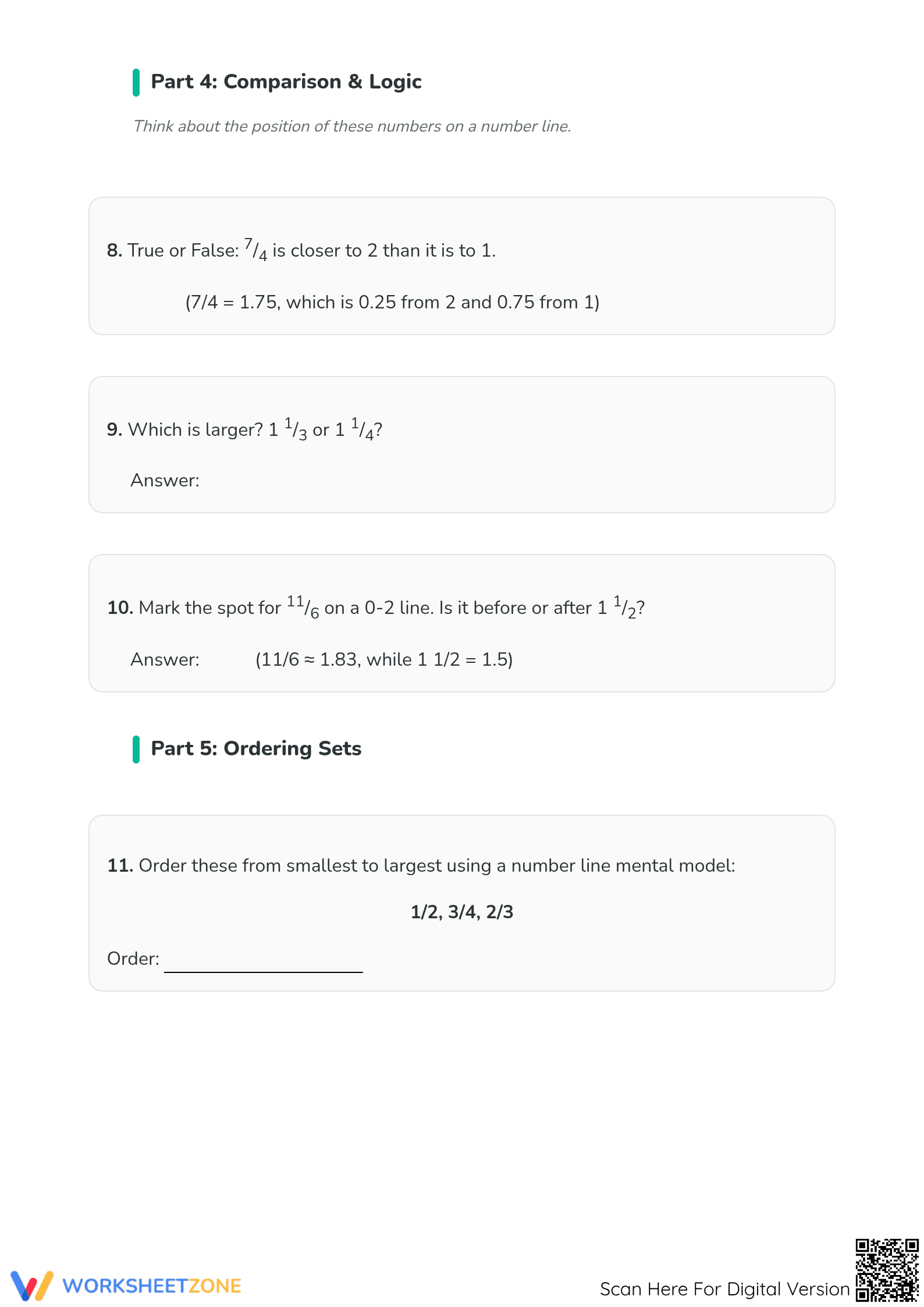
This comprehensive resource features 14 targeted problems spread across six structured parts. The first half focuses on representing individual and multiple points on a number line, while the second half transitions into higher-order thinking with logical comparisons, set ordering, and real-world race and measurement applications. A full answer key is provided for immediate grading.
Zero-Prep Workflow
- Print: Select the 4-page PDF and print enough copies for your class. This takes approximately 30 seconds.
- Distribute: Hand out the packet as a morning warm-up or a sub-plan activity. No additional manipulatives are required.
- Review: Use the included answer key to check student work in under 90 seconds, focusing on common misconceptions like miscounting intervals.
Standards Alignment
The primary focus is `CCSS.MATH.CONTENT.4.NF.A.2`, which requires students to compare fractions by creating common denominators or comparing to a benchmark. This resource specifically uses the number line as the benchmark model. It also supports 3.NF.A.2 by extending the number line beyond 1 to include whole number intervals. Both standard codes can be copied directly into lesson plans, IEP goals, or district curriculum mapping tools.
How to Use It
Assign this packet after an introductory lesson on improper fractions to reinforce the relationship between 1 and 2 on the number line. During the Comparison & Logic section, observe if students are correctly identifying 7/4 as 1 and 3/4. This formative-assessment observation tip helps identify students who need support with mixed number conversion. Completion typically takes 30 minutes.
Who It's For
This resource is designed for Grade 4 general education students, but it serves as an excellent challenge for Grade 3 learners or a necessary review for Grade 5 students. It pairs naturally with fraction tile sets or anchor charts that display equivalent fractions and common denominators for visual support.
Mastering the number line is essential for developing a robust sense of numerical magnitude. According to research by Fisher & Frey (2014) on the gradual release of responsibility, visual models like number lines provide the necessary scaffolding for students to transition from procedural fraction arithmetic to conceptual understanding. This worksheet aligns with `CCSS.MATH.CONTENT.4.NF.A.2` by requiring students to order fractions from smallest to largest using a mental model of the number line. By engaging with 14 distinct tasks that include mixed numbers and improper fractions on a 0-2 scale, students build the spatial reasoning required for later success with decimals. The inclusion of word problems ensures that skills are applied to real-world contexts, meeting the rigorous demands of state assessments. This resource is an essential component of any research-based fraction curriculum, providing structured practice that leads to long-term mastery.


