


























Views
Downloads

Essential Ordering Fractions Worksheet | Grade 3 Math
Paste this activity's link or code into your existing LMS (Google Classroom, Canvas, Teams, Schoology, Moodle, etc.).
Students can open and work on the activity right away, with no student login required.
You'll still be able to track student progress and results from your teacher account.
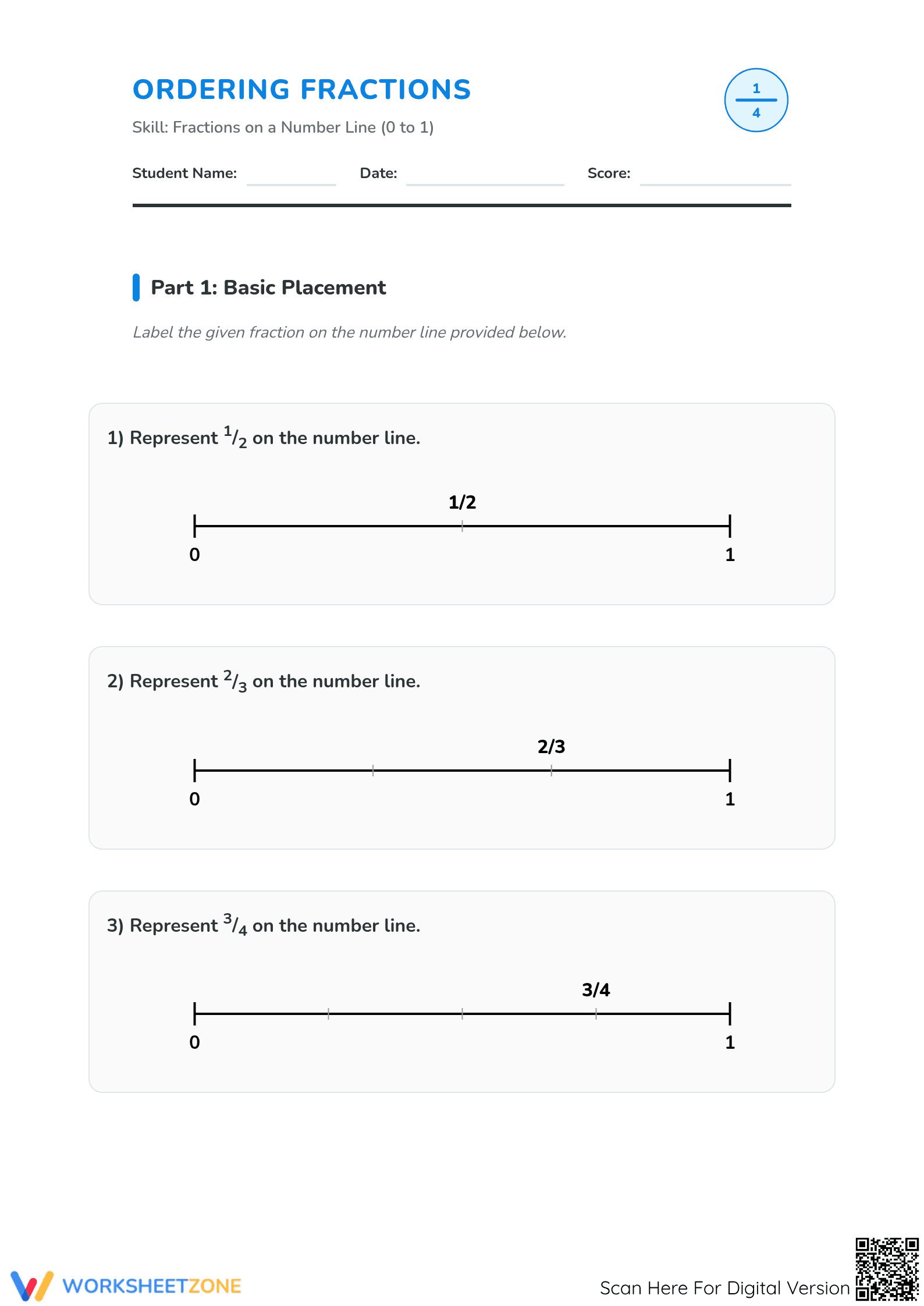
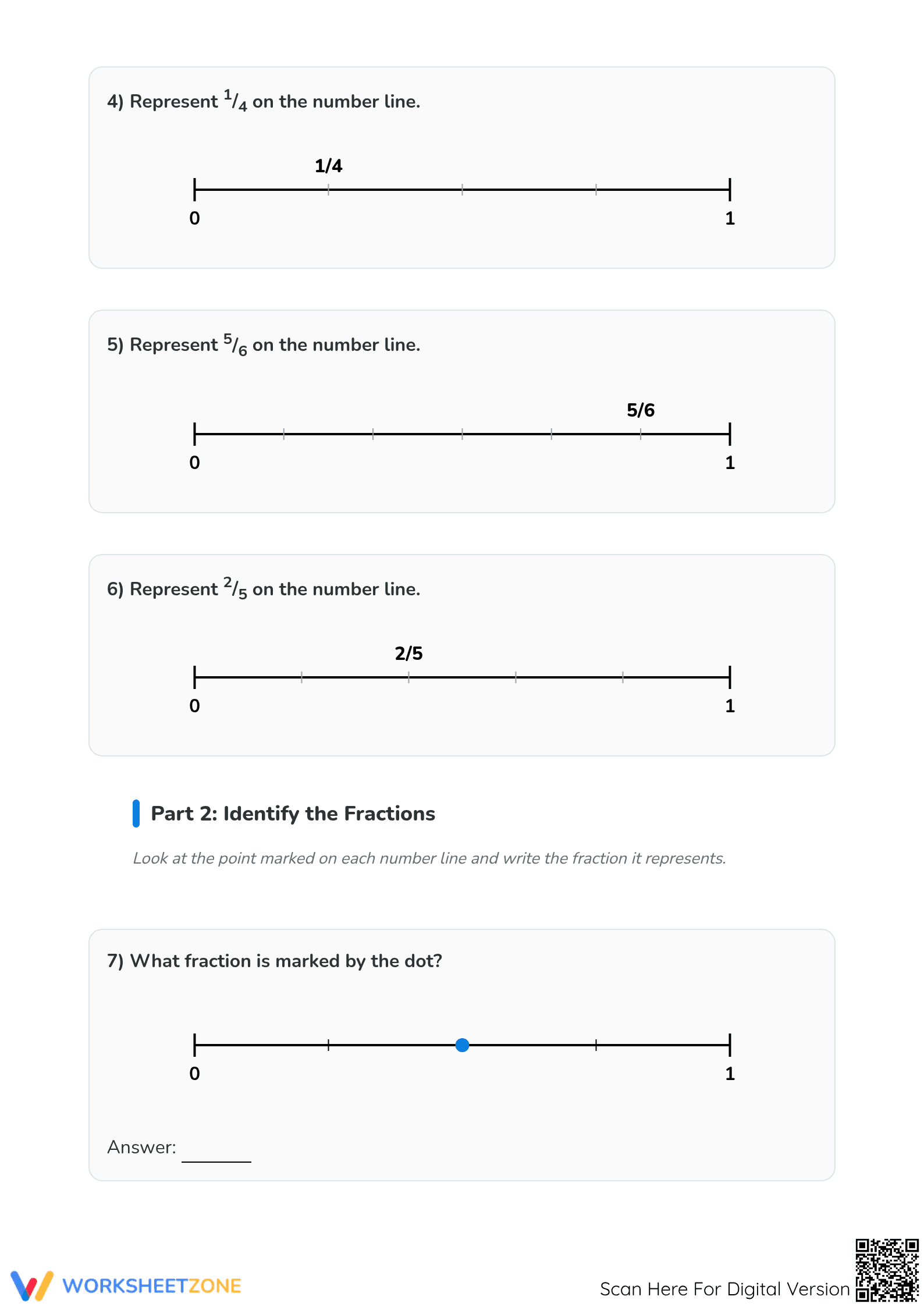
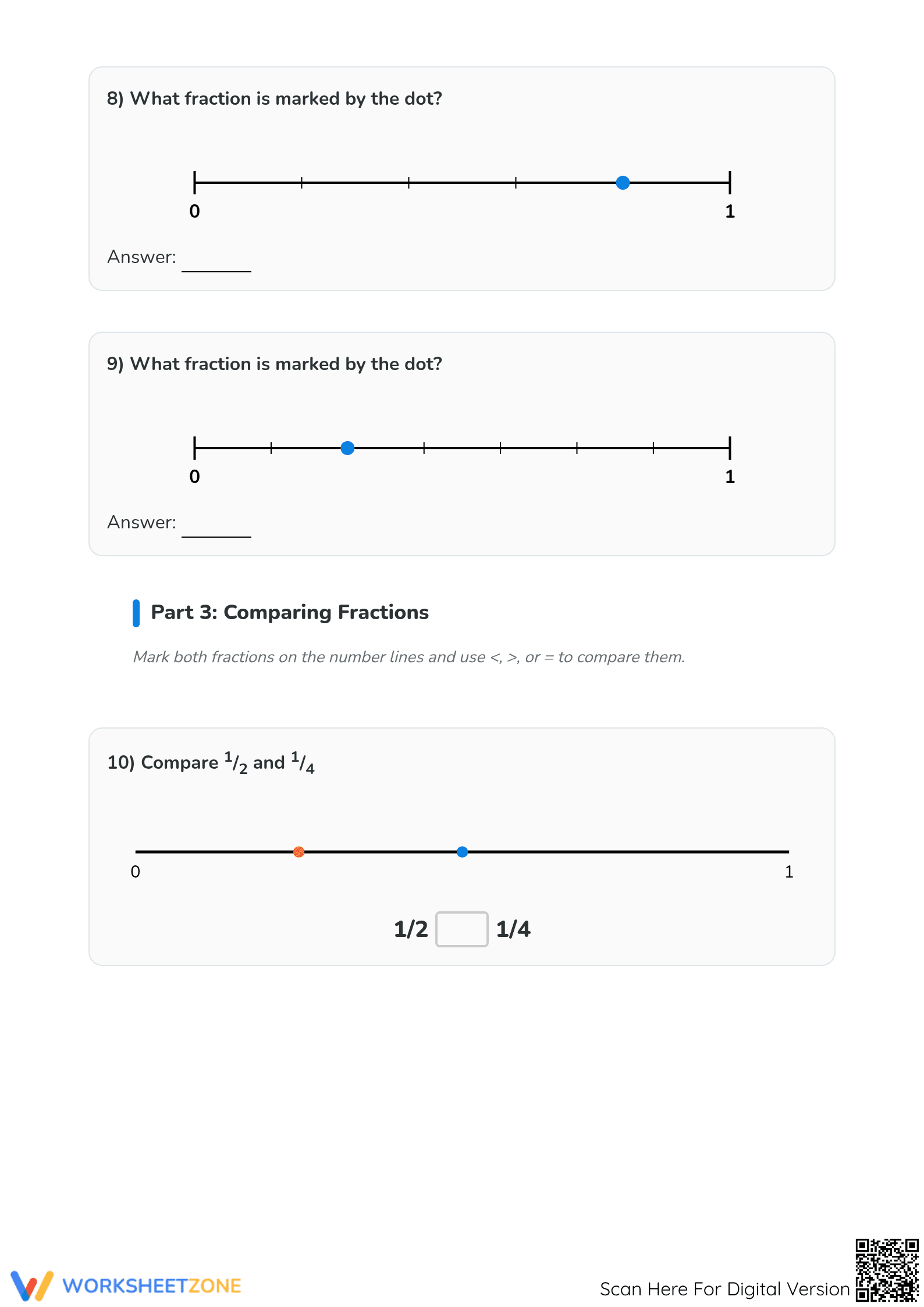
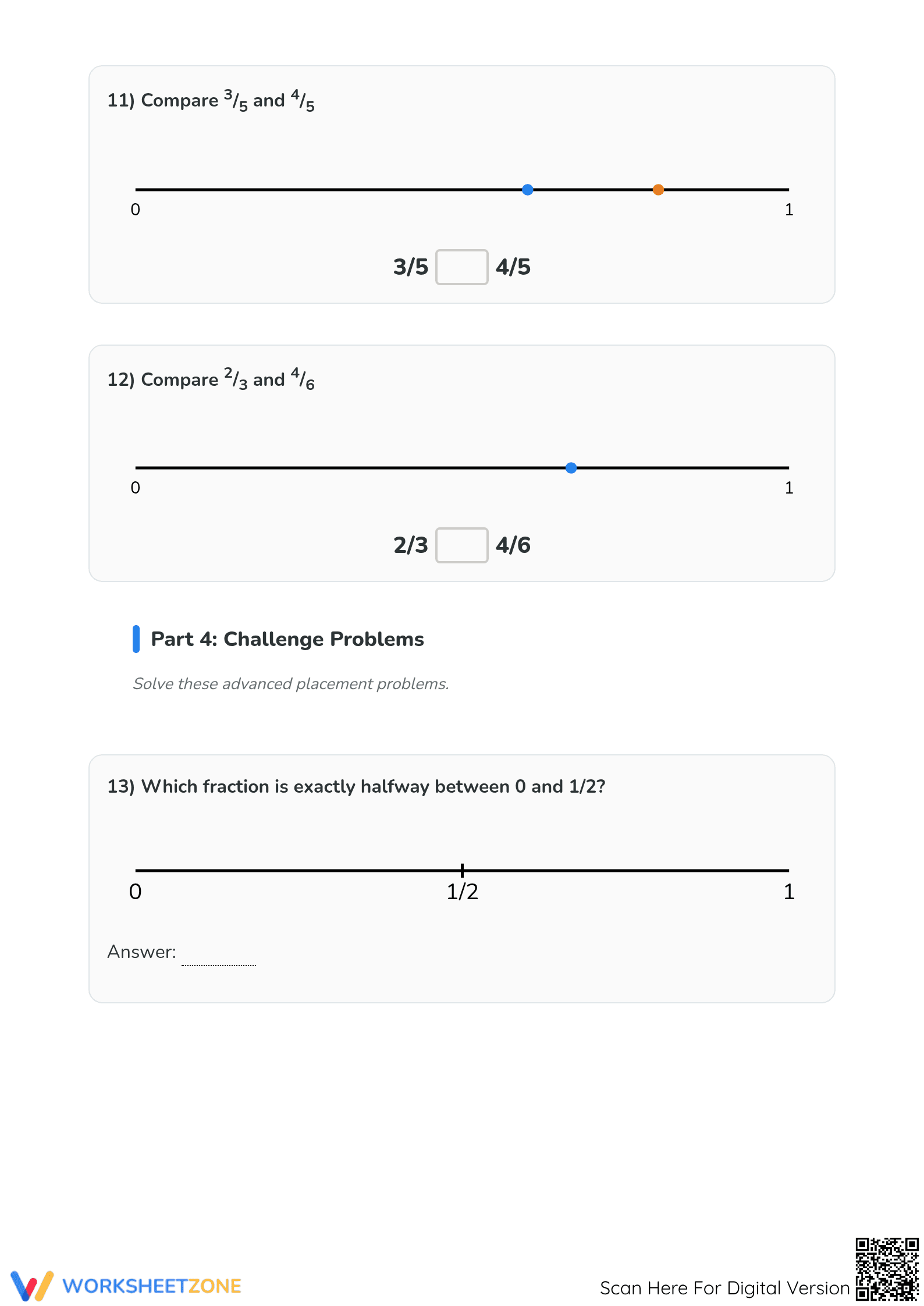
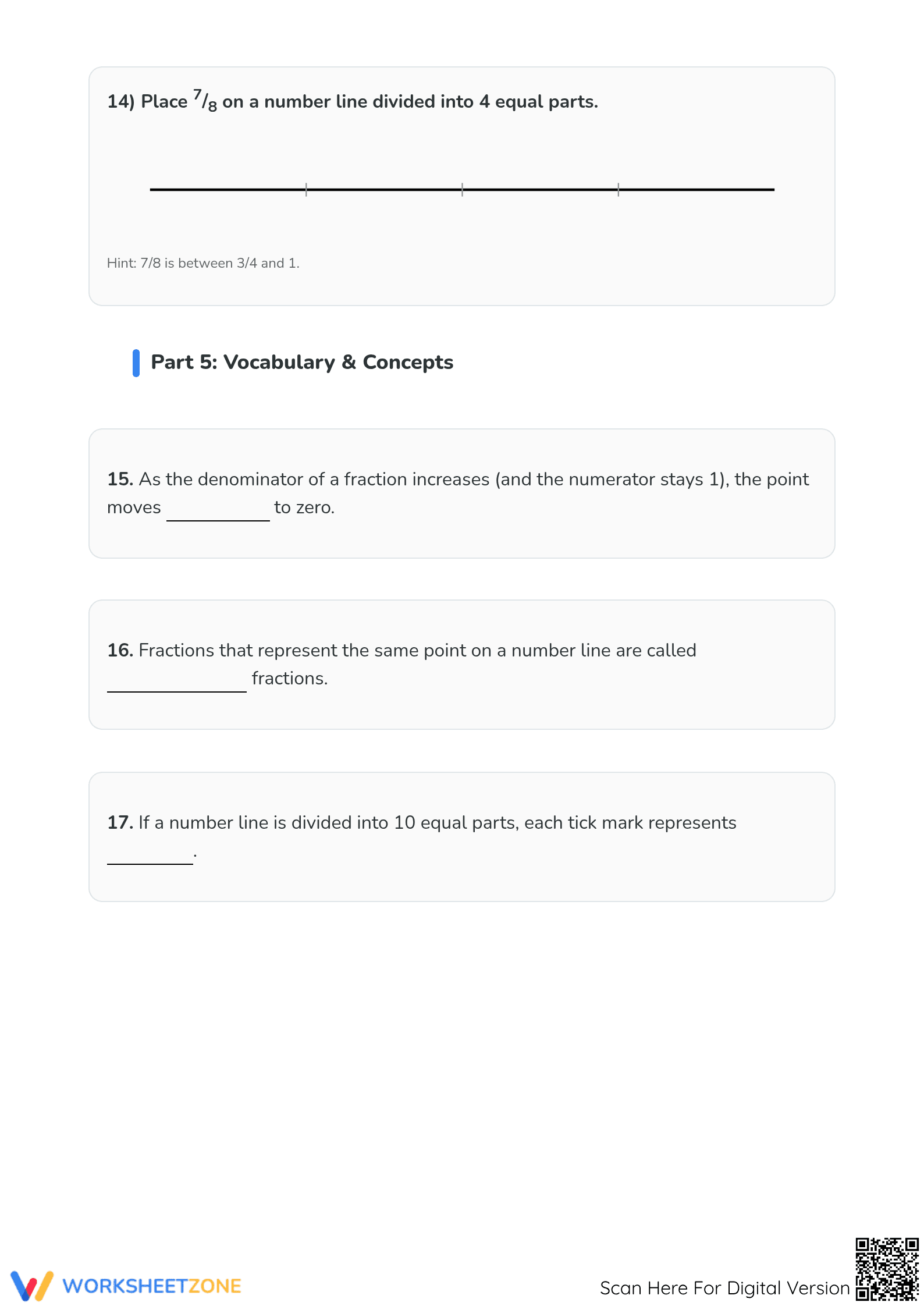
This Grade 3 math worksheet helps students visualize and order fractions on a number line from zero to one. Students progress from basic placement of unit fractions to identifying specific points and comparing values. It provides a structured path for mastering fraction magnitude and spatial reasoning in elementary mathematics.
At a Glance
- Grade: 3 · Subject: Math
- Standard:
CCSS.MATH.CONTENT.3.NF.A.2— Represent a fraction on a number line diagram by defining the interval.- Skill Focus: Fraction placement and comparison
- Format: 5 pages · 17 problems · Answer key included · PDF
- Best For: Small group instruction or independent practice
- Time: 25–40 minutes
What's Inside
Across five pages, this resource contains 17 distinct tasks divided into five parts. It includes basic placement exercises, identification drills where students name marked points, and a comparison section using inequality symbols. The final pages introduce challenge problems and conceptual vocabulary checks to ensure students understand denominators and equivalent fractions.
Skill Progression
- Guided Practice: Six problems focus on labeling pre-partitioned number lines for common unit and non-unit fractions, establishing the physical sense of fraction location.
- Supported Practice: Students move to identification, determining the exact numeric value of marked points on various number line scales.
- Independent Practice: The final tasks require students to compare different fractions and solve advanced placement challenges, such as finding the halfway point between zero and one-half.
This sequence follows a gradual-release model, moving from concrete visualization to abstract numeric comparison.
Standards Alignment
This resource aligns with CCSS.MATH.CONTENT.3.NF.A.2, requiring students to represent a fraction on a number line diagram. It specifically addresses sub-standards for defining intervals and locating specific non-unit fractions. This standard code can be copied directly into lesson plans, IEP goals, or district curriculum mapping tools to track student progress.
How to Use It
Use this during the "You Do" phase of instruction. It serves as a formative-assessment tool; teachers should observe if students count intervals or tick marks, as counting marks is a common misconception. Expect students to complete the 17-task set in approximately 30 minutes during a math center or as homework.
Who It's For
This is for Grade 3 and 4 students developing an understanding of fractions. It is effective for visual learners who succeed when seeing physical distance. Pair this with physical manipulatives or a large-scale classroom number line for a multi-sensory instructional experience.
According to EdReports 2024, the use of number lines is a critical component of high-quality instructional materials for developing fraction sense in elementary students. This worksheet specifically targets the skill of representing fractions as distances from zero, which is essential for transitioning from part-whole models to the real number system. By requiring students to identify, place, and compare values, the 17 tasks provide the repetitive but varied practice necessary for long-term retention. Research by Fisher & Frey (2014) highlights that scaffolding from unit fractions to complex comparisons, as seen in these 5 pages, supports the gradual release of responsibility. The inclusion of conceptual vocabulary checks further reinforces the linguistic precision required by CCSS.MATH.CONTENT.3.NF.A.2. This evidence-based approach ensures that students build a robust mental model of fraction magnitude before moving to more advanced operations in higher grades.


