


























Views
Downloads

Essential Number Line Worksheet | Ordering Fractions
Paste this activity's link or code into your existing LMS (Google Classroom, Canvas, Teams, Schoology, Moodle, etc.).
Students can open and work on the activity right away, with no student login required.
You'll still be able to track student progress and results from your teacher account.
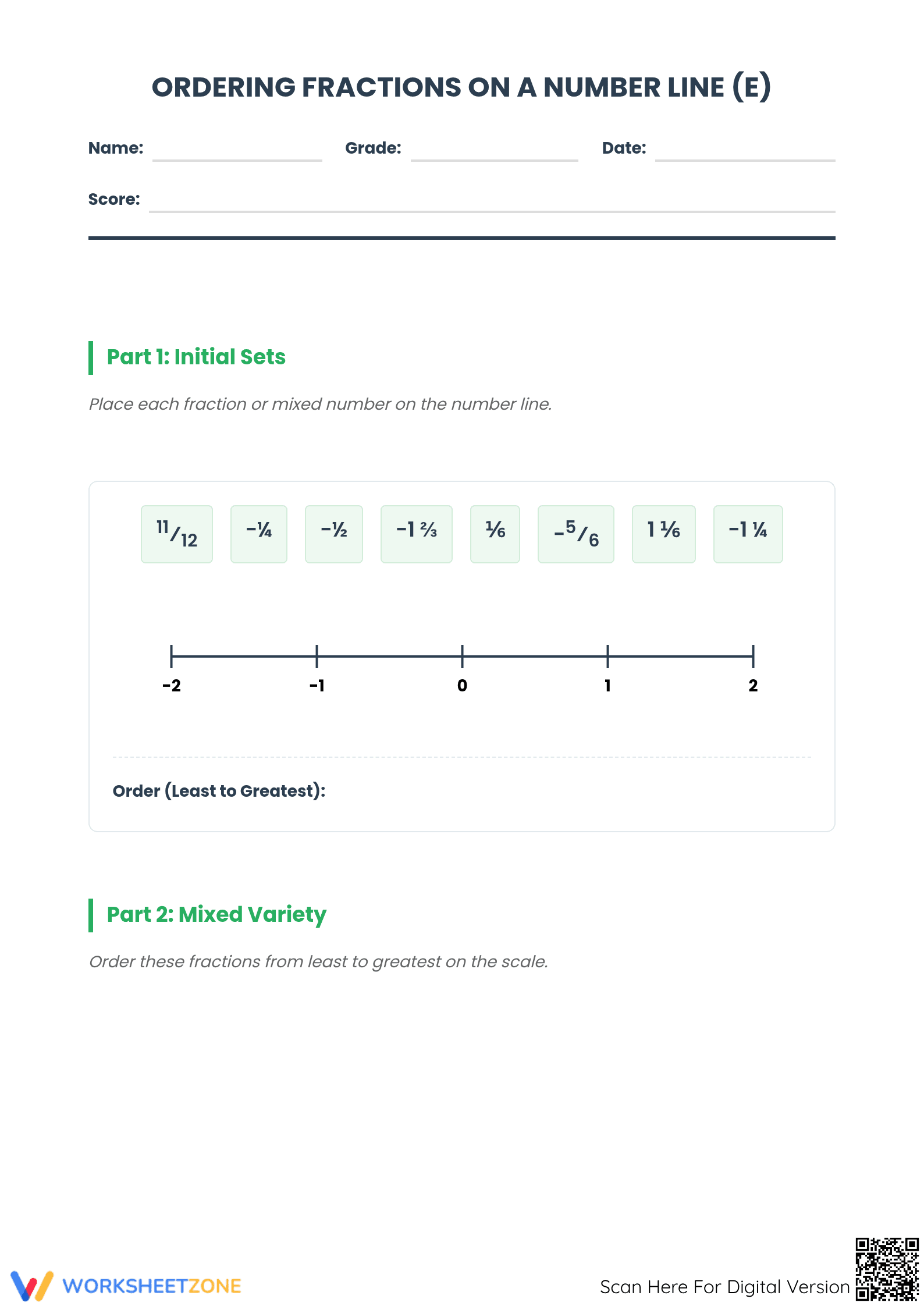
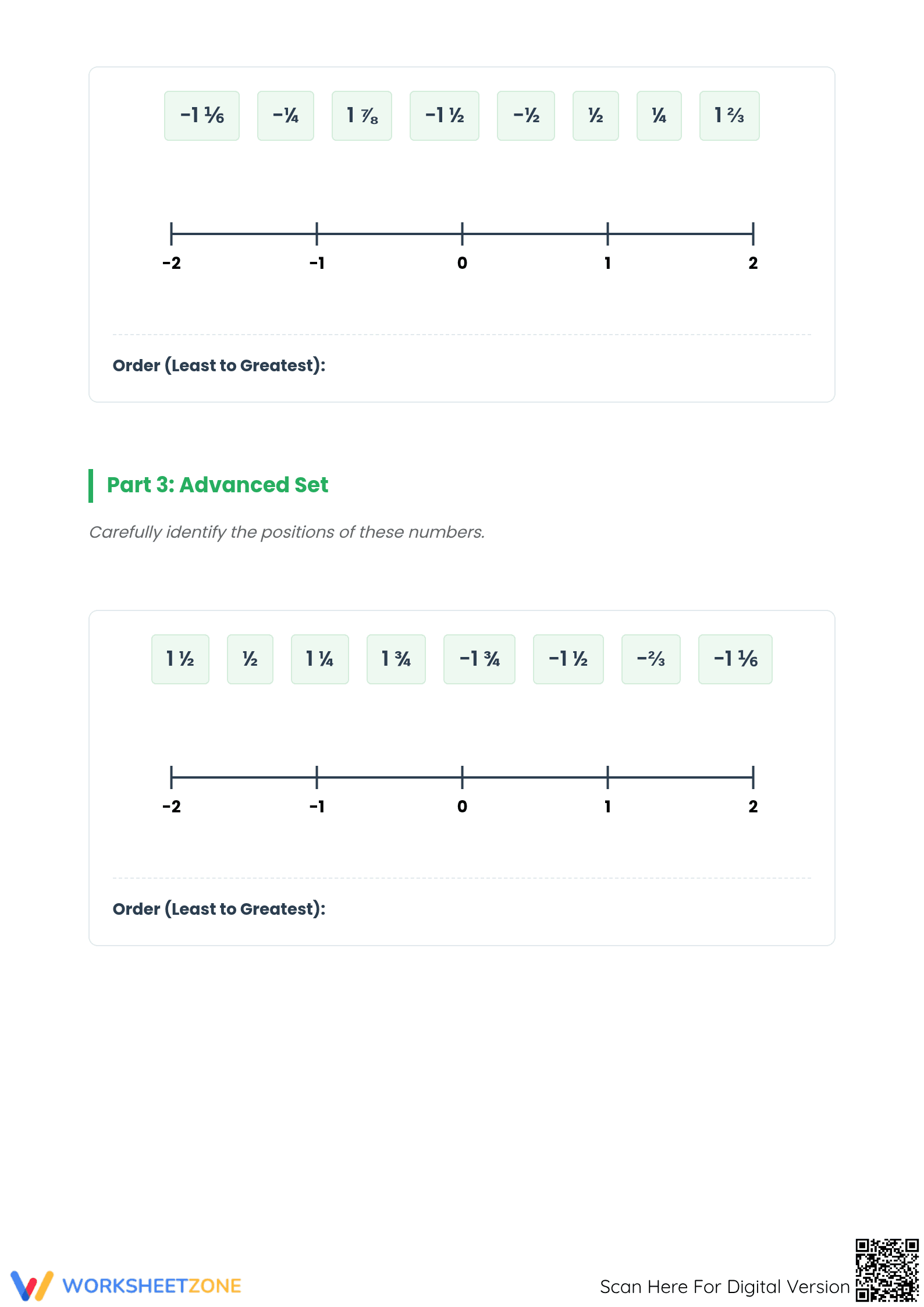
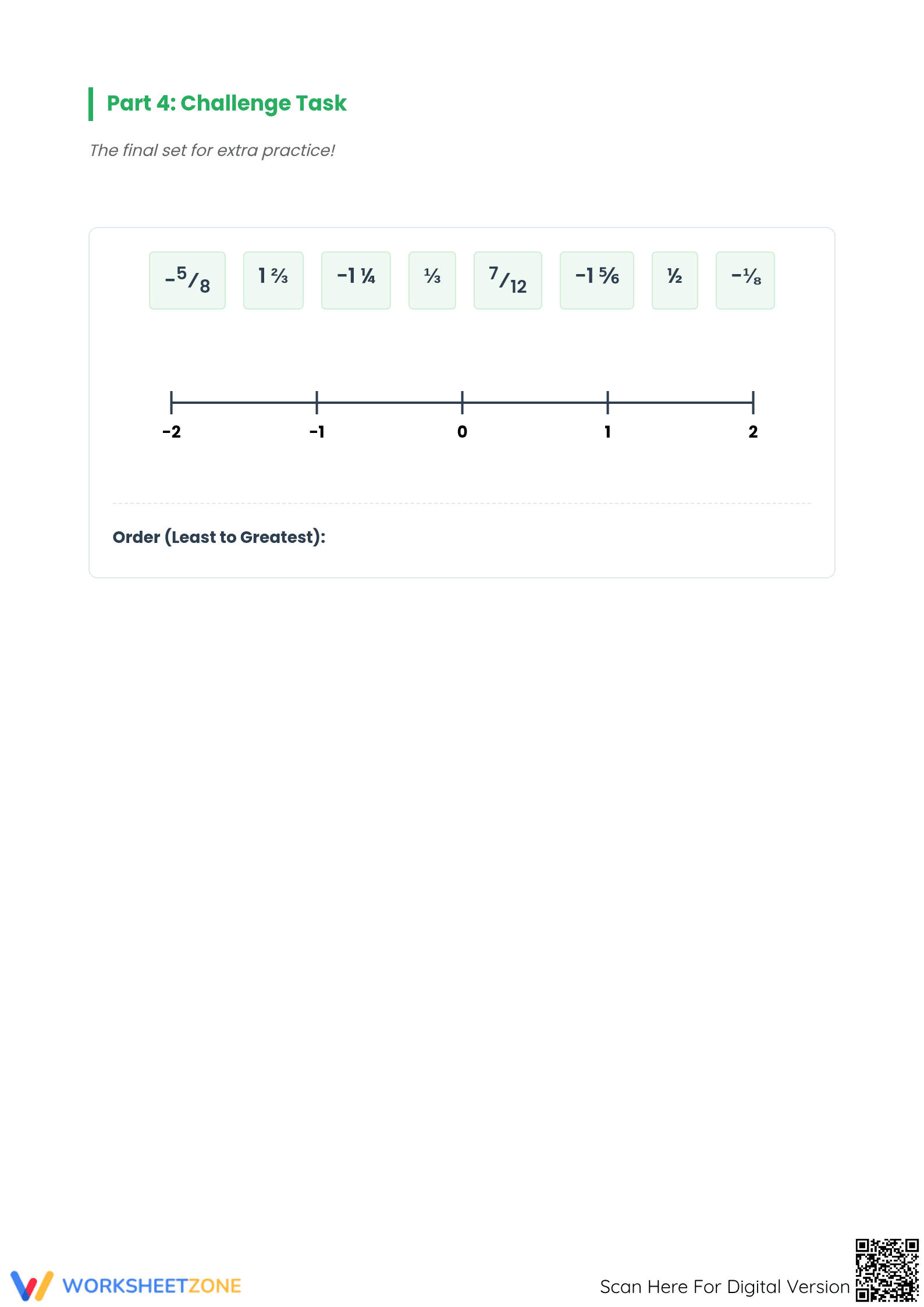
This comprehensive Grade 6 fractions worksheet helps students master the spatial relationship between rational numbers by plotting them on a coordinate scale. Students will practice ordering 32 distinct fractions and mixed numbers across four progressive sections, moving from simple initial sets to complex challenge tasks. This resource ensures students can accurately visualize magnitude and directionality in the number system.
At a Glance
- Grade: 6 · Subject: Math
- Standard:
6.NS.C.7— Understand ordering and absolute value of rational numbers on a line- Skill Focus: Ordering Rational Numbers
- Format: 3 pages · 32 problems · Answer key included · PDF
- Best For: Middle school math independent practice
- Time: 25–35 minutes
What's Inside: This three-page practice packet is structured into four distinct parts: Initial Sets, Mixed Variety, Advanced Set, and a Challenge Task. Each section features a clear number line ranging from -2 to 2, accompanied by eight numerical values in various forms. The packet includes a full answer key, providing immediate feedback for students and reducing grading time for teachers.
Zero-Prep Workflow: This resource is designed for immediate classroom implementation with zero teacher setup required. 1. Print the three-page PDF in less than 30 seconds for your entire class. 2. Distribute the worksheets and spend roughly one minute explaining the horizontal scale. 3. Review the completed work using the provided answer key in under five minutes. This efficient structure makes the packet an ideal choice for substitute lesson plans or unexpected schedule shifts.
Standards Alignment
Primary Standard: `6.NS.C.7`. Understand ordering and absolute value of rational numbers. This worksheet specifically targets 6.NS.C.7.A, interpreting statements of inequality as statements about the relative position of two numbers on a number line diagram. Both standard codes can be copied directly into lesson plans, IEP goals, or district curriculum mapping tools.
How to Use It
This resource is best utilized during the independent practice phase of a lesson on rational numbers or as a comprehensive review before a unit assessment. For a formative assessment observation, walk around and note if students are correctly placing negative mixed numbers relative to their whole number counterparts. The expected completion time for all 32 tasks ranges from 25 to 35 minutes depending on student proficiency.
Who It's For
This worksheet is primarily for 6th-grade students learning about the number system, though it serves as excellent remediation for 7th and 8th graders. It provides necessary visual scaffolding for students who struggle with abstract numerical comparisons. Pair this resource with a physical number line anchor chart or a digital graphing tool for a multi-modal instructional experience.
Fractions and rational numbers are fundamental to middle school mathematical success, often serving as a gateway to algebra. According to research by Fisher & Frey (2014), visual scaffolds like number line diagrams are critical for students to internalize the concept of magnitude, especially when transitioning from positive integers to signed rational numbers. This worksheet aligns with standard 6.NS.C.7, which requires students to understand ordering and absolute value of rational numbers. By requiring students to both plot and list fractions in order, the resource supports dual coding—linking visual spatial reasoning with symbolic numerical ordering. The 32 distinct tasks provide sufficient repetition to achieve procedural fluency, while the inclusion of mixed numbers and varying denominators prevents over-reliance on simple pattern recognition. Educators can utilize this tool to bridge the gap between concrete fraction models and abstract coordinate geometry.


