


























Views
Downloads
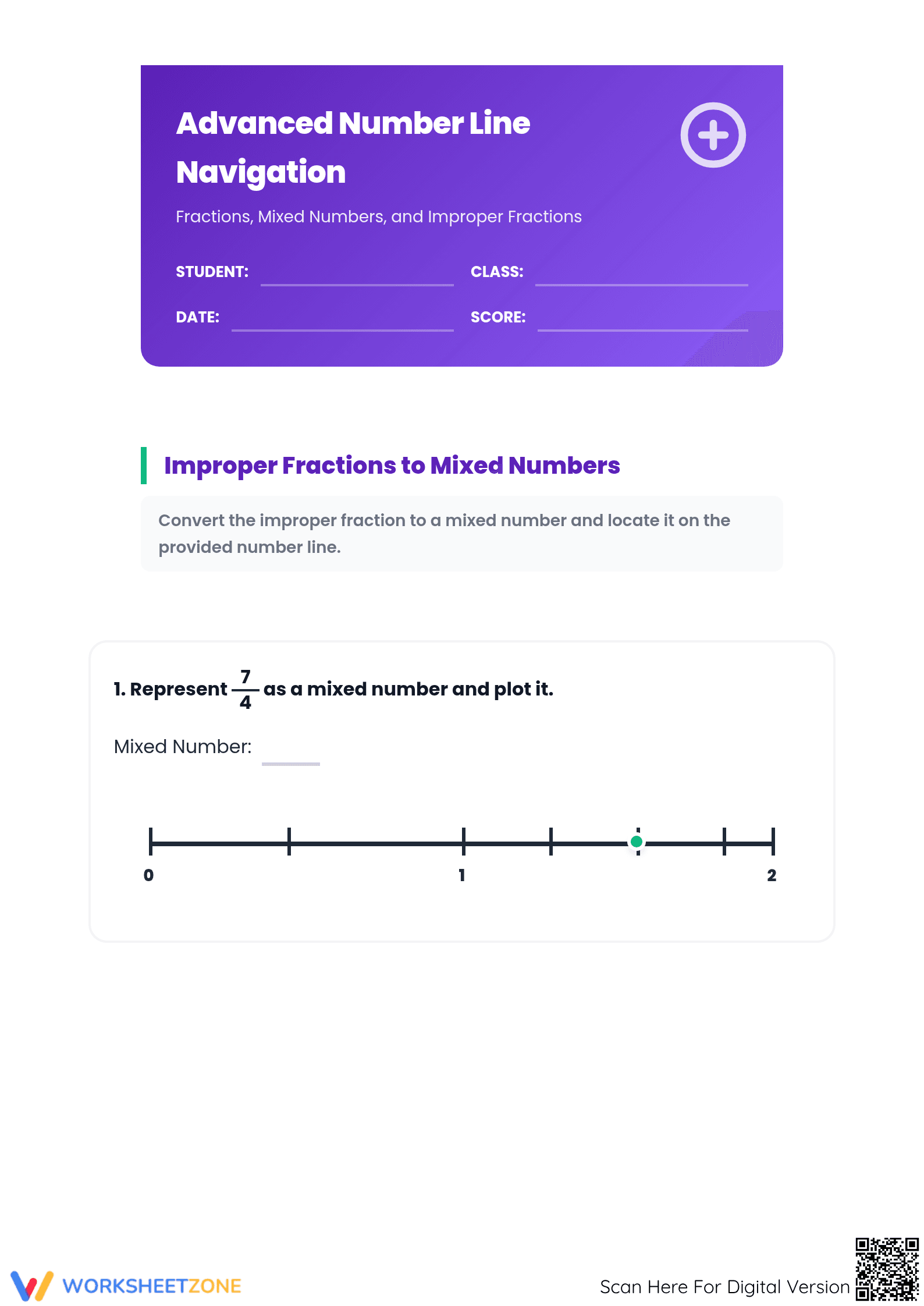
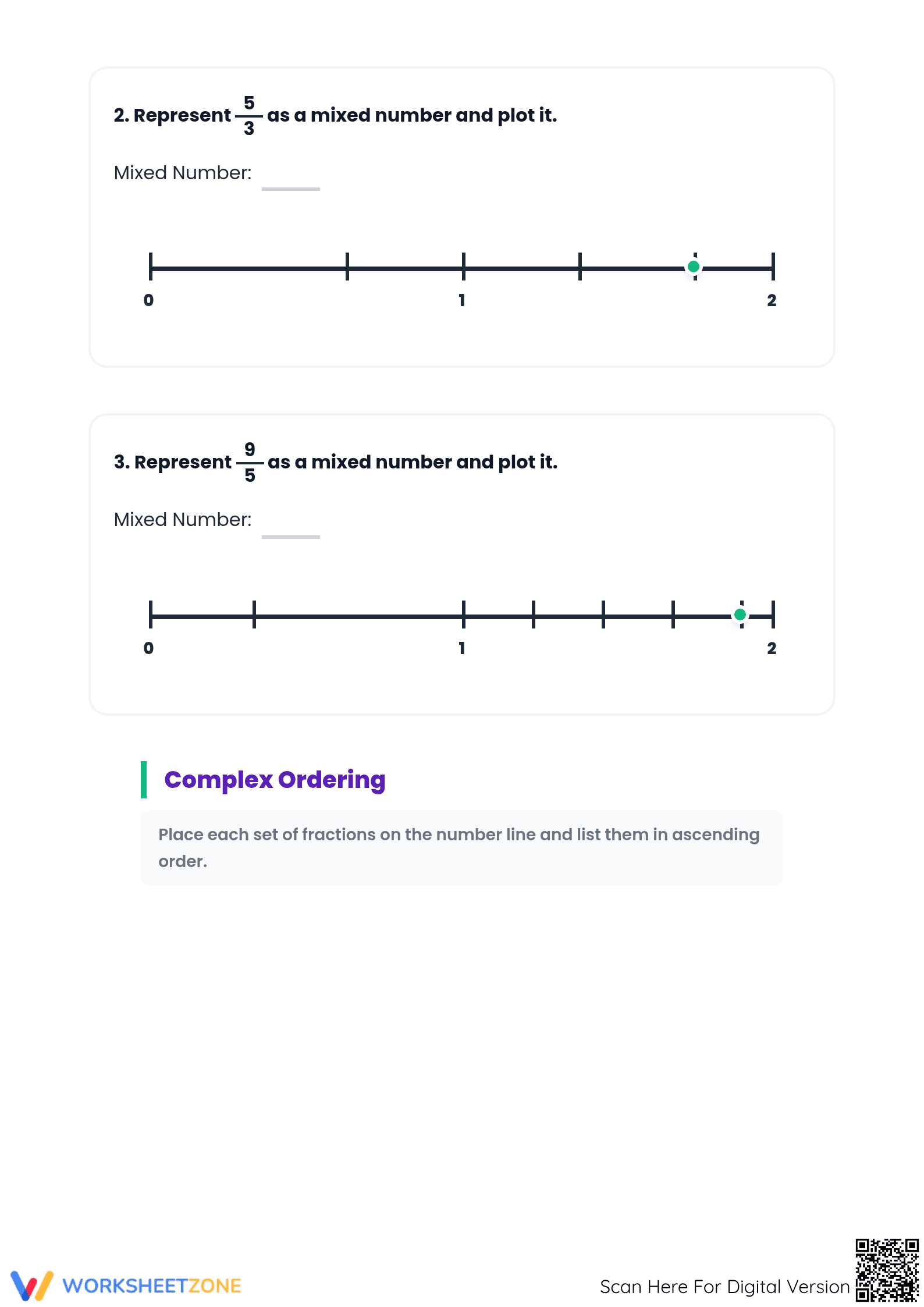
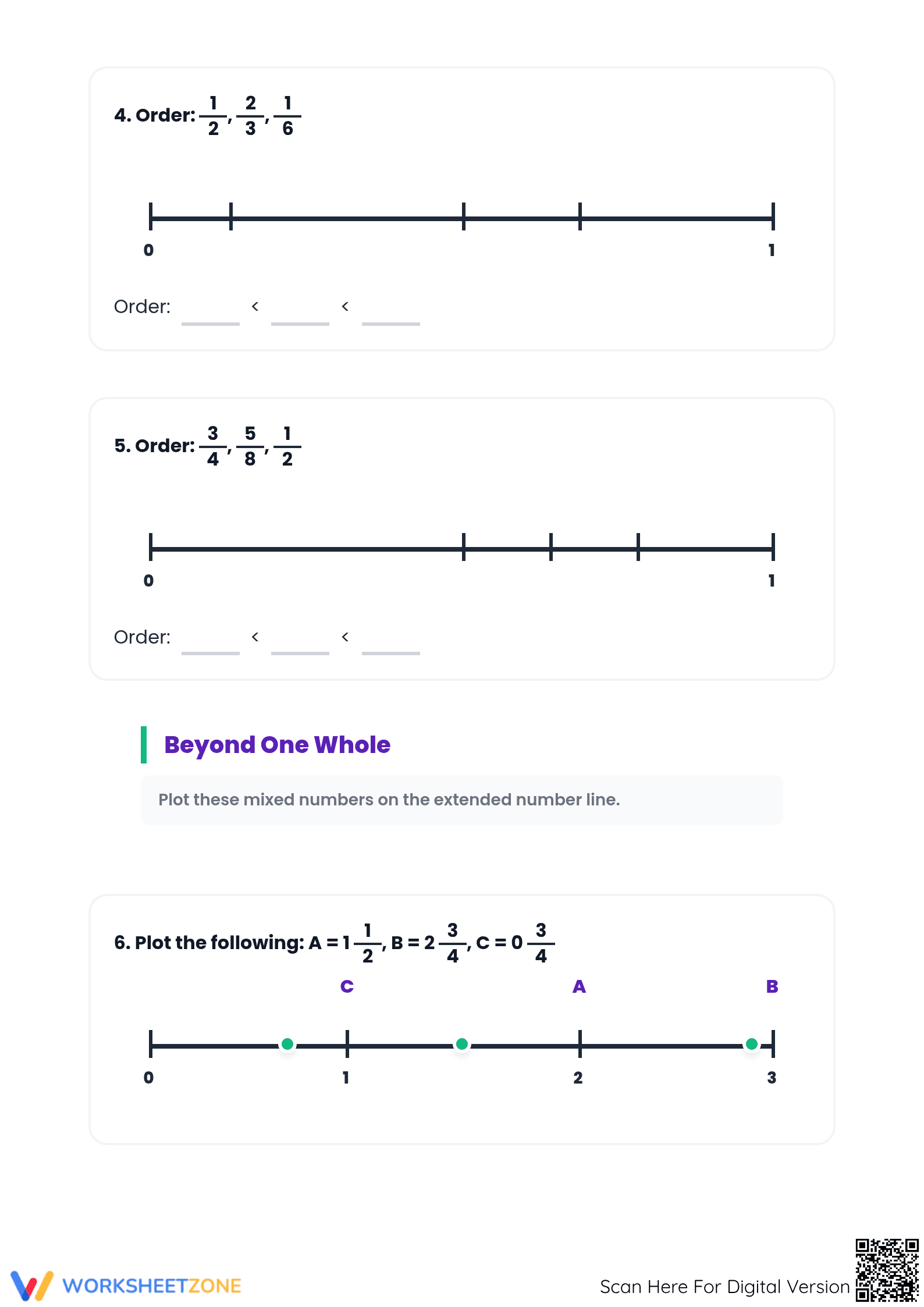
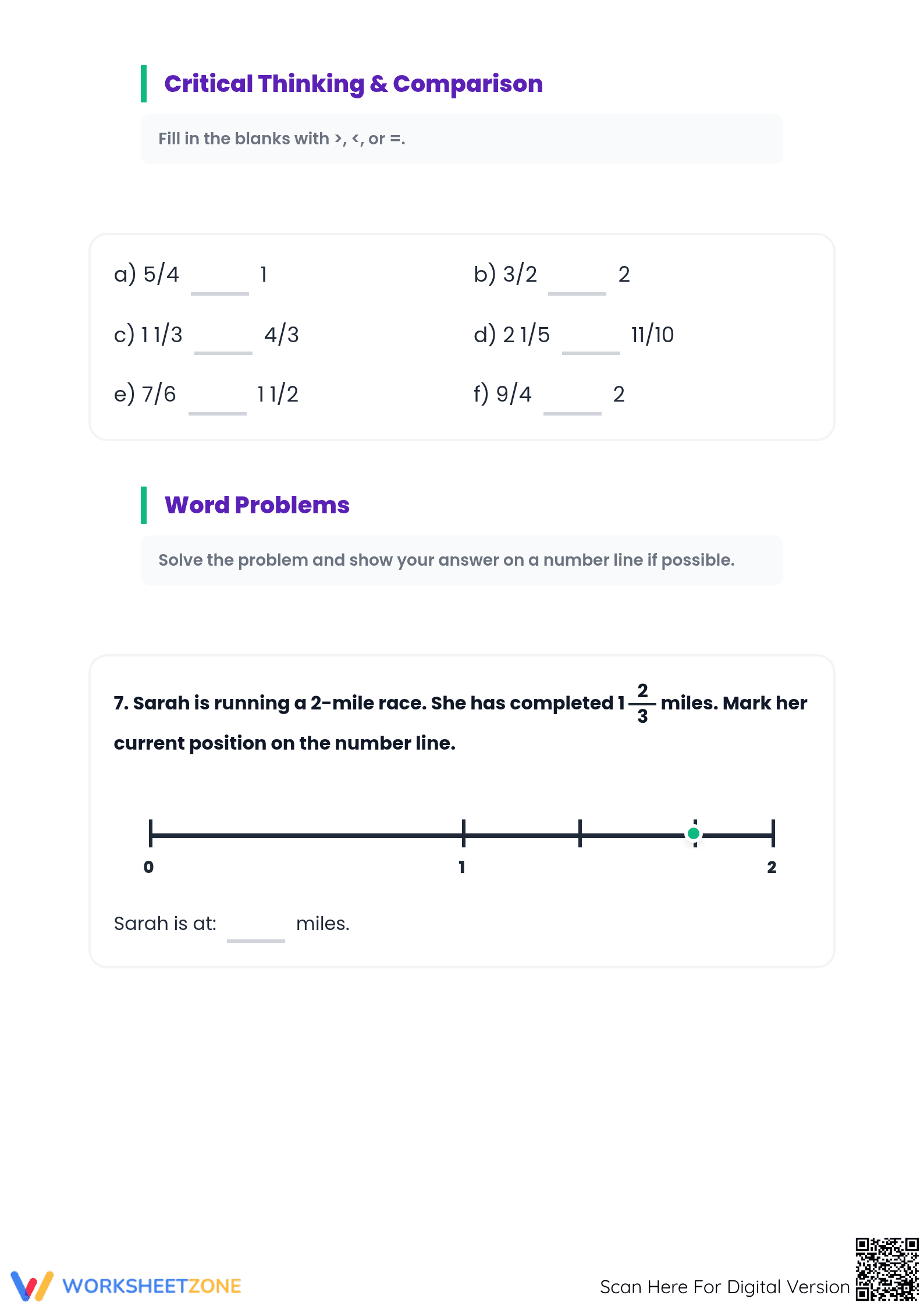

Printable Advanced Fractions on a Number Line | Grades 4-6
Paste this activity's link or code into your existing LMS (Google Classroom, Canvas, Teams, Schoology, Moodle, etc.).
Students can open and work on the activity right away, with no student login required.
You'll still be able to track student progress and results from your teacher account.
This advanced fractions worksheet transforms abstract numerical concepts into clear visual representations. By plotting improper fractions and mixed numbers on interactive number lines, students bridge the gap between calculation and conceptual understanding. The resource provides rigorous practice in ordering, comparing, and applying fractions to real-world word problems, ensuring students achieve deep procedural fluency and mathematical accuracy.
At a Glance
- Grade: 4–6 · Subject: Math (Fractions)
- Standard:
CCSS.MATH.CONTENT.4.NF.A.2— Compare two fractions with different numerators and different denominators- Skill Focus: Improper to Mixed Number Conversion & Number Line Plotting
- Format: 5 pages · 15 items · Answer key included · PDF
- Best For: Independent practice after direct fraction instruction
- Time: 30–45 minutes
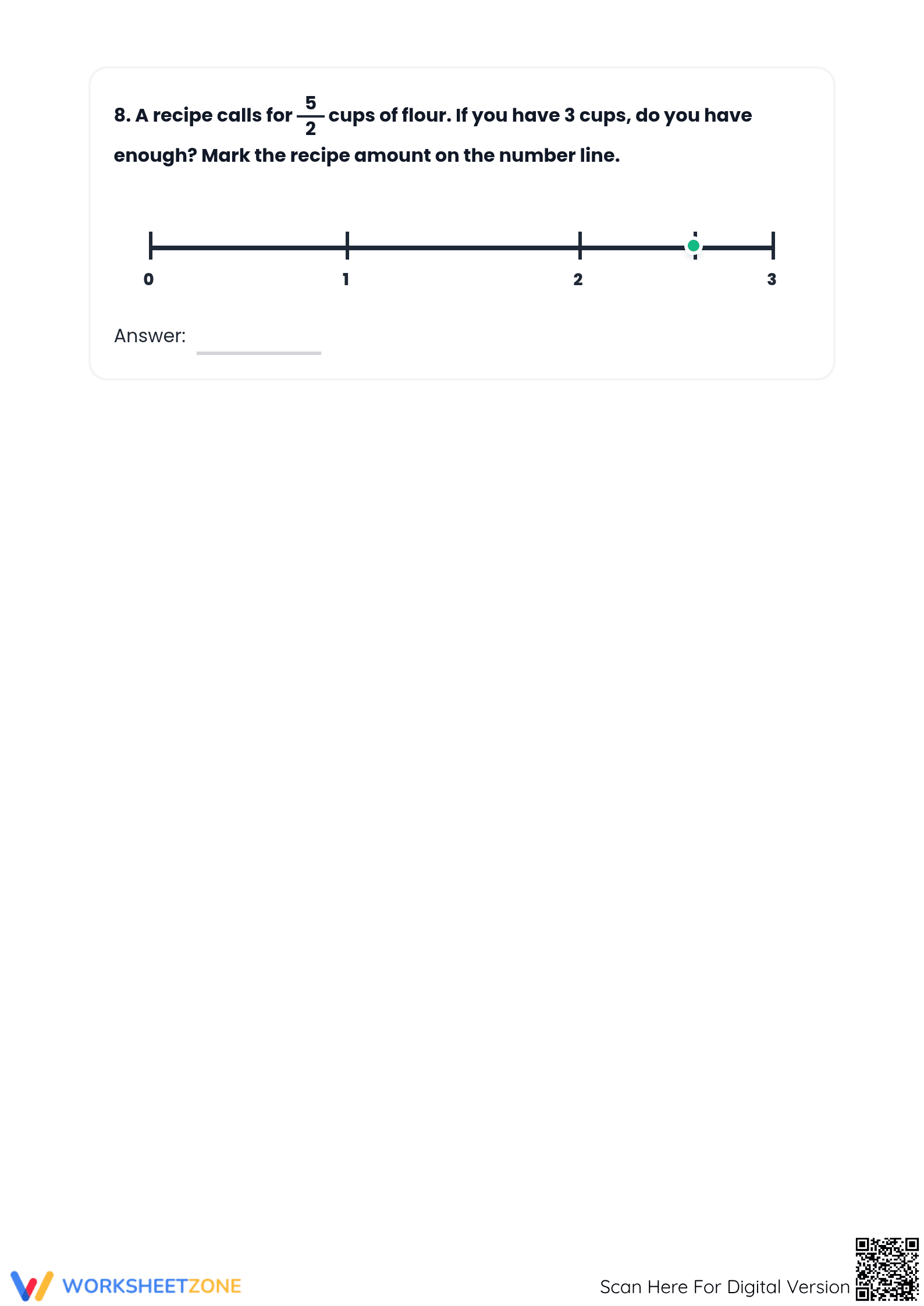
This comprehensive five-page PDF features 15 targeted mathematical tasks designed to challenge upper elementary students. The resource includes visual number line plots for improper fractions, ascending order sequences, and comparison exercises using inequality symbols. It concludes with complex word problems involving multi-step logic and a distance-based race scenario. A complete answer key is provided for immediate grading or student self-correction.
Skill Progression
- Guided practice: The first two pages focus on converting improper fractions (like 7/4 and 5/3) into mixed numbers, providing segmented number lines with integer anchors to scaffold the initial plotting process.
- Supported practice: Middle sections transition to ordering multiple fractions (e.g., 1/2, 2/3, 1/6) on a single scale, requiring students to determine common intervals before placing and ranking each value.
- Independent practice: Final tasks demand higher-order application through comparison drills and realistic word problems, requiring students to translate narrative data into number line coordinates without visual prompts.
This instructional sequence follows a gradual-release model, moving from basic representation to complex problem-solving.
Standards Alignment
The primary alignment is CCSS.MATH.CONTENT.4.NF.A.2: "Compare two fractions with different numerators and different denominators, e.g., by creating common denominators or numerators, or by comparing to a benchmark fraction such as 1/2." This worksheet also supports 4.NF.B.3.c by requiring improper fraction to mixed number conversion. Both standard codes are readily usable for lesson plans, IEP goals, or curriculum mapping.
How to Use It
Deploy this resource after a direct instruction lesson on improper fractions to reinforce the relationship between numerator-heavy values and their mixed-number equivalents. Use the comparison section as a "Check for Understanding" mid-lesson; observe if students are using benchmark fractions or common denominators to make their decisions. The word problems take approximately 10 minutes and serve as an excellent exit ticket for formative assessment.
Who It's For
This resource is tailored for Grade 4 and 5 students mastering rational numbers, as well as Grade 6 students requiring remediation in fraction visualization. It naturally pairs with physical manipulatives like fraction tiles or interactive whiteboard number lines to support visual learners. The clear spacing and structured layout make it suitable for students who benefit from visual organization or reduced cognitive load during multi-step math tasks.
Research underscores that visual models, particularly number lines, are critical for students to develop a "sense of magnitude" for fractions, moving beyond rote algorithms. Students engaging in multi-modal representation (symbolic and visual) show higher retention. This worksheet addresses misconceptions by treating fractions as continuous points of value, aligning with CCSS.MATH.CONTENT.4.NF.A.2 for essential comparison skills and bridging abstract calculation with real-world application through word problems. This approach supports upper-elementary math proficiency and high-quality instructional materials.


