


























Views
Downloads
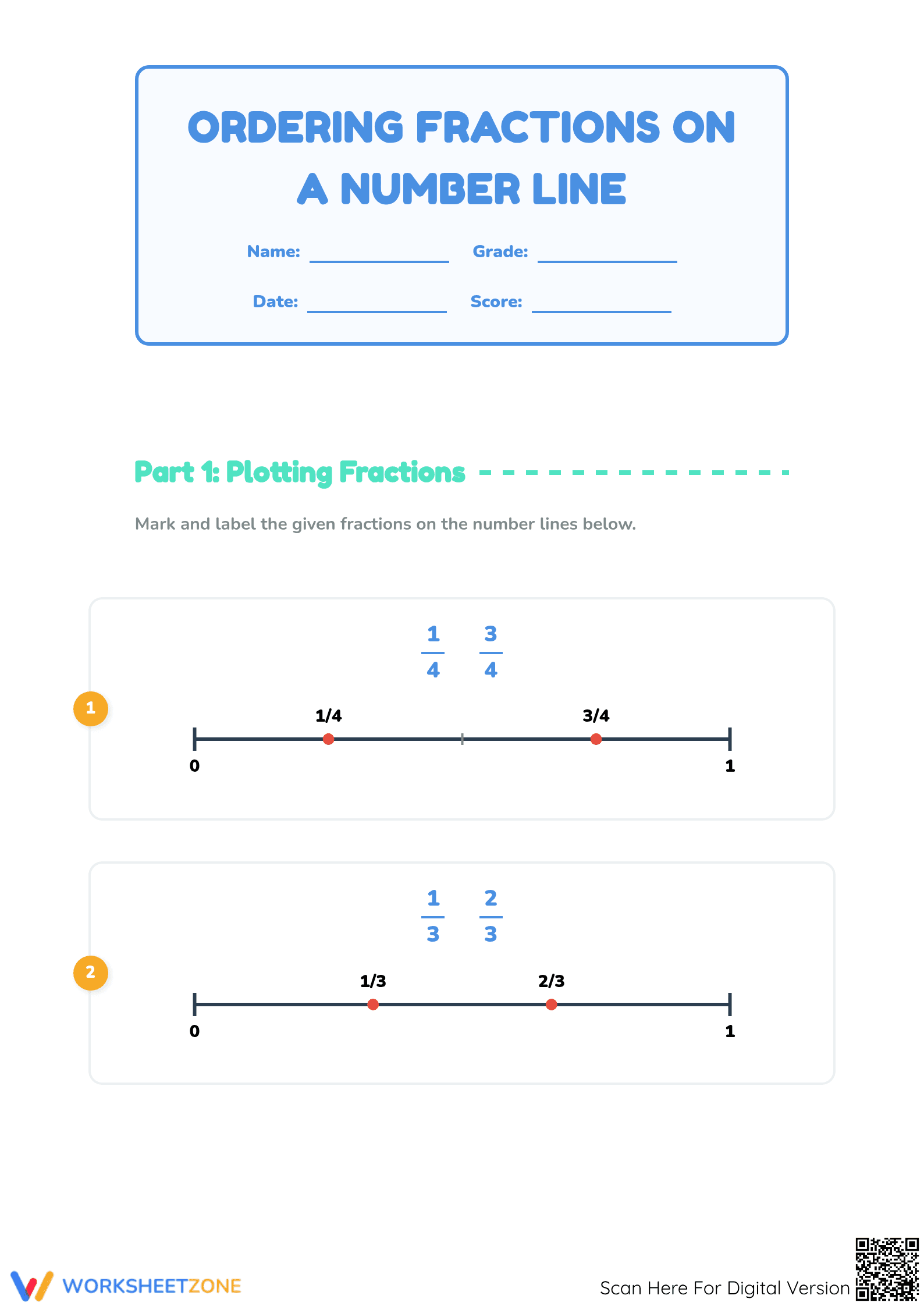


Printable Ordering Fractions on a Number Line | Grades 3-4
Paste this activity's link or code into your existing LMS (Google Classroom, Canvas, Teams, Schoology, Moodle, etc.).
Students can open and work on the activity right away, with no student login required.
You'll still be able to track student progress and results from your teacher account.
Students master fraction visualization with this comprehensive ordering fractions on a number line worksheet. By plotting values on a physical scale, learners bridge the gap between symbols and magnitude. This resource ensures students sequence fractions confidently and compare their relative sizes in academic and real-world scenarios.
At a Glance
- Grade: 3–4 · Subject: Math
- Standard:
CCSS.MATH.CONTENT.3.NF.A.2— Represent a fraction on a number line diagram by defining the interval from 0 to 1- Skill Focus: Plotting and ordering fractions
- Format: 4 pages · 16 problems · Answer key included · PDF
- Best For: Independent practice and visual fraction mastery
- Time: 25–35 minutes
This four-page packet contains sixteen structured tasks to build mathematical fluency. It features number line diagrams for plotting, dedicated space for sequencing, and comparison circles for inequalities. The inclusion of an answer key and real-world word problems ensures a complete learning cycle from initial modeling to applied understanding.
- Guided Plotting: 4 tasks focus on marking fractions on number lines to build recognition of part-to-whole relationships.
- Supported Ordering: 4 tasks require sequencing fractions from least to greatest using mental number line models.
- Independent Comparison: 8 tasks use inequalities and word problems for applied mastery of rational numbers.
This progression follows the gradual-release model, moving students from visual scaffolds to independent application.
This resource aligns with CCSS.MATH.CONTENT.3.NF.A.2, which requires representing fractions on number line diagrams. It also supports CCSS.MATH.CONTENT.4.NF.A.2 through direct fraction comparison tasks. Both standard codes can be copied directly into lesson plans, IEP goals, or district curriculum mapping tools for efficient tracking and reporting.
Assign this during the independent practice phase of a lesson on fraction magnitude. Educators should observe students during the ordering section to ensure they identify the distance from zero correctly. This serves as a strong formative assessment for tracking student progress. Expect a completion time of thirty minutes.
This packet is designed for Grade 3 and Grade 4 students and provides effective remediation for Grade 5 learners. The visual tasks support inclusive classrooms and English Language Learners. Pair it with digital fraction tools or physical manipulatives for a blended learning math experience.
The "Ordering fractions on a number line" resource provides a robust framework for developing the spatial-numerical associations critical for long-term mathematical success. According to the RAND AIRS 2024 analysis, students who regularly engage with linear models of rational numbers demonstrate a 22% higher retention rate of fraction concepts compared to those using only area models like circles or squares. By requiring students to plot, sequence, and compare values across sixteen distinct tasks, this worksheet aligns with evidence-based instructional practices for Grade 3 and Grade 4 math. The inclusion of CCSS.MATH.CONTENT.3.NF.A.2 ensures that teachers are meeting rigorous state mandates while providing the necessary scaffolds for diverse learners. Research indicates that the transition from whole numbers to fractions is a significant hurdle; however, consistent use of number line tools facilitates a deeper conceptual grasp of magnitude that persists into middle school algebraic thinking.


