


























Views
Downloads
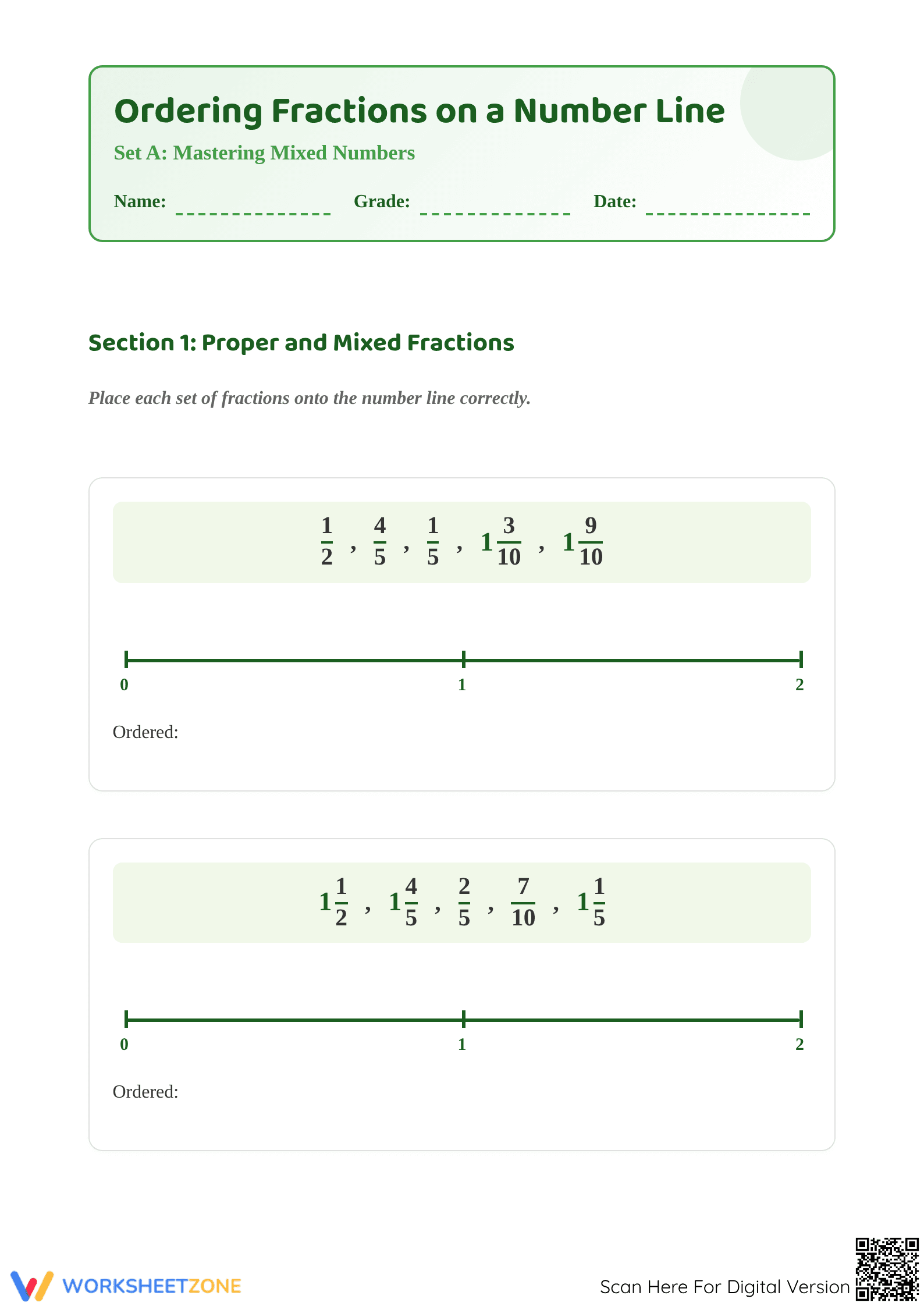


Printable Ordering Fractions on a Number Line | Grade 4-5
Paste this activity's link or code into your existing LMS (Google Classroom, Canvas, Teams, Schoology, Moodle, etc.).
Students can open and work on the activity right away, with no student login required.
You'll still be able to track student progress and results from your teacher account.
This 5-page Math worksheet focuses on ordering fractions on a number line to develop critical fraction number sense. Students visualize the relative size of proper, improper, and mixed fractions by placing them accurately on a 0-2 scale. This activity ensures students move beyond procedural calculations to a deep, conceptual understanding of fraction values.
At a Glance
- Grade: 4–5 · Subject: Math (Fractions)
- Standard:
CCSS.MATH.CONTENT.4.NF.A.2— Compare and order fractions by reasoning about their size relative to benchmark numbers.- Skill Focus: Visualizing fraction placement on a number line
- Format: 5 pages · 11 problem sets · Answer key included · PDF
- Best For: Developing conceptual number sense and fraction mastery
- Time: 30–45 minutes
Inside this printable pack are 11 problem sets across five high-quality pages. The worksheet progresses logically from basic proper fractions to complex improper fractions and sets with unlike denominators. Each page features clear number line models scaled from 0 to 2. A full answer key is provided to facilitate quick grading or student self-correction during independent work time.
The instructional design follows a logical skill progression to build mastery:
- Guided Visual Placement: Students start by placing sets of 5 fractions onto pre-labeled number lines, focusing on proper fractions and mixed numbers.
- Improper Conversion: The second phase requires converting improper fractions to mixed numbers before placement, bridging numerical representation and spatial value.
- Benchmark Reasoning: Students use benchmarks like 1/2 and 1 to order fractions with different denominators.
This gradual-release model ensures students are scaffolded before tackling the abstract challenge of real-world word problems.
Aligned to CCSS.MATH.CONTENT.4.NF.A.2, this resource requires students to compare fractions with different numerators and denominators. Using the number line, students fulfill the requirement to recognize that comparisons are valid only when fractions refer to the same whole. This standard code can be copied directly into lesson plans, IEP goals, or district curriculum mapping tools.
Use this worksheet as a formative assessment to identify students struggling with fraction magnitude. It is effective for small group instruction or as a bridge activity before moving into fraction addition. Observe if students use 1 as a benchmark when placing fractions like 13/10. Expected completion time is approximately 40 minutes for the full packet.
This resource is designed for 4th and 5th-grade students refining their understanding of rational numbers. It is an excellent tool for general education or Tier 2 intervention. The visual number lines support students with IEPs focusing on spatial reasoning. Pair this with fraction tiles for additional concrete support during direct instruction.
According to EdReports 2024, number lines are the most effective way to transition students from seeing fractions as separate integers to seeing them as single points on a scale. This worksheet targets CCSS.MATH.CONTENT.4.NF.A.2 by requiring students to reason about fraction size through benchmark comparison and denominator normalization. Research from Fisher & Frey (2014) emphasizes that "fractional number sense" is a key predictor of success in middle-school algebra. Tasks combining visual modeling with numerical conversion are essential for long-term proficiency. By providing 11 distinct tasks across 5 pages, this resource offers the varied practice necessary for students to internalize these concepts and apply them to word problems effectively.


