


























Views
Downloads
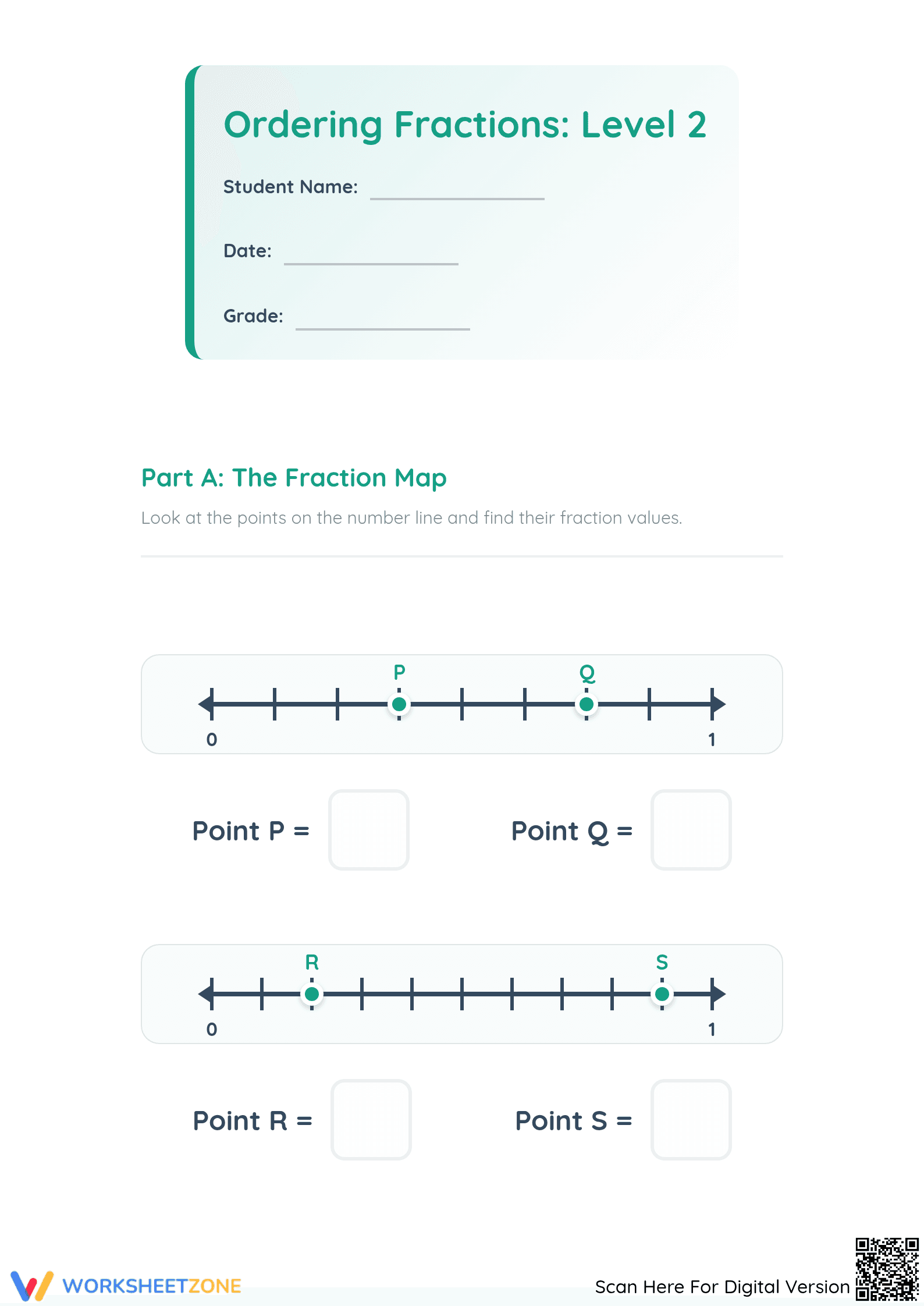


Printable Ordering Fractions on a Number Line Level 2
Paste this activity's link or code into your existing LMS (Google Classroom, Canvas, Teams, Schoology, Moodle, etc.).
Students can open and work on the activity right away, with no student login required.
You'll still be able to track student progress and results from your teacher account.
This comprehensive Grade 3 fractions worksheet helps students visualize and master the relationship between numerical values and their placement on a number line. By identifying, ordering, and comparing fractions, learners build a robust mental model of fractional parts of a whole, ensuring a smooth transition from concrete counting to abstract mathematical reasoning.
At a Glance
- Grade: 3 · Subject: Math
- Standard:
CCSS.MATH.CONTENT.3.NF.A.2— Partition a number line into equal parts to represent fractional units- Skill Focus: Fractions on a Number Line
- Format: 4 pages · 12 problems · Answer key included · PDF
- Best For: Small group tiered math instruction
- Time: 25–35 minutes
Inside this 4-page resource, you will find twelve carefully structured tasks divided into four distinct parts. Students begin by identifying specific points on pre-partitioned number lines in "The Fraction Map." They then progress to ordering sets of four fractions with common denominators and performing direct comparisons using inequality symbols. The final section challenges students with word problems that require deep conceptual understanding.
This "Level 2" version serves as the central pillar of our tiered fraction series. All three versions are designed to be used simultaneously within the same classroom to support inclusive instruction:
- Below Grade (Level 1): Focuses on unit fractions with larger intervals and heavy visual scaffolding to support foundational number sense.
- On Grade (Level 2): This version targets standard Grade 3 expectations, requiring students to partition wholes into varying denominators and compare non-unit fractions.
- Above Grade (Level 3): Challenges advanced learners with mixed numbers and number lines that extend beyond the 0-1 interval.
The primary alignment for this resource is CCSS.MATH.CONTENT.3.NF.A.2, which requires students to represent a fraction on a number line diagram by partitioning it into equal parts. Additionally, it supports CCSS.MATH.CONTENT.3.NF.A.3 by helping students explain the equivalence of fractions and compare them based on size. Both standard codes can be copied directly into lesson plans, IEP goals, or district curriculum mapping tools.
Use this worksheet during the independent practice phase of a gradual release lesson. It is particularly effective as a mid-unit formative assessment. While students work, observe if they count the partition marks or the intervals between them; this diagnostic insight reveals their understanding of fractions as distances. Completion typically takes 30 minutes, making it an ideal small-group activity.
This resource is tailored for Grade 3 students but provides excellent remediation for older learners struggling with visual fraction models. It pairs naturally with physical manipulatives like fraction strips or classroom number lines. The clear layout and scaffolded sections make it accessible for students with diverse learning needs, including those requiring explicit visual cues for abstract concepts.
Research by Fisher & Frey (2014) emphasizes that visual representations, specifically number lines, are critical for students to develop a linear model of fractions, which is often more difficult than area-based circle models. This Level 2 worksheet operationalizes these findings by requiring students to interact with standard CCSS.MATH.CONTENT.3.NF.A.2 through multi-step tasks. By moving from identification to comparison and finally to complex problem-solving, the resource ensures that students do not just memorize procedures but actually see the magnitude of each fractional part. According to the NAEP data, students who master number line representations demonstrate significantly higher proficiency in later algebraic concepts involving ratios and proportions. This printable tool provides the structured practice necessary to bridge that gap, offering a classroom-ready solution that balances procedural fluency with conceptual depth and rigorous standards alignment for every learner.


