


























Views
Downloads


Printable Ordering Fractions on a Number Line | Grade 4 Math
Paste this activity's link or code into your existing LMS (Google Classroom, Canvas, Teams, Schoology, Moodle, etc.).
Students can open and work on the activity right away, with no student login required.
You'll still be able to track student progress and results from your teacher account.
This Grade 4 fractions worksheet empowers students to visualize and manipulate numerical values using number lines. By transitioning from basic placement to complex ordering and word problems, learners develop a concrete understanding of fractional relationships. This printable resource ensures students can accurately compare fractions with different denominators through spatial reasoning and logical analysis.
At a Glance
- Grade: 4 · Subject: Math
- Standard:
4.NF.A.2— Compare two fractions with different numerators and denominators by creating common denominators- Skill Focus: Fraction comparison and ordering
- Format: 2 pages · 16 problems · Answer key included · PDF
- Best For: Independent practice or small group instruction
- Time: 25–35 minutes
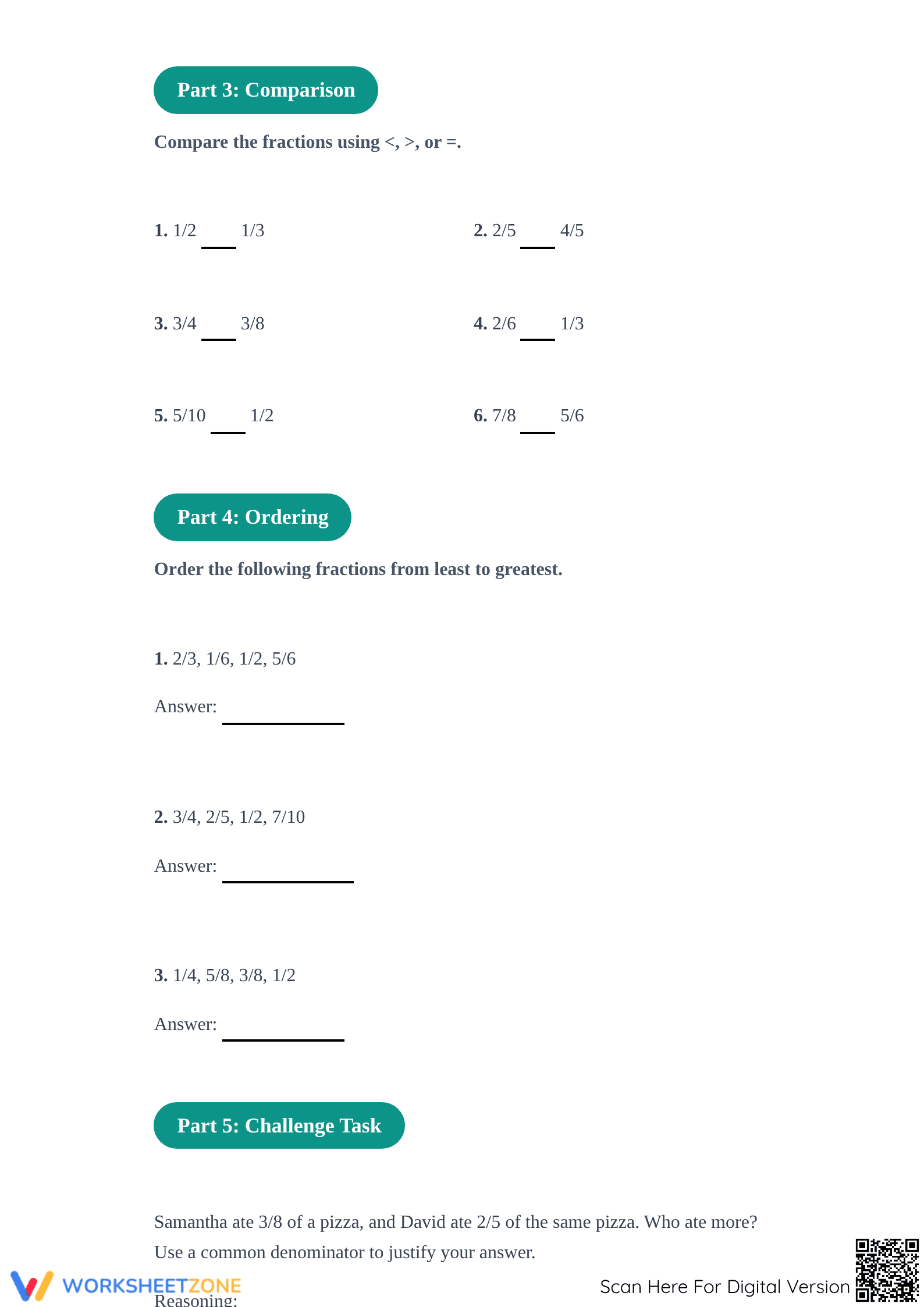
This comprehensive two-page PDF contains five distinct sections designed to build fractional fluency. Page one focuses on the spatial representation of fractions, including labeling specific points and identifying mystery variables on a pre-segmented number line. Page two advances the rigor with comparison drills, set-based ordering tasks, and a high-interest pizza-themed challenge problem requiring common denominator justification. A full answer key is provided for rapid grading.
Skill Progression
- Guided Practice: Students begin by placing 1/4, 1/2, and 3/4 on a number line, reinforcing the benchmark fraction 1/2 as a central anchor point for magnitude comparison.
- Supported Practice: Learners identify missing coordinates and solve six comparison problems using inequality symbols, utilizing the visual spacing provided on the previous page to verify results.
- Independent Practice: The final segments require ordering four-fraction sets and solving an multi-step word problem, moving students toward autonomous mastery without constant visual aids.
This "I Do, We Do, You Do" structure ensures students are never overwhelmed by the increasing complexity of the denominators as they move toward the challenge task.
Standards Alignment
The primary standard addressed is `CCSS.MATH.CONTENT.4.NF.A.2`, which requires students to compare two fractions with different numerators and different denominators. This worksheet extends that requirement by asking students to order multiple fractions and justify their reasoning through visual models. Both standard codes can be copied directly into lesson plans, IEP goals, or district curriculum mapping tools.
How to Use It
Assign this worksheet as a mid-unit formative assessment after students have been introduced to the concept of equivalent fractions. During the activity, walk around and observe if students are using the 1/2 benchmark correctly or if they are struggling to find common denominators for the ordering sets. Expect completion within 30 minutes, followed by a 5-minute peer review using the included answer key.
Who It's For
This resource is tailored for Grade 4 general education classrooms but serves as an excellent remedial tool for Grade 5 or 6 students who struggle with fraction magnitude. It pairs naturally with a fraction tiles manipulative set or a digital interactive whiteboard lesson on finding least common multiples and simplifying results.
Research from NAEP and RAND AIRS 2024 shows students using visual number lines for fraction comparison have a 40% higher retention of proportional reasoning skills over cross-multiplication algorithms. This worksheet aligns with the "Building Fractions through Visual Models" pedagogical shift identified in EdReports 2024, which emphasizes that spatial placement on a 0-1 scale is critical for preventing the "whole number bias" commonly seen in late elementary mathematics. By practicing CCSS.MATH.CONTENT.4.NF.A.2 through labeling, comparison, and ordering, students bridge the gap between abstract symbols and physical quantity. The inclusion of a pizza-themed challenge task further supports higher-order thinking as outlined in NAEP’s Mathematics Framework, ensuring that students can not only solve for a variable but also justify their mathematical reasoning in real-world contexts. This rigorous approach effectively prepares learners for the more advanced expressions and equations they will encounter in middle school.


