


























Views
Downloads

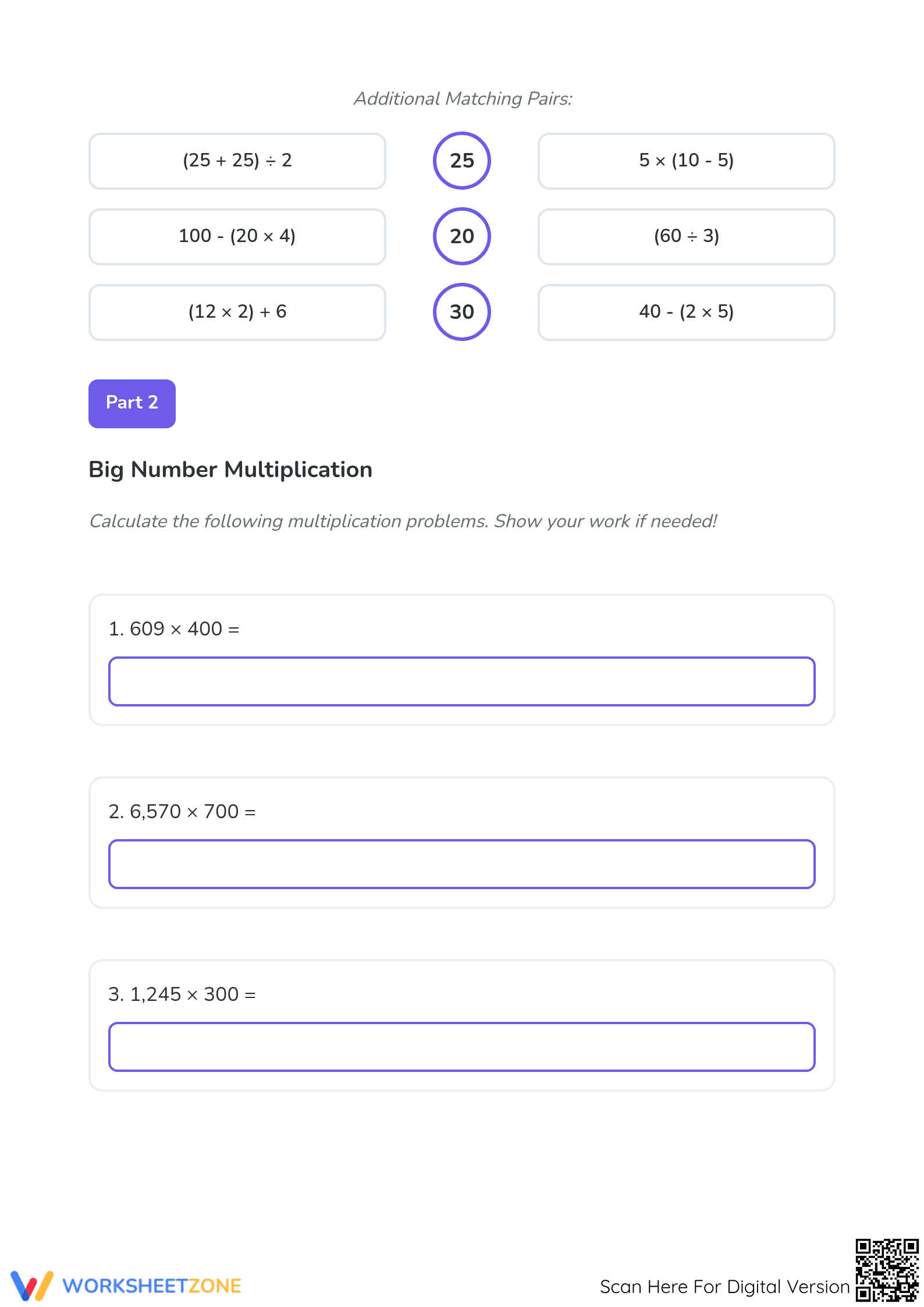
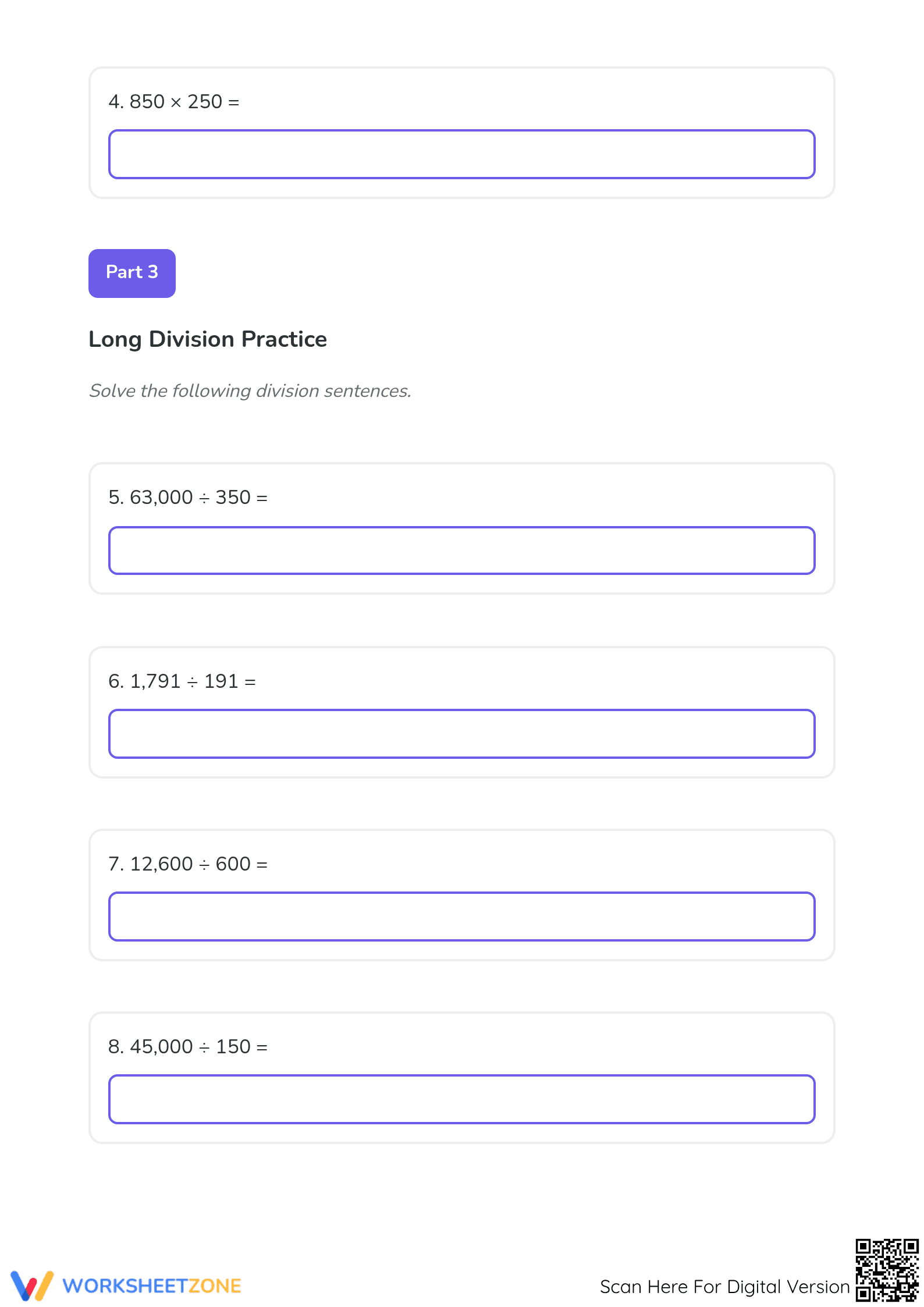



Essential Order of Operations Worksheet | Grade 4 Aligned
Paste this activity's link or code into your existing LMS (Google Classroom, Canvas, Teams, Schoology, Moodle, etc.).
Students can open and work on the activity right away, with no student login required.
You'll still be able to track student progress and results from your teacher account.
This essential Order of Operations worksheet helps fourth-grade students master the fundamental rules of mathematical precedence. By practicing with fifty structured expressions, learners develop the procedural fluency needed to evaluate multi-step problems accurately. This resource ensures students understand how to handle grouping symbols and operations in the correct sequence for mathematical success.
Quick Overview
At a Glance
- Grade: 4 · Subject: Math
- Standard:
CCSS.MATH.CONTENT.4.OA.A.3— Evaluate multi-step numerical expressions using the correct order of operations- Skill Focus: Order of Operations (PEMDAS/BODMAS)
- Format: 5 pages · 50 problems · Answer key included · PDF
- Best For: Daily math warm-ups and independent practice
- Time: 15–25 minutes
What's Inside
The packet contains five comprehensive pages with ten unique mathematical expressions per page. These tasks challenge students to apply the order of operations to find correct whole-number solutions. The uncluttered layout provides ample workspace for calculations. A full set of answer keys is included to facilitate rapid grading or self-correction, making it an ideal tool for any busy classroom.
Skill Progression
- Guided Practice: Initial tasks focus on grouping symbols, helping students build confidence with foundational PEMDAS rules.
- Supported Practice: Middle sections increase complexity with mixed operations, requiring students to apply precedence across varied problem types.
- Independent Practice: Final pages demand full mastery without scaffolding, preparing learners for advanced algebraic thinking.
This gradual-release structure moves students from teacher-supported evaluation to independent procedural mastery.
Standards Alignment
This resource is strictly aligned to `CCSS.MATH.CONTENT.4.OA.A.3`, which requires students to solve multistep problems posed with whole numbers using the four operations and assess the reasonableness of answers. Mastery of these precedence rules is a prerequisite for success in higher-level algebraic reasoning. Both standard codes can be copied directly into lesson plans, IEP goals, or district curriculum mapping tools.
How to Use It
Use this worksheet during independent practice after a direct instruction lesson on the order of operations. It serves as an excellent formative assessment tool; while students work, observe whether they are correctly prioritizing multiplication over addition or handling parentheses first. For a more interactive approach, assign one page as a timed "Math Sprint" to build computational speed and accuracy before a unit test.
Who It's For
This resource is designed for Grade 4 students, but it also serves as a robust review for Grade 5 learners or a scaffolded introduction for advanced third graders. It is particularly effective for students requiring repetitive practice to cement procedural memory. Pair this worksheet with a BODMAS anchor chart or a short video tutorial to reinforce the conceptual "why" behind operational precedence.
Research and Methodology
According to the RAND AIRS 2024 report on mathematics instruction, procedural fluency in the order of operations is a critical predictor of later success in middle school algebra and functions. This worksheet addresses that need by providing high-repetition practice aligned with the CCSS.MATH.CONTENT.4.OA.A.3 standard. Research from Fisher & Frey (2014) emphasizes that the gradual release of responsibility, as modeled in this resource's progression from simple to complex expressions, significantly improves student retention of mathematical rules. By evaluating fifty distinct expressions, learners move beyond rote memorization of acronyms like PEMDAS toward a deeper, operational understanding of numerical structure. This data-driven design ensures that students develop the necessary mental models to assess the reasonableness of their answers in multi-step scenarios. Educators can confidently integrate this worksheet into their curriculum, knowing it meets the rigorous demands of modern standards-based assessments and college-readiness benchmarks.


