


























Views
Downloads
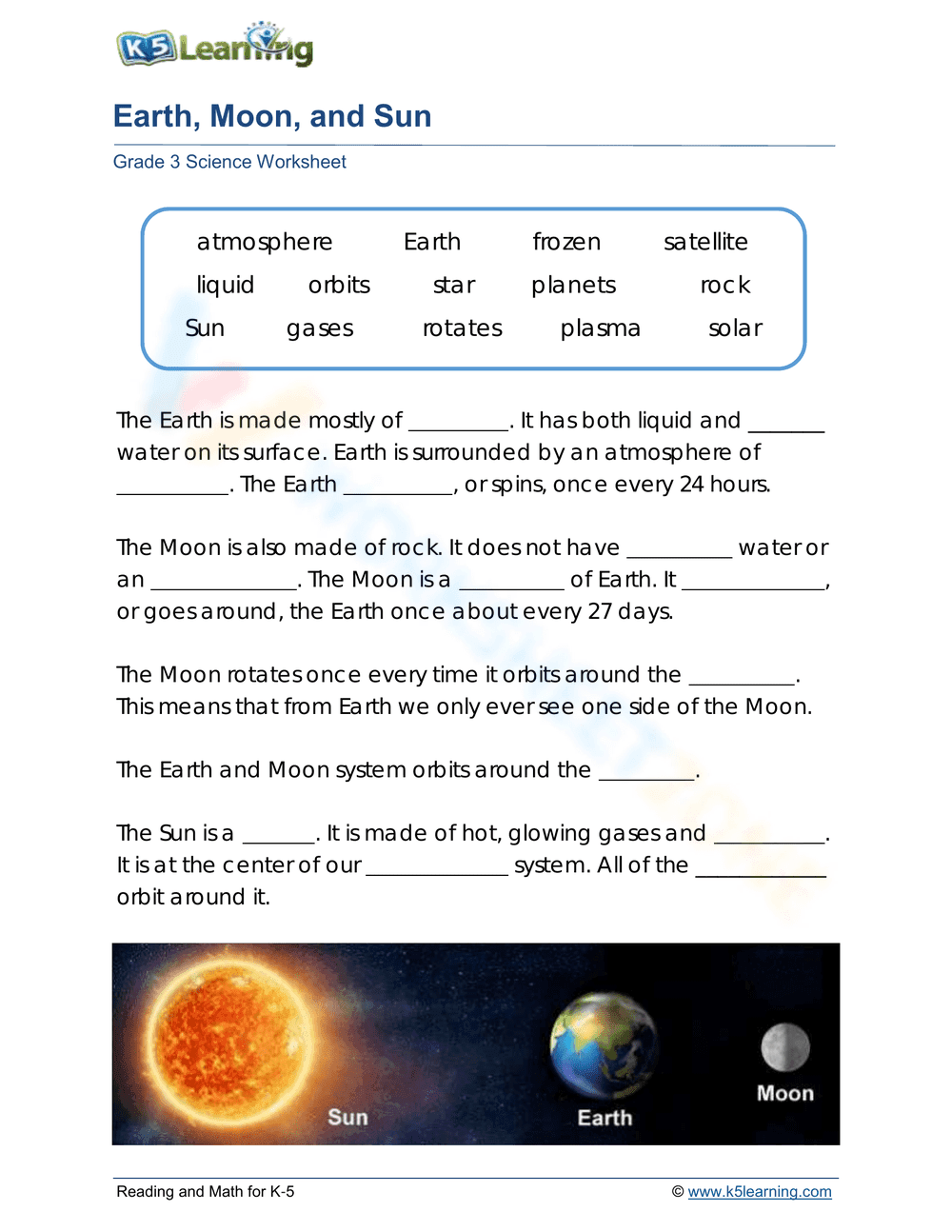


Printable Earth, Moon, and Sun Worksheet | Grade 3 Science
Paste this activity's link or code into your existing LMS (Google Classroom, Canvas, Teams, Schoology, Moodle, etc.).
Students can open and work on the activity right away, with no student login required.
You'll still be able to track student progress and results from your teacher account.
This Grade 3 Earth, Moon, and Sun science worksheet helps students master key astronomical concepts through a structured vocabulary and reading comprehension activity. Students identify the composition, motion, and relationships between our planet, its satellite, and our central star to build a foundational understanding of the solar system.
At a Glance
- Grade: 3 · Subject: Science
- Standard:
3-ESS1-1— Represent data to describe typical objects in the sky that can be observed and predicted- Skill Focus: Solar System Relationships
- Format: 2 pages · 15 problems · Answer key included · PDF
- Best For: Independent practice and vocabulary reinforcement
- Time: 15–20 minutes
What's Inside
This comprehensive resource features a two-page layout, including a student worksheet and a full answer key. The primary task is a fill-in-the-blank narrative supported by a 15-word bank, which covers critical terminology such as "atmosphere," "rotates," "satellite," and "plasma." A detailed diagram at the bottom of the page provides visual support, illustrating the relative positions of the Sun, Earth, and Moon.
Zero-Prep Workflow
This worksheet is designed for immediate classroom integration with minimal teacher overhead. Educators can print the single-page document in under 30 seconds and distribute it directly to students without additional setup. The included answer key allows for a rapid 2-minute review or can be provided to students for self-correction, making it an ideal choice for substitute lesson plans or morning work.
Standards Alignment
The primary focus is 3-ESS1-1, which requires students to represent data to describe typical objects in the sky. By identifying the specific traits of the Sun, Earth, and Moon—such as the Moon’s 27-day orbit and the Earth’s 24-hour rotation—students demonstrate mastery of observable celestial patterns. Both standard codes can be copied directly into lesson plans, IEP goals, or district curriculum mapping tools.
How to Use It
Deploy this worksheet during the "Explain" or "Elaborate" phase of a 5E science cycle. It serves as an excellent formative assessment tool; teachers should observe students to see if they can correctly distinguish between "rotation" and "orbit," which is a common point of confusion. Expect completion within 20 minutes, followed by a brief discussion about the diagram.
Who It's For
This resource is tailored for Grade 3 learners but works effectively as a review for Grade 4 or as a scaffolded activity for older students with IEPs. It pairs naturally with a classroom anchor chart detailing the phases of the moon or a short reading passage about the Sun’s composition to provide a multi-modal learning experience.
According to the NAEP framework for science literacy, understanding the Earth-Sun-Moon system is a critical milestone for elementary students to develop spatial reasoning and scientific vocabulary. Research from EdReports 2024 emphasizes that high-quality, focused practice materials that bridge the gap between abstract astronomical concepts and concrete terminology are essential for long-term retention in the physical sciences. This worksheet aligns with the ScienceDirect TpT Analysis findings that student engagement increases when scientific facts are presented in a narrative format with visual diagrams. By using standard 3-ESS1-1, this resource ensures that Grade 3 students are meeting national benchmarks for describing typical objects in the sky through observable data. The inclusion of a 15-word bank encourages academic language acquisition and provides necessary scaffolding for diverse learners to achieve mastery in solar system dynamics and planetary motion. This approach supports students in building the mental models required for complex science topics in middle school.


