


























Views
Downloads
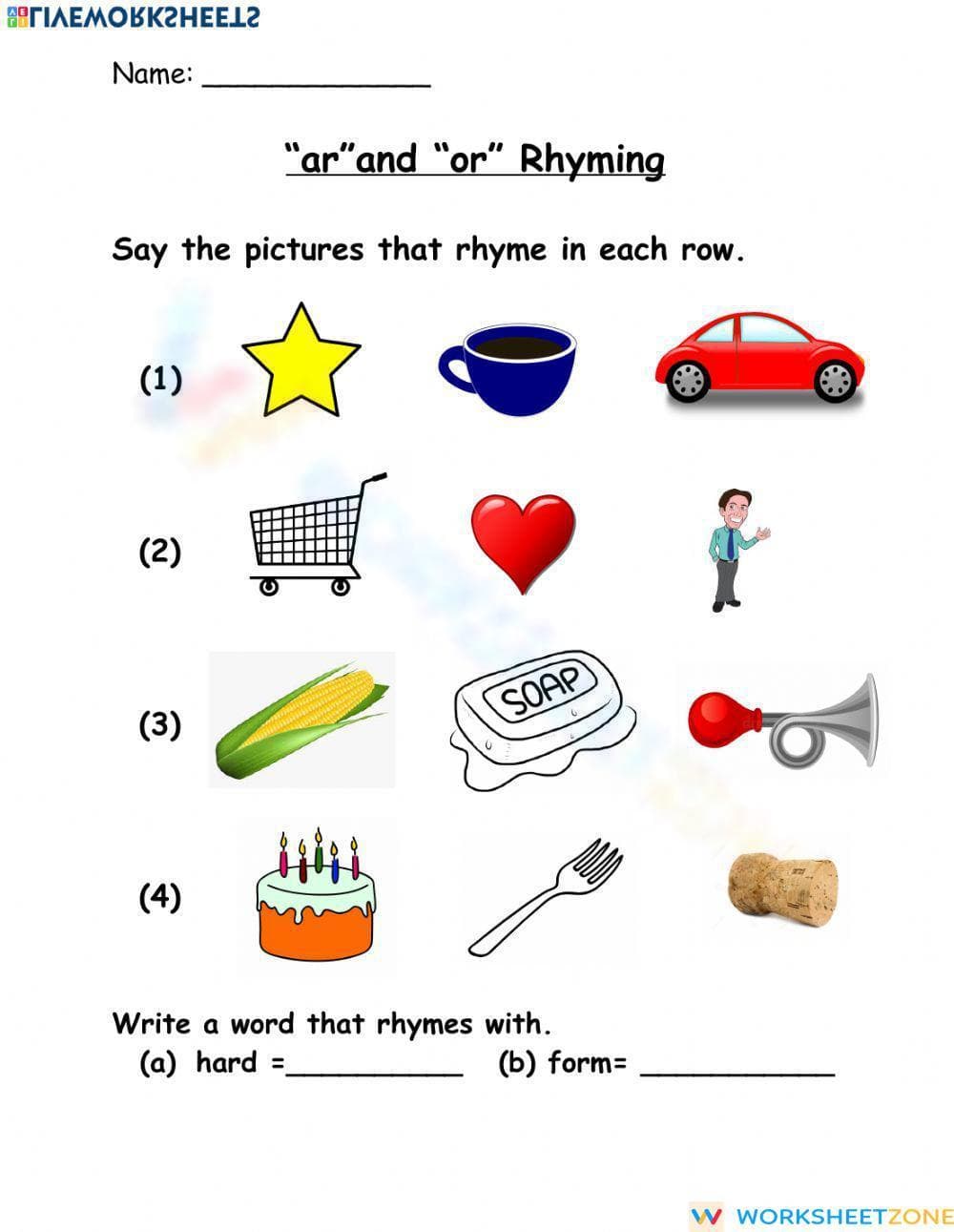

Essential ar and or Rhyming Worksheet | Grade 1 ELA
Paste this activity's link or code into your existing LMS (Google Classroom, Canvas, Teams, Schoology, Moodle, etc.).
Students can open and work on the activity right away, with no student login required.
You'll still be able to track student progress and results from your teacher account.
This Grade 1 phonics worksheet helps young learners master rhyming words containing "ar" and "or" r-controlled vowels. By identifying auditory patterns in common objects, students strengthen their phonological awareness and decoding abilities. This essential practice ensures that foundational reading skills are solidified before moving to complex multisyllabic words and varying vowel sounds.
At a Glance
- Grade: 1 · Subject: English Language Arts
- Standard:
CCSS.ELA-LITERACY.RF.K.2.A— Recognize and produce rhyming words through auditory identification and written production.- Skill Focus: R-controlled vowel rhyming ("ar" and "or")
- Format: 1 page · 6 problems · Answer key included · PDF
- Best For: Independent phonics practice and small groups
- Time: 10–15 minutes
The worksheet is organized into two distinct sections to evaluate different levels of mastery. The first portion consists of four pictorial rows where students must verbally identify which two images rhyme (e.g., star/car, corn/horn). The final section transitions to production, requiring students to generate their own rhyming words for "hard" and "form," ensuring a complete grasp of the "ar" and "or" sounds.
The zero-prep workflow allows for immediate classroom integration. Teachers can print the single-page PDF in under 30 seconds and distribute it to the entire class without any additional setup. The intuitive visual layout means students can begin the task in less than 1 minute. Reviewing the work takes approximately 2 minutes using the provided answer key, making it an ideal choice for emergency sub plans or morning work.
The primary focus is CCSS.ELA-LITERACY.RF.K.2.A, which emphasizes the ability to recognize and produce rhyming words. While designed for first grade, it supports CCSS.ELA-LITERACY.RF.1.3.E by reinforcing r-controlled vowel patterns. Both standard codes can be copied directly into lesson plans, IEP goals, or district curriculum mapping tools to maintain rigorous compliance with state and national frameworks.
Use this resource during the "independent practice" phase of a phonics lesson after introducing r-controlled vowels. It serves as an excellent formative assessment; observing if students can "say" the pictures correctly helps identify those who may need auditory processing support. The expected completion time is 10 to 15 minutes, allowing it to fit perfectly into a literacy center rotation.
This resource is tailored for Grade 1 students but remains highly effective for Kindergarteners ready for extension or Grade 2 students needing intervention. It pairs naturally with a short reading passage featuring "ar" and "or" words or an anchor chart displaying r-controlled vowel families. The visual prompts provide necessary support for English Language Learners and students with varied learning needs.
Phonological awareness is a critical predictor of later reading success, as highlighted by Fisher & Frey (2014) in their research on gradual release of responsibility. This worksheet aligns with CCSS.ELA-LITERACY.RF.K.2.A by requiring students to bridge the gap between auditory recognition and orthographic representation of "ar" and "or" sounds. The inclusion of pictorial cues supports dual-coding theory, allowing students to associate visual symbols with specific phonemes. Such structured practice is vital for developing the orthographic mapping required for fluent reading. By engaging in both the recognition of rhymes in sets like fork and cork and the production of new rhymes for words like hard, students build the cognitive pathways necessary for phonemic proficiency. This resource provides the repetition needed to move these skills from guided instruction to independent mastery, ensuring students are prepared for more advanced literacy tasks in subsequent grades.


