


























Views
Plays



Opportunity Cost & Comparative Advantage | Essential Grade 4
Paste this activity's link or code into your existing LMS (Google Classroom, Canvas, Teams, Schoology, Moodle, etc.).
Students can open and work on the activity right away, with no student login required.
You'll still be able to track student progress and results from your teacher account.
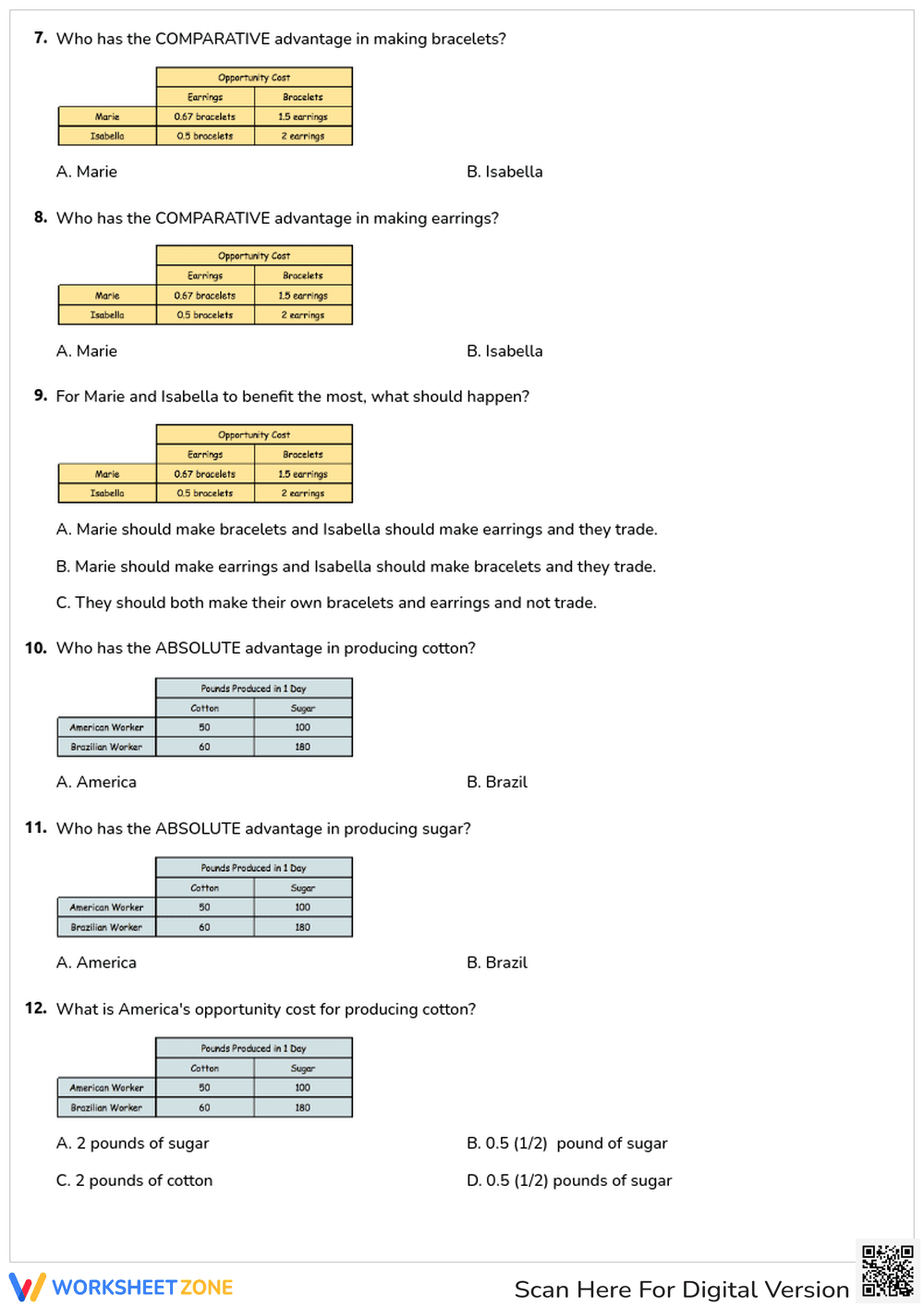
This Grade 4 Social Studies worksheet provides students with 22 structured problems to master the concepts of absolute and comparative advantage. By analyzing production tables, learners calculate opportunity costs and determine optimal trade scenarios. This resource ensures students can distinguish between producing more and producing more efficiently, a core requirement for elementary economic literacy.
At a Glance
- Grade: 4 · Subject: Economics
- Standard:
D2.Eco.14.3-5— Explain how trade leads to specialization and increased economic efficiency.- Skill Focus: Opportunity Cost Calculation
- Format: 4 pages · 22 problems · Answer key included · PDF
- Best For: Independent practice or assessment
- Time: 30–45 minutes
The packet contains four comprehensive pages featuring three distinct data scenarios. Students interact with production tables for individual artisans (Marie and Isabella), international trade data (America and Brazil), and a production possibilities table for manufactured goods (widgets and gizmos). Each of the 22 multiple-choice questions is designed to test a specific step in the economic decision-making process, from identifying raw output to calculating the ratio of goods sacrificed.
This resource is designed for immediate classroom implementation with a total teacher prep time of under 2 minutes. First, print the four-page PDF for your class (1 minute). Second, distribute the materials and provide a brief 30-second overview of the table headers (1 minute). Finally, use the included answer key to review student responses in real-time or as a summative grade. Its self-contained nature makes it an ideal choice for emergency sub plans or quiet independent work blocks.
The primary focus is D2.Eco.14.3-5, which requires students to explain how trade leads to specialization. By calculating opportunity costs, students provide the mathematical evidence required to justify specialization. Additionally, it supports D2.Eco.3.3-5 by illustrating how individuals and nations make choices when resources are limited. Both standard codes can be copied directly into lesson plans, IEP goals, or district curriculum mapping tools.
Use this worksheet as a formative assessment after a direct instruction lesson on trade and scarcity. It works best during the "You Do" phase of a gradual release model, allowing students to apply formulas to new data sets. For a collaborative twist, have students work in pairs to check each other's opportunity cost calculations before selecting their final answer. Expect completion within 35 minutes for most fourth-grade learners.
This resource is tailored for upper elementary students beginning their study of microeconomics. It is particularly effective for visual learners who benefit from seeing data organized in clear, color-coded tables. It pairs naturally with an anchor chart on the Law of Increasing Opportunity Cost or a short introductory video on global trade and resource allocation.
According to the RAND AIRS 2024 report on economic literacy, early exposure to quantitative decision-making models significantly improves a student's ability to grasp complex financial concepts in later secondary education. This worksheet aligns with those findings by requiring students to use the D2.Eco.14.3-5 standard to evaluate trade-offs through comparative advantage. By calculating the specific cost of moving from point A to point C on a production table, students move beyond abstract definitions into concrete mathematical application. Research from Fisher & Frey (2014) emphasizes that structured practice with data tables helps bridge the gap between literacy and numeracy in the Social Studies classroom. This 22-task resource provides the necessary repetition for students to internalize the logic of specialization, ensuring they can identify who should produce which good to maximize total utility. It serves as a rigorous tool for measuring student mastery of foundational economic principles.


