


























0
Views
0
Downloads

0.0
0
Save
0 Likes
Share
Onomatopoeia Chart: Exploring Sound Words in Language
0 Views
0 Downloads
Paste this activity's link or code into your existing LMS (Google Classroom, Canvas, Teams, Schoology, Moodle, etc.).
Students can open and work on the activity right away, with no student login required.
You'll still be able to track student progress and results from your teacher account.
Information
Description
What It Is:
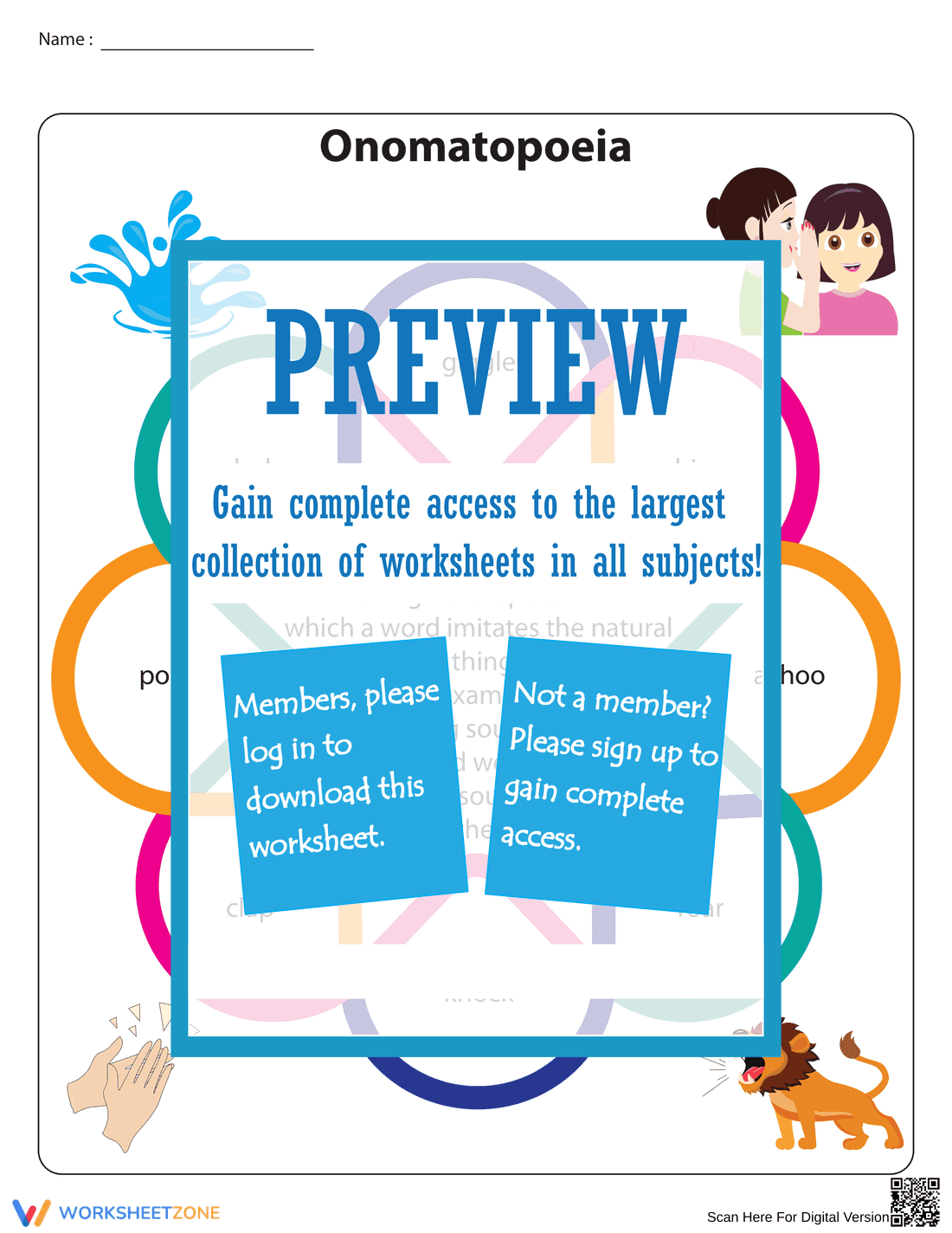
This is an educational worksheet focused on teaching onomatopoeia. It features a colorful graphic organizer in a flower shape, defining onomatopoeia as a figure of speech where words imitate sounds. Examples provided include 'buzz,' and the worksheet includes illustrations and words like 'splash,' 'giggle,' 'whisper,' 'achoo,' 'roar,' 'knock,' 'clap,' and 'pop' around the central definition. There is a space at the top for a student's name.
Grade Level Suitability:
This worksheet is suitable for grades 2-4. The concept of onomatopoeia is introduced in early elementary grades, and the visual format with simple words makes it accessible to this age group.
Why Use It:
This worksheet helps students understand and identify onomatopoeia. It provides a clear definition and several examples, enhancing vocabulary and reading comprehension skills. The visual layout makes learning engaging and memorable.
How to Use It:
Students can read the definition of onomatopoeia and then identify the words around the flower that are examples of onomatopoeia. Teachers can use it as an introduction to the topic or as a review activity. Students could also be asked to provide additional examples of onomatopoeia.
Target Users:
This worksheet is designed for elementary school students learning about figures of speech, specifically onomatopoeia. It's also helpful for ESL students learning English vocabulary related to sounds.
This is an educational worksheet focused on teaching onomatopoeia. It features a colorful graphic organizer in a flower shape, defining onomatopoeia as a figure of speech where words imitate sounds. Examples provided include 'buzz,' and the worksheet includes illustrations and words like 'splash,' 'giggle,' 'whisper,' 'achoo,' 'roar,' 'knock,' 'clap,' and 'pop' around the central definition. There is a space at the top for a student's name.
Grade Level Suitability:
This worksheet is suitable for grades 2-4. The concept of onomatopoeia is introduced in early elementary grades, and the visual format with simple words makes it accessible to this age group.
Why Use It:
This worksheet helps students understand and identify onomatopoeia. It provides a clear definition and several examples, enhancing vocabulary and reading comprehension skills. The visual layout makes learning engaging and memorable.
How to Use It:
Students can read the definition of onomatopoeia and then identify the words around the flower that are examples of onomatopoeia. Teachers can use it as an introduction to the topic or as a review activity. Students could also be asked to provide additional examples of onomatopoeia.
Target Users:
This worksheet is designed for elementary school students learning about figures of speech, specifically onomatopoeia. It's also helpful for ESL students learning English vocabulary related to sounds.


