


























Views
Downloads
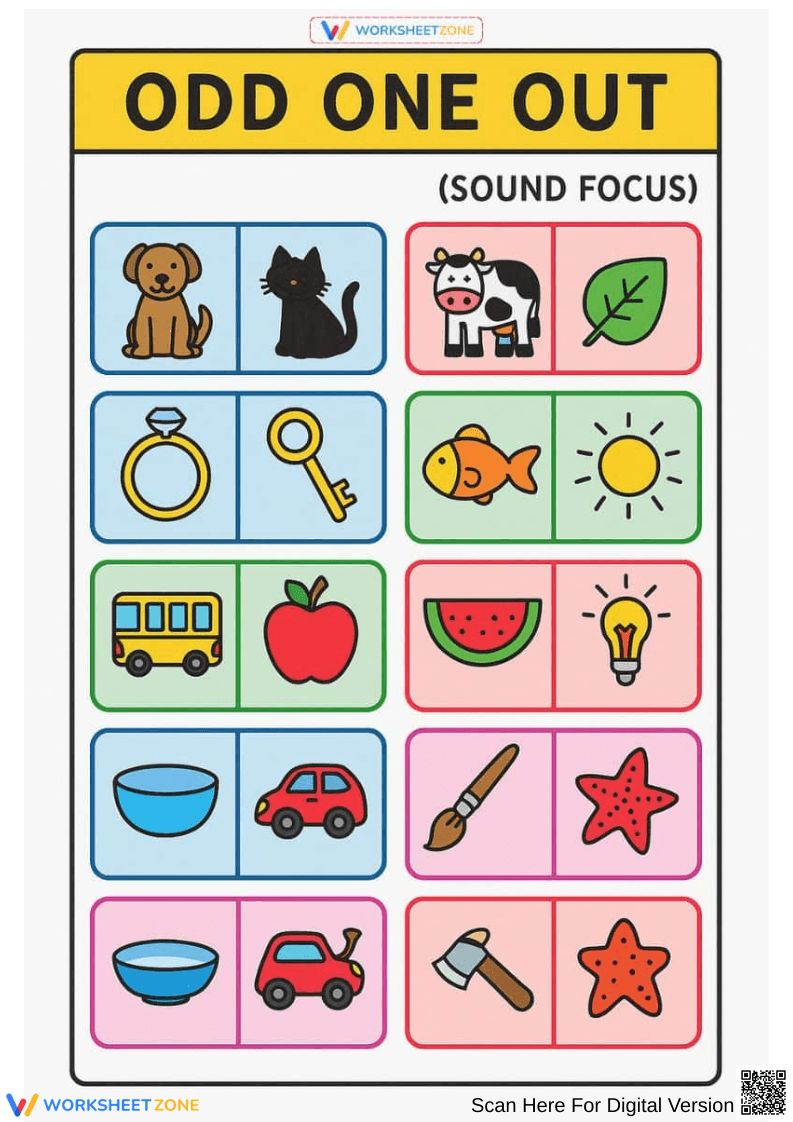

Grade K Phonics — Printable No-Prep Worksheet
Paste this activity's link or code into your existing LMS (Google Classroom, Canvas, Teams, Schoology, Moodle, etc.).
Students can open and work on the activity right away, with no student login required.
You'll still be able to track student progress and results from your teacher account.
This printable phonological awareness worksheet helps early readers isolate and identify beginning sounds and rhymes. Students analyze pairs of familiar images to determine which word does not belong based on its phonetic properties. This targeted practice builds essential decoding skills and strengthens foundational reading readiness for kindergarten and first-grade learners.
At a Glance
- Grade: K · Subject: ELA
- Standard:
CCSS.ELA-LITERACY.RF.K.2— Identify and manipulate sounds in spoken words- Skill Focus: Phonological Awareness
- Format: 1 page · 10 problems · No answer key · PDF
- Best For: Independent practice and centers
- Time: 10–15 minutes
This single-page resource features ten highly visual problem sets arranged in a clear, domino-style layout. Each section presents recognizable everyday objects—such as animals, vehicles, and household items—allowing pre-readers to focus entirely on auditory processing rather than text decoding. The clean design minimizes visual clutter, ensuring students can independently navigate the odd-one-out sound identification tasks without extensive teacher guidance.
Deploying this activity requires virtually zero teacher preparation, making it an ideal classroom-ready solution.
- Print (30 seconds): Generate the single-page PDF directly from your device. The high-contrast line art prints clearly in grayscale.
- Distribute (1 minute): Hand out the sheets alongside crayons or markers for students to circle their answers.
- Review (3 minutes): Quickly scan completed pages to check for phonetic mastery.
With a total prep time of under two minutes, this worksheet serves as an excellent emergency sub-plan or a rapid transition activity between literacy blocks.
This activity is directly aligned to CCSS.ELA-LITERACY.RF.K.2: Demonstrate understanding of spoken words, syllables, and sounds (phonemes). It also supports CCSS.ELA-LITERACY.RF.1.2 by reinforcing the ability to distinguish contrasting sounds in spoken words. Both standard codes can be copied directly into lesson plans, IEP goals, or district curriculum mapping tools.
Integrate this worksheet during small-group literacy centers or as a warm-up before direct phonics instruction. For a formative assessment observation tip, ask students to verbally name each picture out loud before circling their answer; this ensures they are identifying the correct vocabulary word and accurately producing the initial phoneme. Expected completion time ranges from 10 to 15 minutes, depending on the student's familiarity with the vocabulary.
This resource is designed for kindergarten and early first-grade students developing foundational phonemic awareness. It is particularly effective for visual learners and English Language Learners (ELLs) who benefit from clear picture cues when practicing English speech sounds. Pair this worksheet with a whole-class read-aloud or a rhyming anchor chart to reinforce the auditory concepts before independent practice.
Mastering phonological awareness through targeted visual-auditory tasks is a critical predictor of future reading success. According to the RAND AIRS 2024 report, early interventions that explicitly connect spoken sounds to visual representations significantly reduce later decoding difficulties in primary grades. This worksheet directly supports CCSS.ELA-LITERACY.RF.K.2 by requiring students to identify and manipulate sounds in spoken words without the cognitive load of letter recognition. When young learners practice isolating initial phonemes and recognizing rhyming patterns using familiar images, they build the essential neural pathways necessary for fluent reading. Regular, structured practice with odd-one-out sound games ensures that students can distinguish subtle phonetic differences, a foundational skill for advanced phonics and spelling acquisition. Educators utilizing this evidence-based approach can effectively bridge the gap between oral language development and written text comprehension, ensuring all students reach literacy benchmarks.


