




























Views
Downloads

Word Families Worksheet | Essential Grade 1 ELA Practice

Paste this activity's link or code into your existing LMS (Google Classroom, Canvas, Teams, Schoology, Moodle, etc.).
Students can open and work on the activity right away, with no student login required.
You'll still be able to track student progress and results from your teacher account.
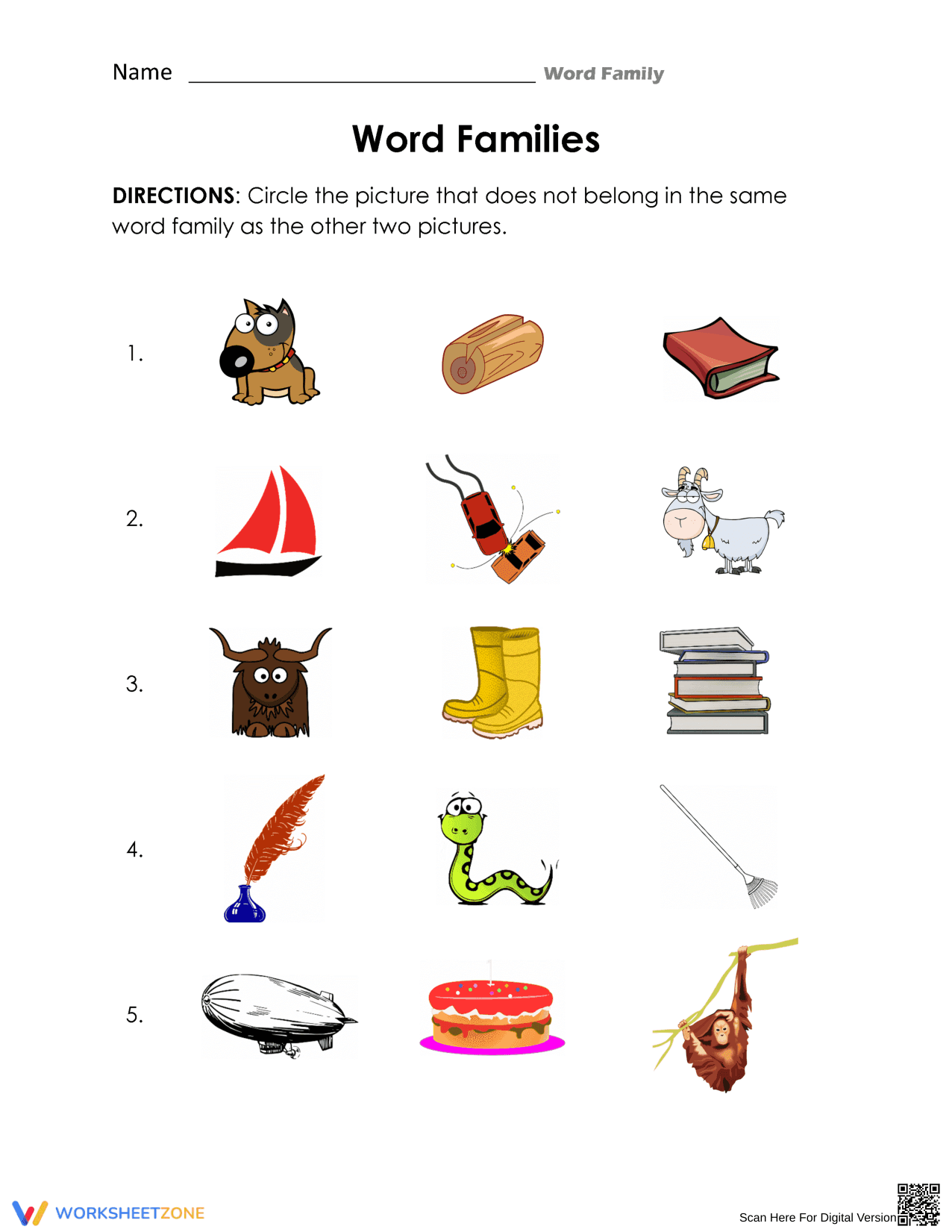
This Grade 1 Word Families worksheet provides a streamlined approach to phonics mastery by challenging students to identify patterns in rhyming words. By isolating the "odd man out" among groups of three images, learners sharpen their phonological awareness and decoding skills. This essential exercise ensures students can distinguish between common word endings and vowel sounds effectively.
At a Glance
- Grade: 1 · Subject: English Language Arts
- Standard:
CCSS.ELA-LITERACY.RF.1.3— Decode phonetically regular one-syllable words and recognize common spelling patterns- Skill Focus: Word Family Recognition
- Format: 1 page · 5 problems · Answer key included · PDF
- Best For: Phonics centers and morning work
- Time: 5–10 minutes
The worksheet features five distinct task rows designed to build confidence in auditory and visual discrimination. Each row presents three high-quality illustrations, such as a dog, a log, and a book. Students are tasked with circling the single image that does not share the same word family ending, providing a clear visual representation of phonics concepts in a single-page format.
Skill Progression
- Guided Practice: The activity begins with highly recognizable CVC words like "dog" and "log" to establish the pattern-matching concept with 1 row of teacher-led modeling.
- Supported Practice: Two middle rows introduce slightly more complex rhymes, requiring closer attention to vowel sounds and ending consonants with minimal scaffolding.
- Independent Practice: The final rows ask students to apply their knowledge to identify outliers without teacher prompts, ensuring mastery of the 5 targeted word families.
This gradual release model reinforces the "I Do, We Do, You Do" instructional strategy for phonics development.
Standards Alignment
This resource is directly aligned to CCSS.ELA-LITERACY.RF.1.3, which requires students to know and apply grade-level phonics and word analysis skills in decoding words. Supporting standard CCSS.ELA-LITERACY.RF.1.2 is also addressed through rhyming tasks. Both standard codes can be copied directly into lesson plans, IEP goals, or district curriculum mapping tools.
How to Use It
Use this worksheet as a quick formative assessment after a direct instruction lesson on short vowel families. As students work, observe if they are subvocalizing the names of the pictures, which indicates active phonological processing. It serves as an excellent morning work activity or a quiet exit ticket to gauge class-wide mastery of specific rhyme patterns before moving to blended sounds.
Who It's For
This activity is ideal for Grade 1 students, Grade 2 learners needing remedial support, and English Language Learners (ELLs) developing basic vocabulary. Pair this worksheet with a rhyming anchor chart or a short decodable passage to provide a comprehensive literacy experience that bridges the gap between isolated phonics practice and fluent reading.
Early literacy research emphasizes the critical role of phonological awareness in long-term reading success. According to the RAND AIRS 2024 report on foundational literacy, students who master word family recognition and rhyming patterns in the first grade demonstrate significantly higher decoding accuracy in subsequent years. This worksheet applies these findings by utilizing "odd man out" tasks, a proven method for sharpening auditory discrimination and visual pattern recognition. By requiring students to compare and contrast phonemes within a controlled set of three items, the activity reduces cognitive load while maximizing focus on the targeted standard, CCSS.ELA-LITERACY.RF.1.3. This approach aligns with evidence-based practices that prioritize explicit, systematic phonics instruction as a precursor to reading fluency. Educators can reliably use this tool to provide the structured repetitions necessary for students to internalize common English spelling-sound correspondences and build the phonemic foundation required for advanced literacy tasks.


