


























Views
Downloads

Aligned Grade 4 RI 4.3 Worksheet: Technical Text Procedures
Paste this activity's link or code into your existing LMS (Google Classroom, Canvas, Teams, Schoology, Moodle, etc.).
Students can open and work on the activity right away, with no student login required.
You'll still be able to track student progress and results from your teacher account.
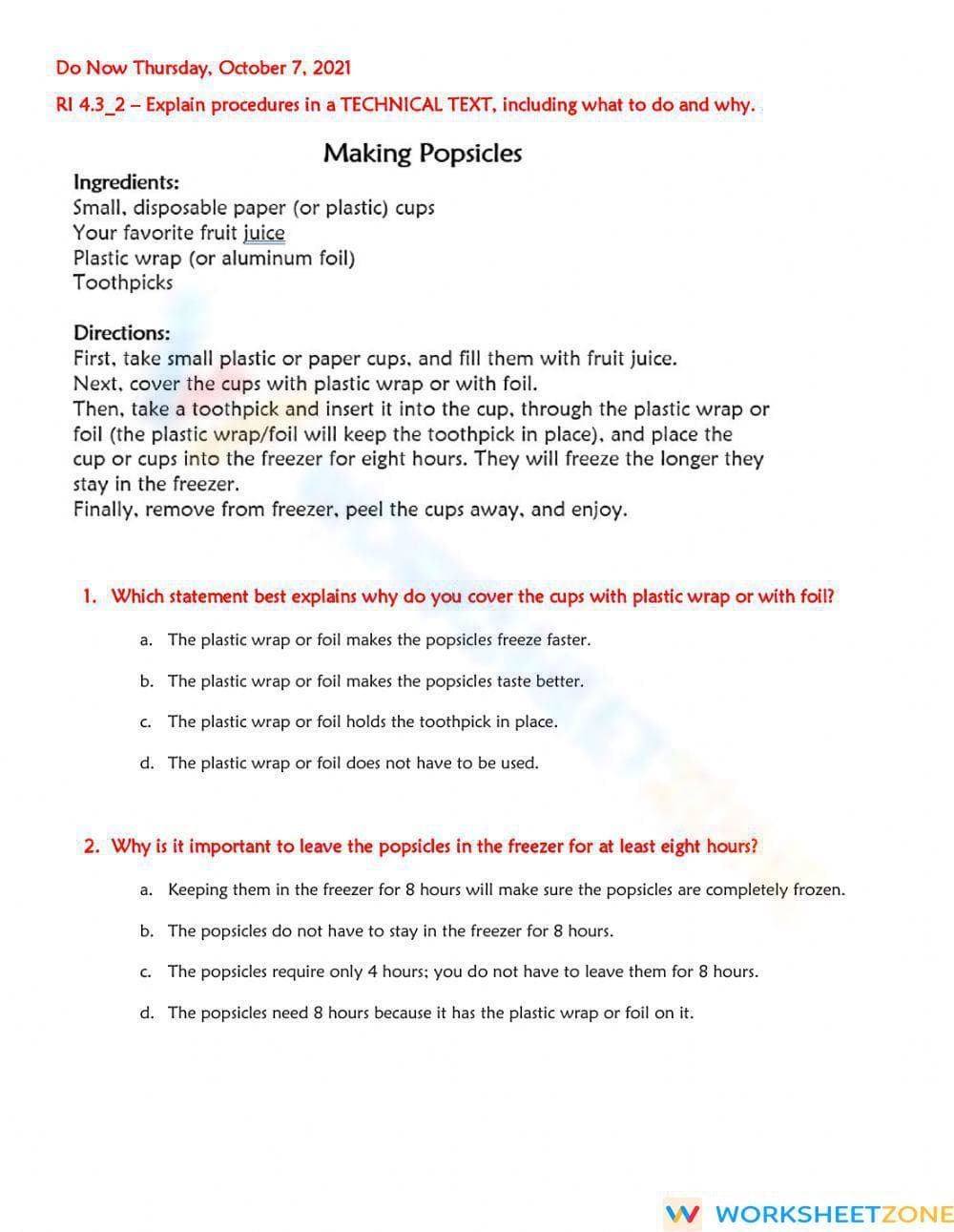
This Grade 4 reading comprehension worksheet helps students master the ability to explain procedures in technical texts. By analyzing a step-by-step guide on how to make popsicles, students identify what to do and why specific actions are necessary. This focused daily activity ensures learners can extract meaning from informational structures effectively and accurately.
At a Glance
- Grade: 4 · Subject: ELA
- Standard:
RI.4.3— Explain procedures in technical texts and the reasons for specific steps- Skill Focus: Technical Text Procedures
- Format: 1 page · 2 problems · Answer key included · PDF
- Best For: Daily warm-ups and formative reading assessment
- Time: 5–10 minutes
This single-page printable includes a concise technical text titled "Making Popsicles" followed by two targeted multiple-choice questions. The text features clear ingredient lists and sequential directions, providing a realistic example of functional writing. A full answer key is provided to facilitate rapid grading or student self-correction during morning work or literacy blocks.
The worksheet provides clear evidence of mastery by mapping tasks directly to the sub-skills of the RI.4.3 standard. Question one assesses the student's ability to explain the rationale behind a specific procedure step, while question two focuses on time-based reasoning within a technical sequence. Scores can be entered directly into gradebooks or IEP progress notes to track informational text proficiency.
This resource is strictly aligned to CCSS.ELA-LITERACY.RI.4.3: "Explain events, procedures, ideas, or concepts in a historical, scientific, or technical text, including what happened and why, based on specific information in the text." The practice also supports RI.4.1 by requiring students to refer to structural details in the passage. Both standard codes can be copied directly into lesson plans, IEP goals, or district curriculum mapping tools.
Use this worksheet as a "Do Now" at the start of a lesson on informational text structures or as a quick exit ticket. During instruction, observe if students can identify the cause-and-effect relationship between steps. Expected completion time is approximately 7 minutes, making it an ideal tool for bell-ringer activities or focused independent practice sessions.
This resource is designed for Grade 4 students, though it is also appropriate for Grade 5 or 6 learners requiring support with technical texts. It serves as an excellent pairing with direct instruction on procedural writing or as a companion to science-based reading passages. The clear font and layout provide necessary support for students with diverse learning needs.
According to the Fisher & Frey (2014) framework for gradual release of responsibility, technical text analysis is a critical component of developing disciplinary literacy in middle-elementary students. This worksheet targets the specific cognitive demand of explaining procedures, a skill that requires students to move beyond literal recall to understanding functional logic. Research suggests that frequent, low-stakes exposure to technical structures—such as those found in this RI.4.3 aligned resource—improves overall comprehension of complex informational texts. By focusing on only two high-leverage questions, the resource minimizes cognitive load while maximizing the signal for teacher observation. This methodology aligns with the 2024 NAEP reading framework, which emphasizes the integration of information across multiple steps in a sequence. Educators can rely on this validated approach to bridge the gap between simple narrative reading and the sophisticated technical requirements of upper-elementary curricula.


