


























Views
Downloads

RI 4.3 Worksheet: Cause and Effect — Grade 4 Aligned
Paste this activity's link or code into your existing LMS (Google Classroom, Canvas, Teams, Schoology, Moodle, etc.).
Students can open and work on the activity right away, with no student login required.
You'll still be able to track student progress and results from your teacher account.
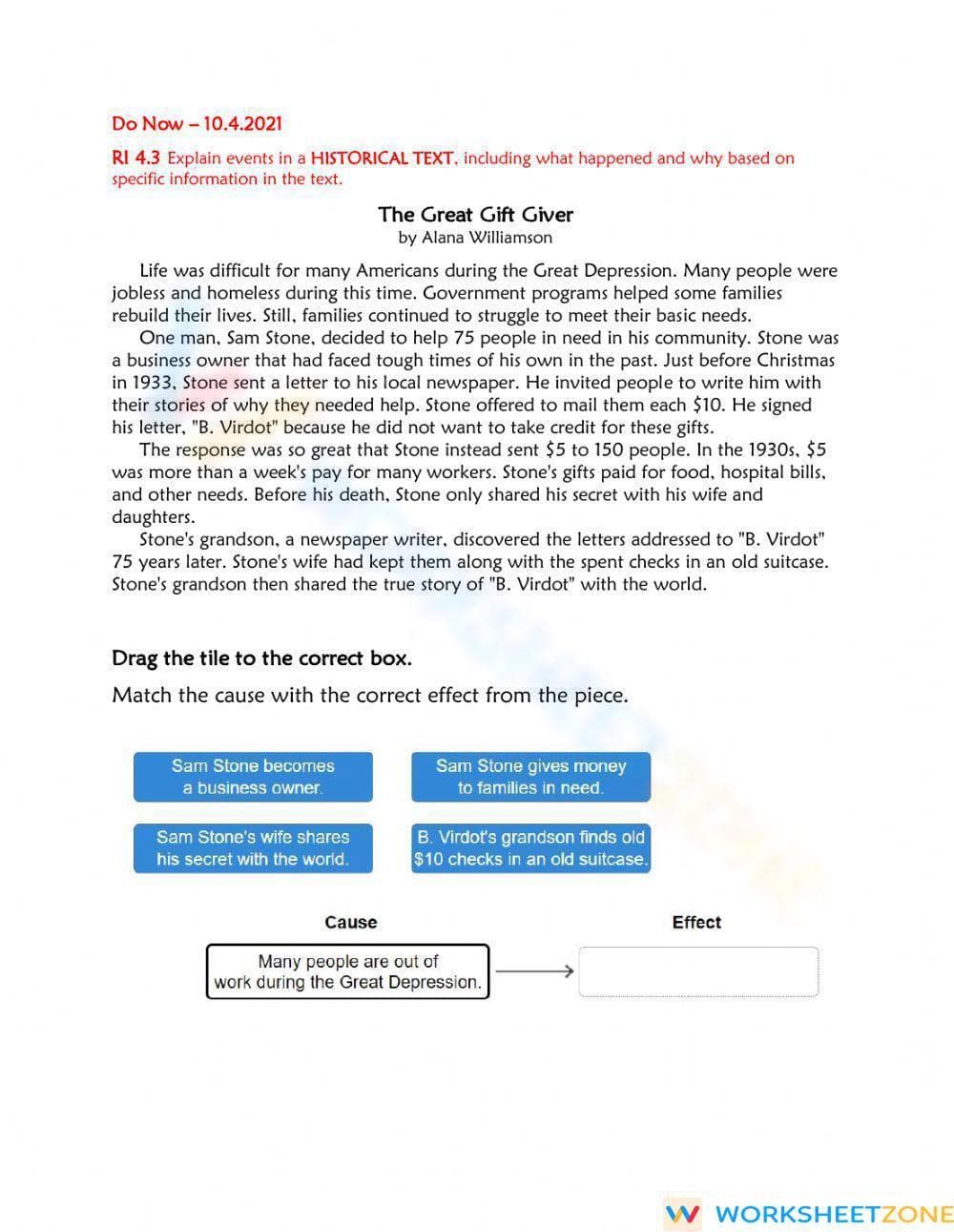
This RI 4.3 standards-aligned worksheet provides students with a targeted historical reading comprehension exercise focused on the Great Depression. By analyzing the narrative of "The Great Gift Giver," learners identify critical cause-and-effect relationships within a real-world context. This printable resource ensures students can explain what happened and why using specific textual evidence.
At a Glance
- Grade: 4 · Subject: English Language Arts
- Standard:
RI 4.3— Explain historical events, including what happened and why based on specific text details- Skill Focus: Historical Cause and Effect
- Format: 1 page · 1 interactive task · Answer key included · PDF
- Best For: Daily Do-Now or formative assessment practice
- Time: 10–15 minutes
This single-page ELA resource features an engaging informational text titled "The Great Gift Giver," which details the compassionate actions of Sam Stone during the 1930s. Structurally, the worksheet includes a focused reading passage followed by an interactive "drag and match" cause-and-effect task. Students are prompted to match specific historical causes, such as the economic hardship of the Great Depression, with their corresponding effects described in the narrative.
The worksheet provides clear mastery evidence for identifying relationships in historical texts. Each matching task maps directly to the sub-skills of CCSS RI 4.3, specifically the ability to link motivations to actions and circumstances to outcomes. Teachers can utilize the provided answer key to categorize student performance into tiers: Approaching (identifies event), Meeting (links cause/effect), or Exceeding (explains the "why" with textual nuance). Data can be entered into progress notes for IEP or general education reporting.
The primary focus is RI 4.3: "Explain events, procedures, ideas, or concepts in a historical, scientific, or technical text, including what happened and why, based on specific information in the text." Supporting standards include RI 4.1 for citing textual evidence. Both standard codes can be copied directly into lesson plans, IEP goals, or district curriculum mapping tools to ensure instructional consistency.
Implement this resource as a "Do Now" to start an ELA block or as a mid-lesson formative assessment after direct instruction on cause-and-effect relationships. Observe if students refer back to the text to verify their matches; this indicates successful evidence-based reasoning. Completion typically takes 12 minutes.
This worksheet is designed for Grade 4 students but serves as an excellent review for Grade 5 or a challenge for Grade 3. It is particularly effective for learners who benefit from scaffolded interactive tasks rather than open-ended response prompts. Pair this resource with a Great Depression anchor chart or a short video clip about 1930s economic history to provide additional context.
Academic analysis of CCSS.ELA-LITERACY.RI.4.3 highlights the necessity of shifting from simple recall to relational thinking. According to EdReports 2024, instructional materials that integrate historical narratives with specific cause-and-effect tasks significantly improve a student's ability to synthesize complex informational texts. This worksheet targets the plain-English skill of explaining why historical events occurred by requiring learners to map specific textual evidence to logical outcomes. Research from Fisher & Frey (2014) emphasizes that targeted practice like this Do Now helps cement the interactive nature of reading comprehension. By focusing on a single, impactful historical event—the generosity of Sam Stone—students build the cognitive muscles required for advanced historical analysis. This resource provides a reliable bridge between basic decoding and the sophisticated interpretive demands of upper-elementary ELA standards, ensuring students are ready for rigorous state assessments.


