




























Views
Downloads

Essential Grade 2 Observable Properties Science Worksheet

Paste this activity's link or code into your existing LMS (Google Classroom, Canvas, Teams, Schoology, Moodle, etc.).
Students can open and work on the activity right away, with no student login required.
You'll still be able to track student progress and results from your teacher account.
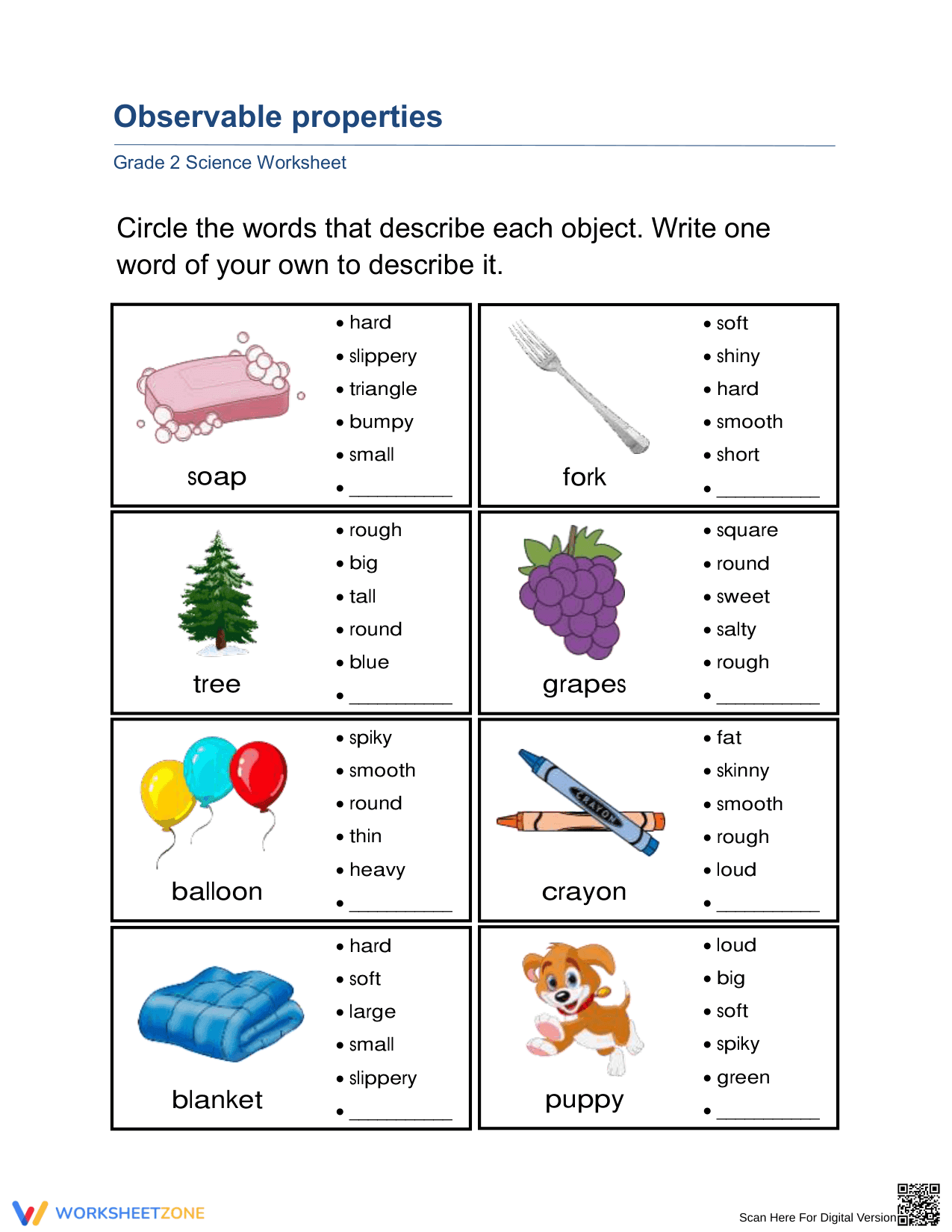
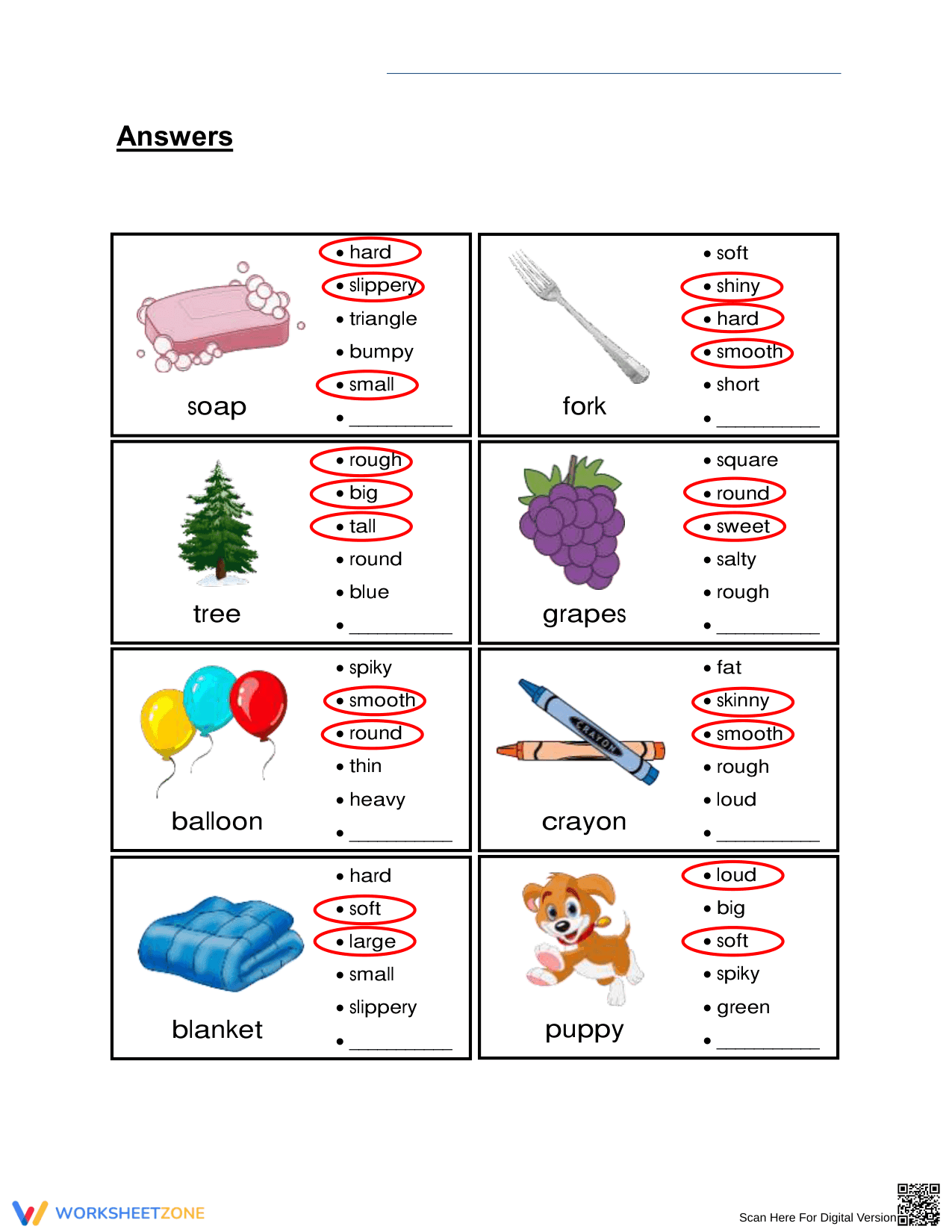
This Grade 2 observable properties science worksheet helps students identify and describe the physical characteristics of everyday objects. Students build scientific vocabulary by selecting appropriate descriptors and generating their own observations. This essential practice prepares learners for the classification and study of material properties in later units. Answer key is included for quick review.
At a Glance
- Grade: 2 · Subject: Science
- Standard:
2-PS1-1— Describe and classify kinds of materials by their observable properties- Skill Focus: Describing physical properties of matter
- Format: 1 page · 8 tasks · Answer key included · PDF
- Best For: Independent practice or formative science assessment
- Time: 15–20 minutes
What's Inside
Inside this resource is a focused one-page activity featuring eight distinct objects like soap and grapes. Each item is paired with potential descriptors such as "hard" or "bumpy." Students circle the correct words and provide one original descriptor. A comprehensive answer key is included to facilitate rapid grading and immediate feedback.
Zero-Prep Workflow
The zero-prep workflow ensures this worksheet is ready for immediate use. Step 1: Print the single-page PDF (30 seconds). Step 2: Distribute the sheets for independent practice during your science block (1 minute). Step 3: Review results as a group or check individually using the provided key (3 minutes). Total teacher preparation time is under two minutes, making it an ideal choice for sub plans.
Standards Alignment
This resource is aligned with `2-PS1-1`, which requires students to "plan and conduct an investigation to describe and classify different kinds of materials by their observable properties." It specifically addresses the "describing" component of the standard. This standard code can be copied directly into lesson plans, IEP goals, or district curriculum mapping tools to document mastery of physical science concepts.
How to Use It
Use this worksheet as a follow-up to a hands-on investigation where students touch and feel various classroom items. It serves as a bridge between concrete experiences and abstract vocabulary development. During the activity, observe if students can distinguish between conflicting textures like "rough" and "smooth" to identify areas needing reinforcement. Completion typically takes 15 to 20 minutes depending on writing speed.
Who It's For
This worksheet is designed for second-grade students but can be adapted for first-grade enrichment or third-grade review. It is particularly effective for English Language Learners who are developing academic vocabulary related to physical descriptions. Pair this resource with a physical "mystery bag" activity where students must guess objects based on the descriptive clues practiced on the page.
According to research from Fisher & Frey (2014), the use of descriptive vocabulary in primary science is a critical precursor to complex scientific reasoning. This Grade 2 worksheet aligns with 2-PS1-1 by providing structured opportunities for students to describe and classify materials by their observable properties. By engaging with eight distinct object sets, learners move from simple identification to active observation, a core competency in the Next Generation Science Standards (NGSS). The dual-mode response—circling provided words and generating original descriptors—supports cognitive flexibility and vocabulary acquisition. This systematic approach ensures that students develop the linguistic precision necessary for advanced material analysis in upper elementary grades. Educational analysts from RAND AIRS 2024 emphasize that such targeted practice reduces cognitive load during initial science investigations, allowing students to focus on the nuances of material characteristics rather than struggling with basic word retrieval. This worksheet provides a scalable, research-backed solution for early physical science instruction.


