




























Views
Downloads


Essential Base Ten Mastery: Addition & Subtraction Math

Paste this activity's link or code into your existing LMS (Google Classroom, Canvas, Teams, Schoology, Moodle, etc.).
Students can open and work on the activity right away, with no student login required.
You'll still be able to track student progress and results from your teacher account.
This essential math resource provides a structured approach to mastering addition and subtraction using base ten blocks. Students engage with complex word problems by visualizing numbers through rods and units, ensuring they develop a solid foundation in place value while solving multi-step scenarios and checking vocabulary.
At a Glance
- Grade: 2–5 · Subject: Math and Addition
- Standard:
CCSS.MATH.CONTENT.2.NBT.B.7— Add and subtract within 1000 using drawings and concrete models- Skill Focus: Base Ten Word Problems
- Format: 4 pages · 8 tasks · Answer key included · PDF
- Best For: Place value mastery and word problems
- Time: 25–40 minutes
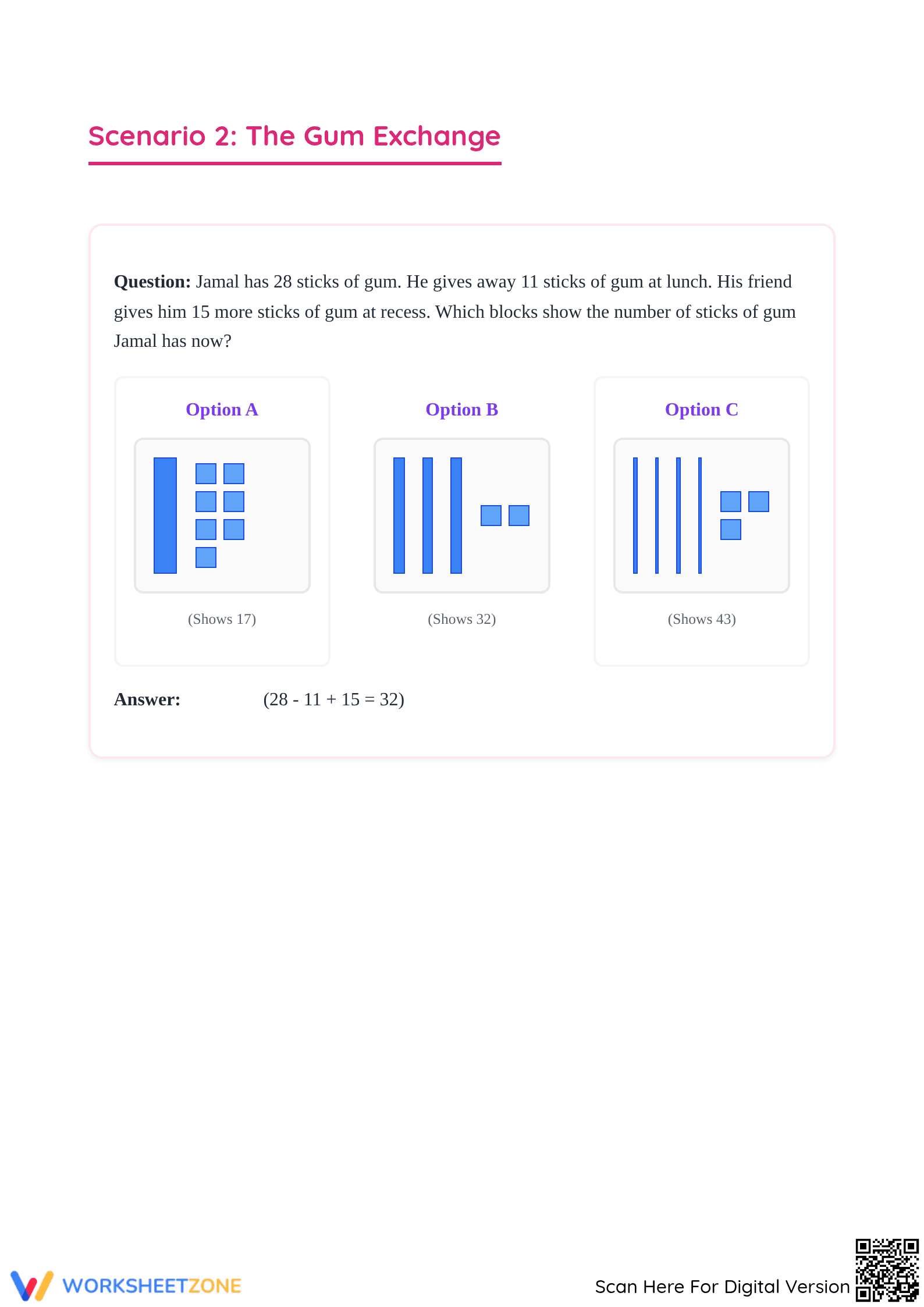
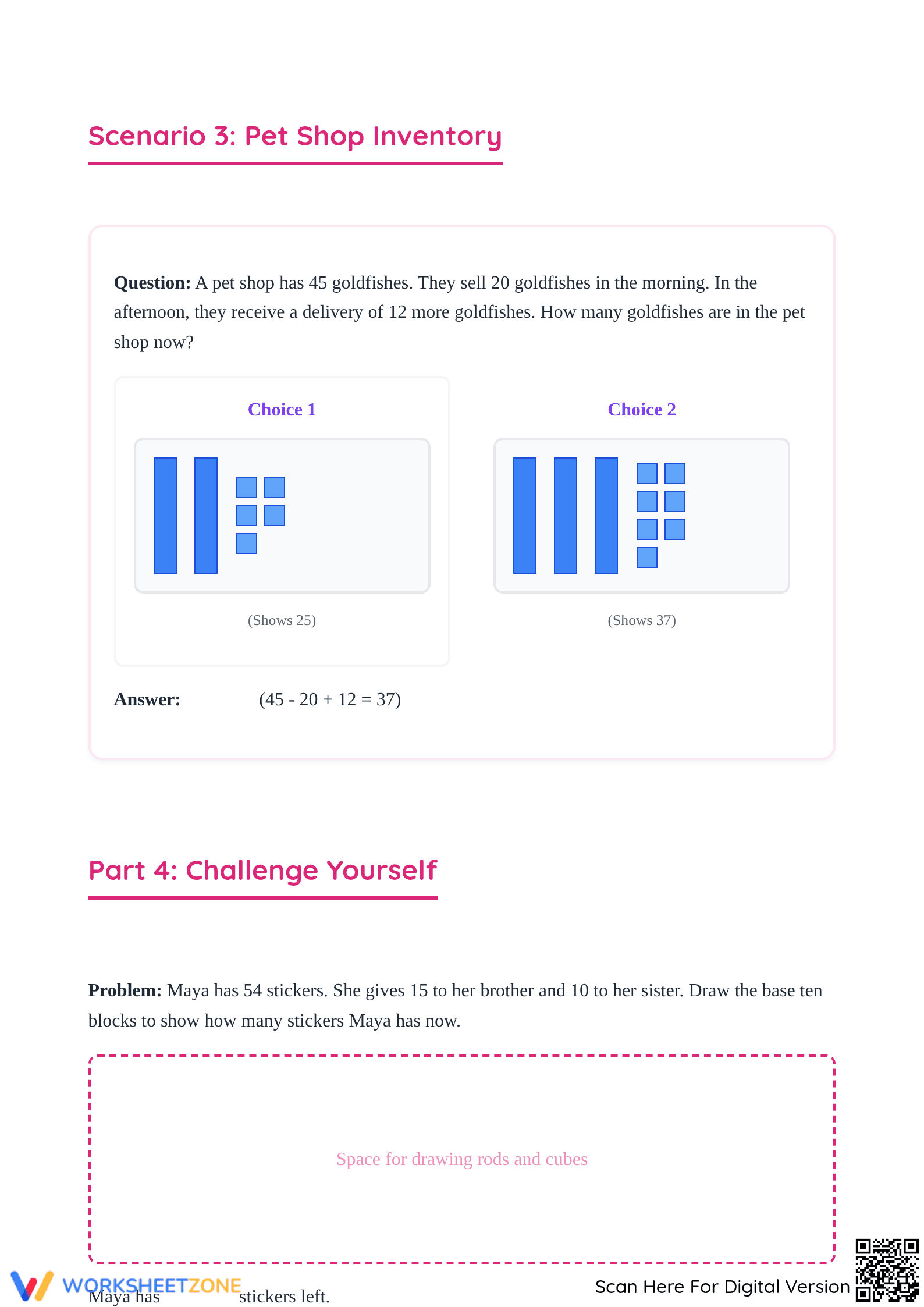
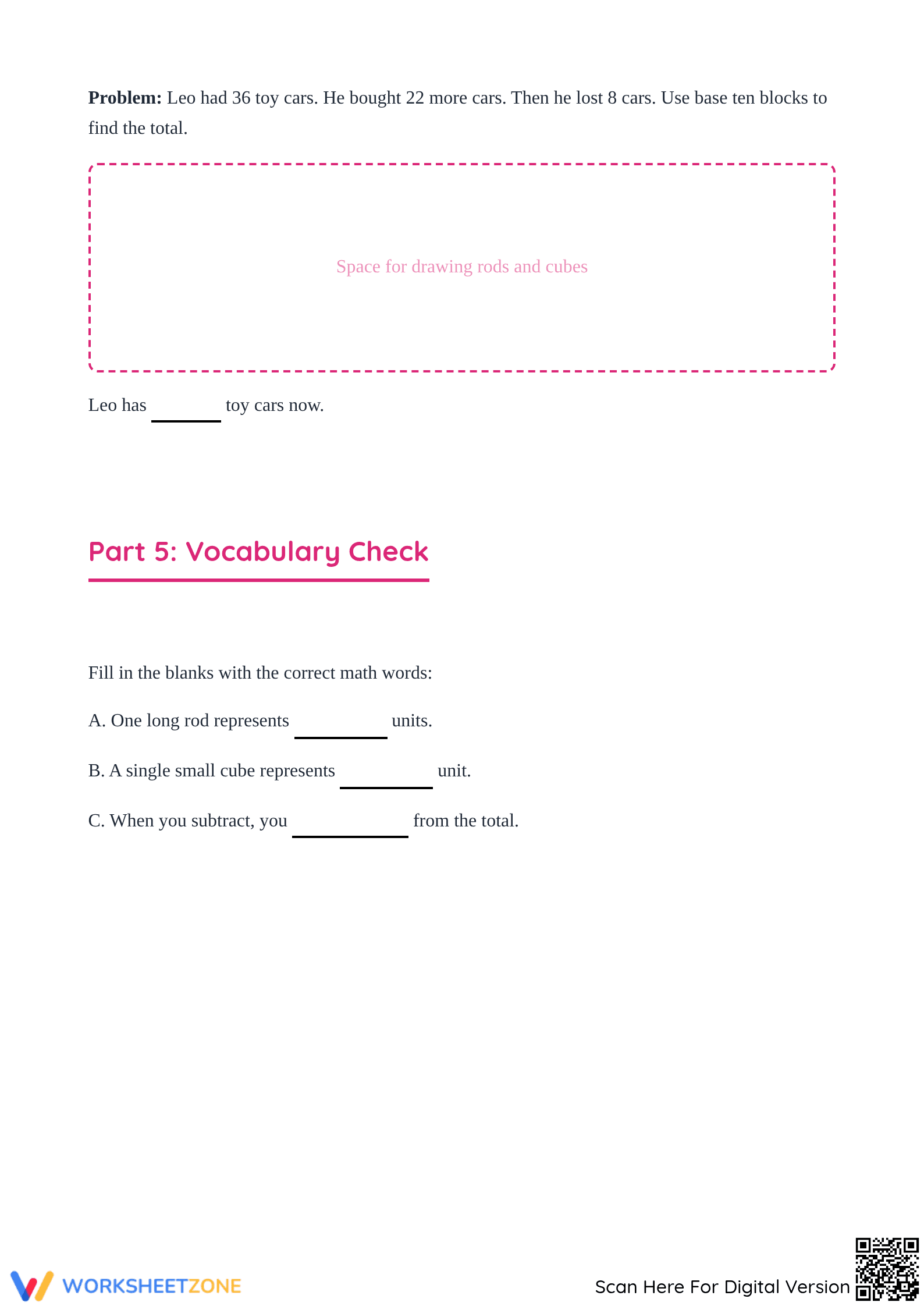
Inside this comprehensive packet, you will find four detailed pages containing five challenging word problem scenarios and a dedicated vocabulary check. The resource features clear illustrations of base ten blocks, multiple-choice options for visual verification, and open drawing spaces that allow students to demonstrate their work by sketching rods and units for complex calculations.
Skill Progression
- Guided Practice: Learners encounter Scenario 1 with provided visual models.
- Supported Practice: Scenarios 2 and 3 offer choice-based visual verification.
- Independent Practice: Challenge sections require students to generate drawings from scratch.
The worksheet follows a proven gradual release of responsibility model to ensure student success.
Standards Alignment
This resource is meticulously aligned to `CCSS.MATH.CONTENT.2.NBT.B.7`, which focuses on adding and subtracting within 1000 using concrete models or drawings. It also supports 2.OA.A.1 for solving one- and two-step word problems. Both standard codes can be copied directly into lesson plans, IEP goals, or district curriculum mapping tools.
How to Use It
Utilize this worksheet as a summative assessment after a unit on place value or as a rigorous test preparation tool. During instruction, observe how students transition from using physical manipulatives to drawing representational rods and units. This observation provides a clear formative-assessment window into their conceptual understanding. Expected completion time ranges from twenty-five to forty minutes depending on grade level.
Who It's For
This material is designed for Grade 2, 3, and 4 students who are refining their multi-digit addition and subtraction skills. It is particularly effective for learners requiring visual scaffolds to process complex language-based problems. Pair this worksheet with a set of physical base ten blocks or a place value anchor chart for a complete, multi-sensory instructional experience.
According to the ScienceDirect TpT Analysis on mathematics instructional materials, the use of visual representations like base ten blocks is a critical factor in developing deep conceptual understanding of place value and operations. This worksheet leverages these concrete-to-representational transitions to bridge the gap between physical manipulation and abstract numerical calculations. By requiring students to draw their own rods and units, the resource reinforces the specific cognitive mapping necessary for multi-step problem solving within the CCSS.MATH.CONTENT.2.NBT.B.7 framework. Research suggests that scaffolded practice with diverse word problem scenarios—such as the block towers and pet shop inventories featured here—enhances the transfer of mathematical skills to real-world contexts. Educators can utilize this standalone summary as evidence for lesson planning or IEP progress monitoring, ensuring that Grade 2–4 learners achieve the standard-aligned fluency required for higher-order algebraic thinking in later elementary years.


