


























Views
Downloads


Kindergarten Number 7 Worksheet | Essential Printable
Paste this activity's link or code into your existing LMS (Google Classroom, Canvas, Teams, Schoology, Moodle, etc.).
Students can open and work on the activity right away, with no student login required.
You'll still be able to track student progress and results from your teacher account.
This comprehensive Number Seven worksheet provides Kindergarten students with a multi-sensory approach to mastering number recognition, formation, and cardinality. By engaging in tracing, counting, and identification tasks, learners build a strong foundation for early numeracy. This resource ensures students can confidently identify and write the number 7 while understanding its value.
At a Glance
- Grade: Kindergarten · Subject: Math
- Standard:
K.CC.B.5— Count to tell the number of objects and answer how many questions- Skill Focus: Number 7 Recognition and Formation
- Format: 3 pages · 25 tasks · Answer key included · PDF
- Best For: Kindergarten number of the week instruction
- Time: 15–20 minutes
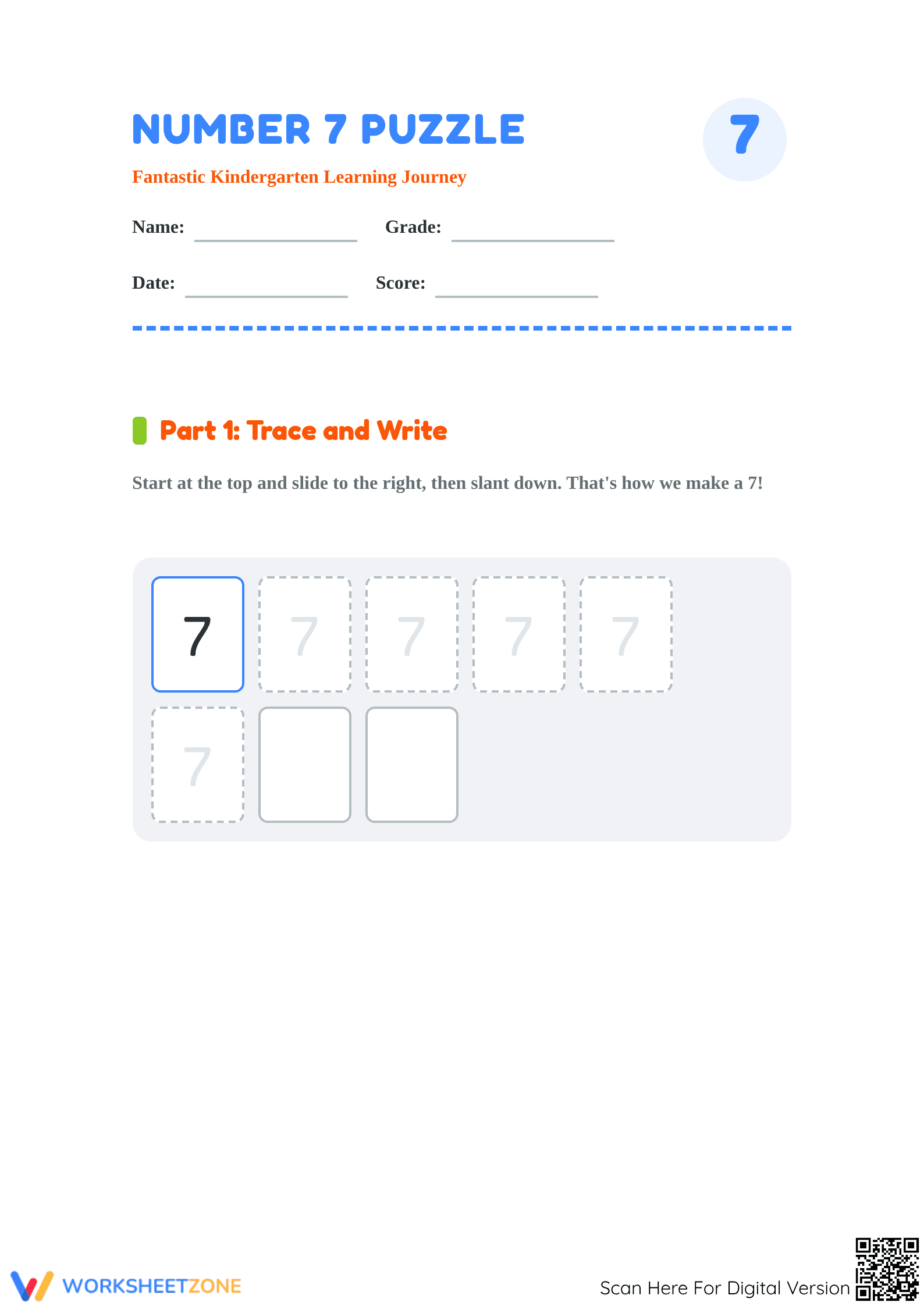
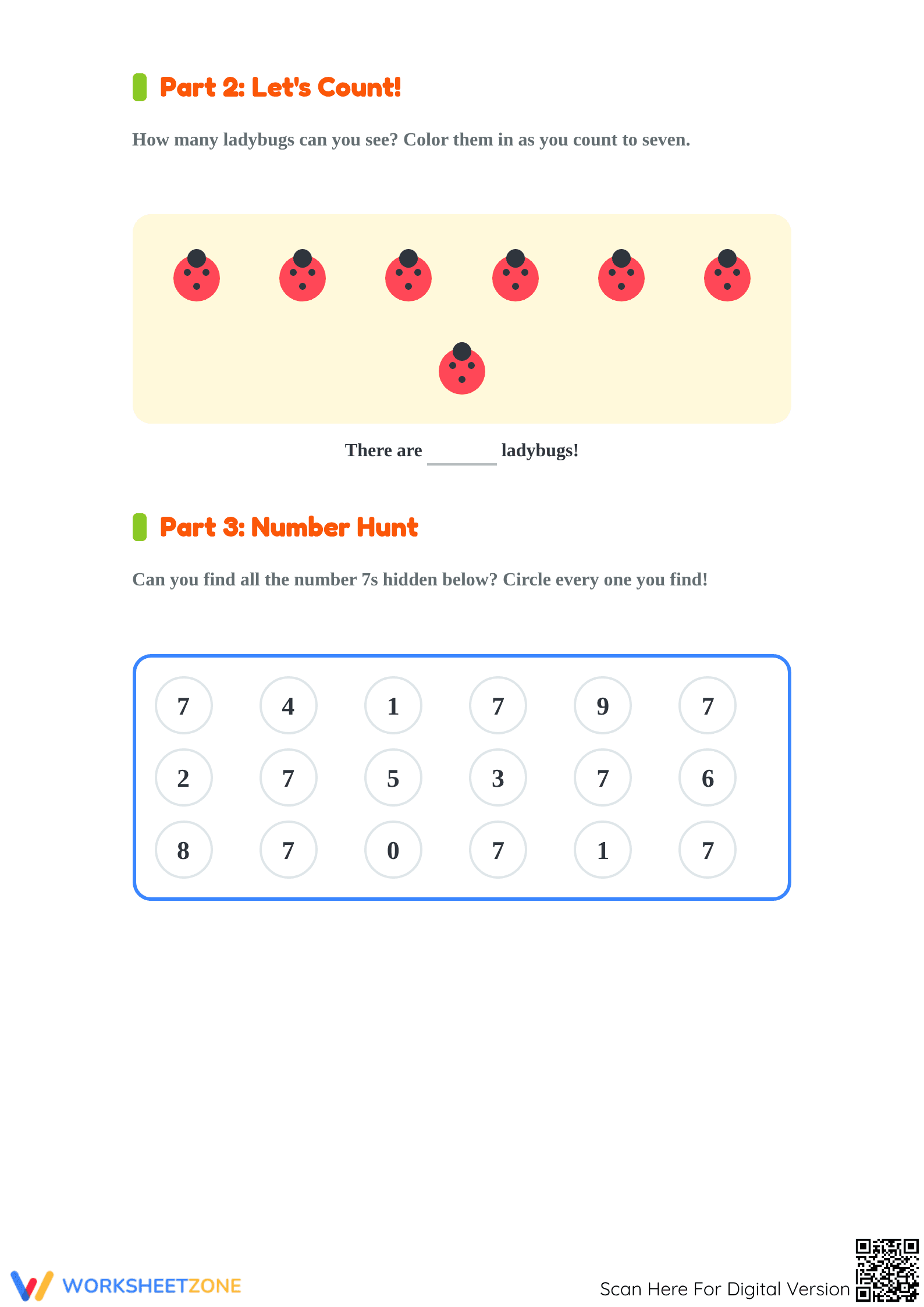
The packet includes three structured pages reinforcing the number 7 through various modalities. Students start with tracing and writing featuring 8 practice boxes. The second page introduces visual counting with ladybugs and a "Number Hunt" grid containing 18 discrete digits. The final page offers a "Big 7 Puzzle" for coloring and a review section focusing on number sequencing.
Zero-Prep Workflow
This worksheet is designed for immediate classroom deployment with a three-step workflow. First, print the 3-page PDF (30 seconds). Second, distribute the packets with pencils and crayons (1 minute). Third, facilitate a quick group review of the ladybug count (5 minutes). The total teacher preparation time is under 2 minutes, making it ideal for sub plans or morning work.
Standards Alignment
The primary focus is `K.CC.B.5`, requiring students to count objects and answer "how many?" questions. The worksheet also supports `K.CC.A.3` by providing spaces for writing the numeral and the word form. Both standard codes can be copied directly into lesson plans, IEP goals, or district curriculum mapping tools.
How to Use It
Use this resource as a core component of your "Number of the Week" rotation. Model the "top and slide" stroke technique before having students complete the tracing tasks independently. As a formative assessment, observe students during the "Number Hunt" to identify those confusing 7 with similar numerals. Expect completion in approximately 20 minutes.
Who It's For
This resource is tailored for Kindergarten students beginning their journey into cardinality. It is effective for learners who benefit from fine-motor scaffolds like dashed lines and visual puzzles. Pair this worksheet with a physical set of counters or an anchor chart to create a rich environment that supports diverse student needs.
According to the NAEP framework for early childhood mathematics, the ability to connect numerals to quantities is a critical predictor of later success in algebraic thinking. This worksheet directly addresses the K.CC.B.5 developmental milestone by bridging the gap between abstract symbols and concrete representations of the number 7. Research from Fisher & Frey (2014) emphasizes the importance of guided practice and multi-modal tasks in the gradual release of responsibility model, which is reflected in the progression from tracing to independent problem-solving. By providing 25 distinct opportunities for engagement, this resource ensures that students move beyond rote memorization toward a functional understanding of number value. Educators can rely on this standards-aligned tool to provide high-quality, evidence-based practice that meets the rigorous demands of modern Kindergarten curricula while maintaining age-appropriate engagement through puzzles and coloring.


