


























Views
Downloads

Grade 1 Number Order — Printable No-Prep Worksheet
Paste this activity's link or code into your existing LMS (Google Classroom, Canvas, Teams, Schoology, Moodle, etc.).
Students can open and work on the activity right away, with no student login required.
You'll still be able to track student progress and results from your teacher account.
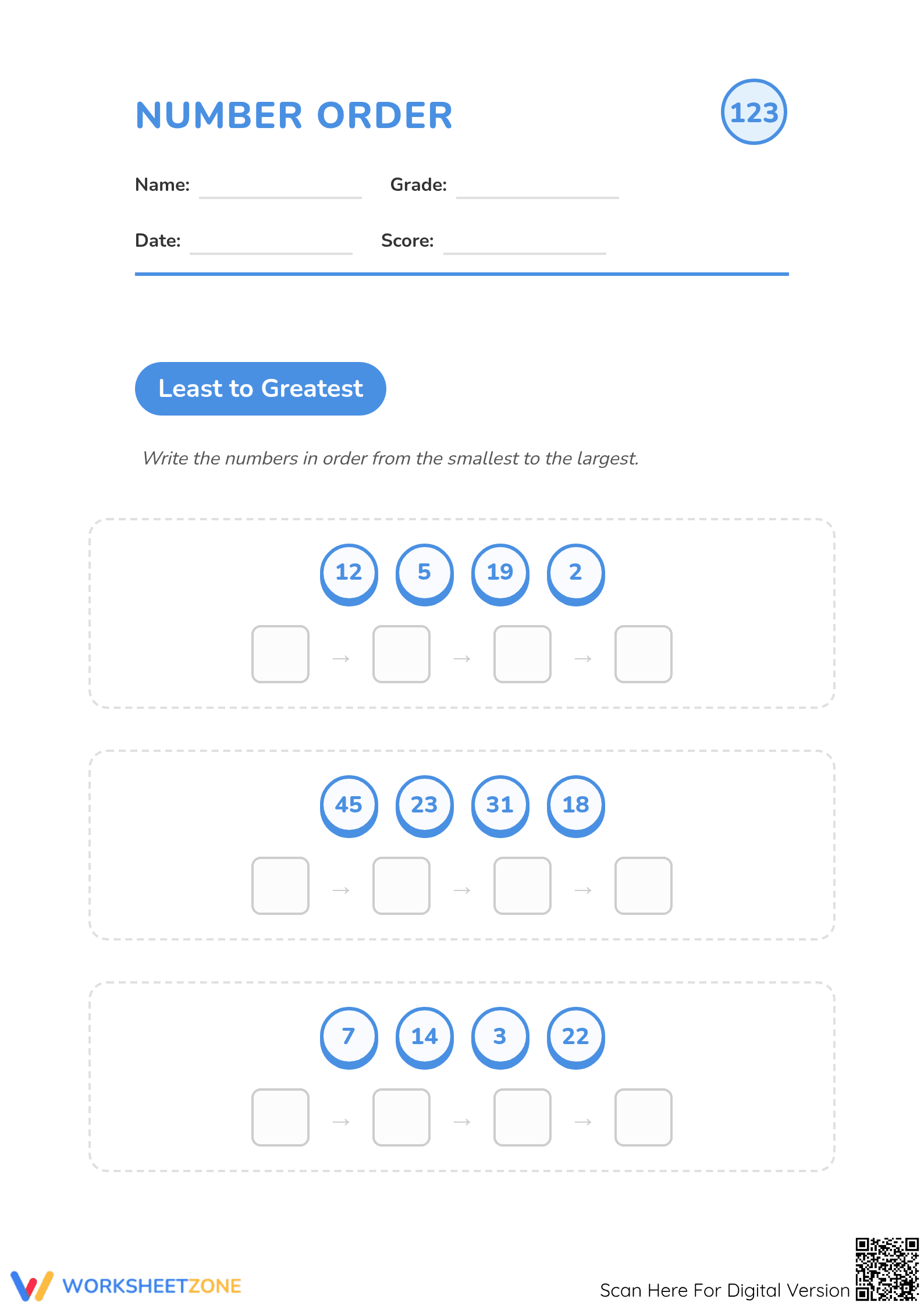
This comprehensive Grade 1 math worksheet helps students master number sequencing through interactive ordering tasks. By arranging sets of one and two-digit numbers, learners develop a deep understanding of place value and numerical relationships. This three-page resource ensures students can confidently navigate both ascending and descending number patterns.
At a Glance
- Grade: 1 · Subject: Math
- Standard:
CCSS.MATH.CONTENT.1.NBT.B.3— Compare two-digit numbers based on meanings of tens and ones digits- Skill Focus: Ordering numbers (Least to Greatest / Greatest to Least)
- Format: 3 pages · 8 problems · Answer key included · PDF
- Best For: Early finishers, homework, or small group intervention
- Time: 15–20 minutes
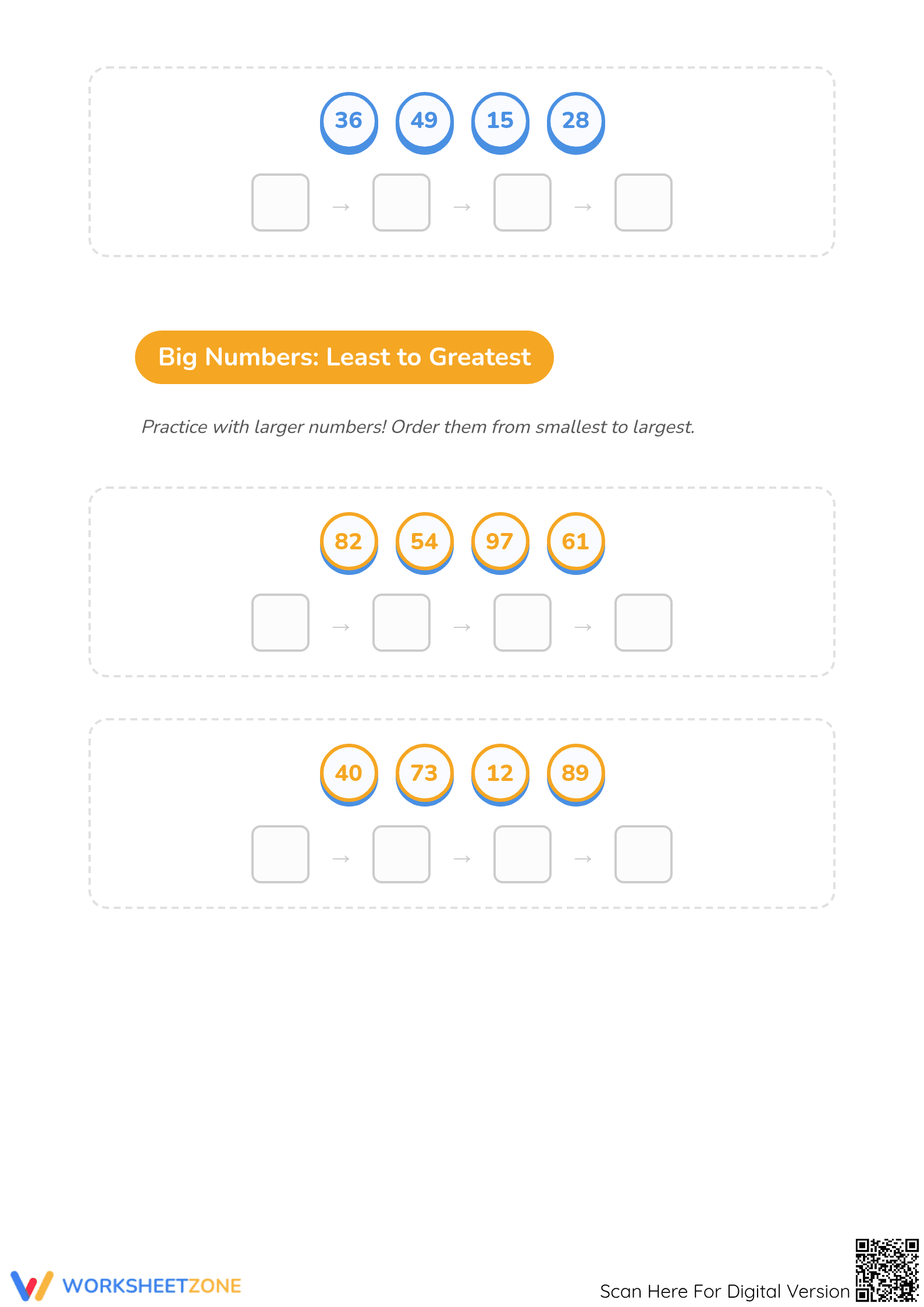
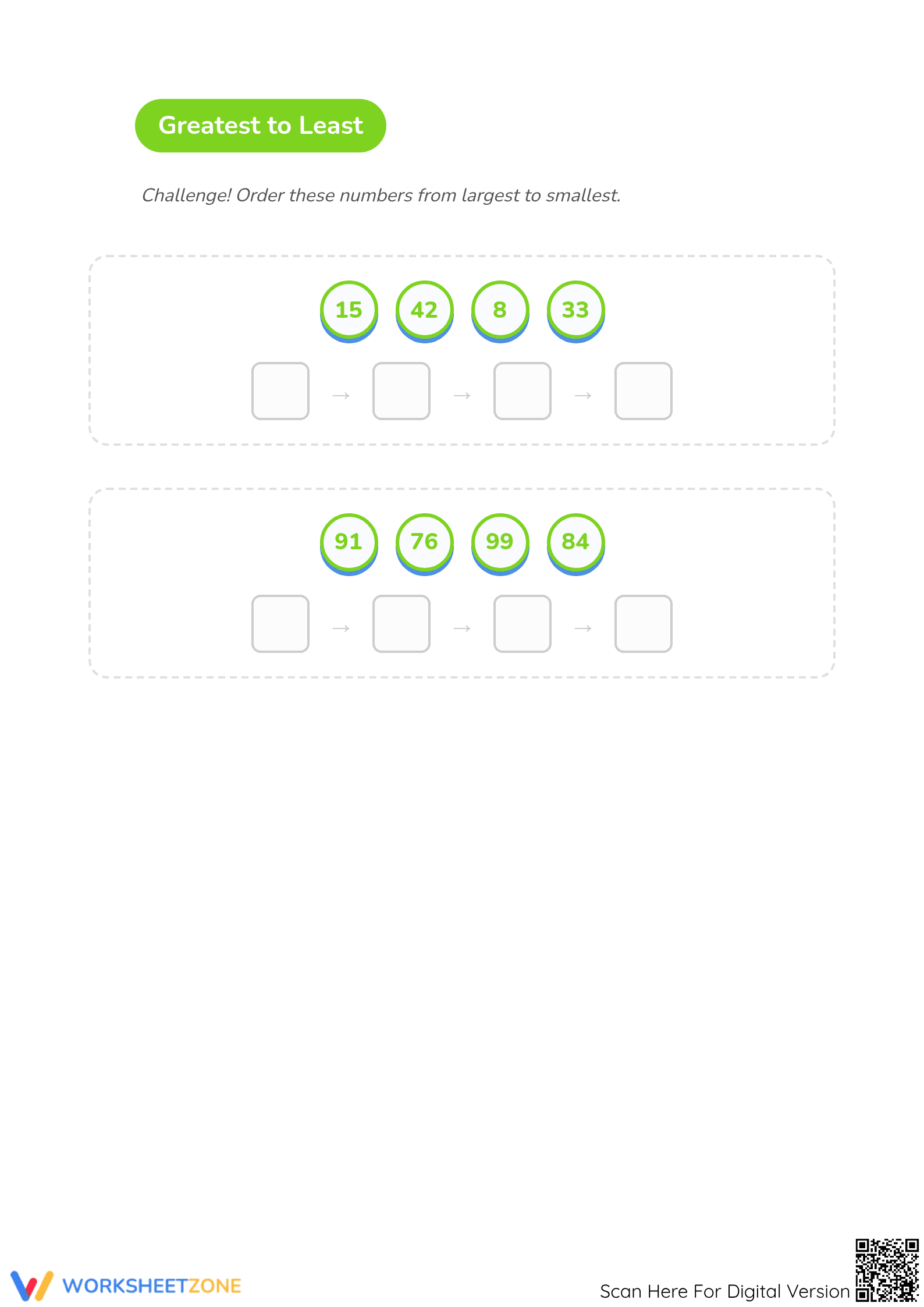
The packet contains eight distinct ordering sets distributed across three themed pages. Page one focuses on introductory least-to-greatest sequences, page two advances to "Big Numbers" up to 99, and page three challenges students with greatest-to-least "challenge" sets. Each task includes four circled numbers and four boxes with directional arrows for student responses, along with a full answer key for grading.
Step 1: Print (30 seconds). The three-page layout is optimized for grayscale printing without losing clarity in the sequence boxes. Step 2: Distribute (30 seconds). Hand out the full packet for a comprehensive lesson or single pages for targeted morning work. Step 3: Review (1 minute). Use the included answer key for rapid checking or project it for whole-class self-correction. Total teacher preparation time is under two minutes, making this an ideal emergency sub plan.
This resource aligns primarily with CCSS.MATH.CONTENT.1.NBT.B.3, which requires students to compare two two-digit numbers based on meanings of the tens and ones digits, recording the results with comparison symbols or logical ordering. It also supports 1.NBT.A.1 by reinforcing the number sequence up to 100. Both standard codes can be copied directly into lesson plans, IEP goals, or district curriculum mapping tools.
Use this worksheet during independent practice after a lesson on place value comparison. It works perfectly as a formative assessment—watch for students who struggle with the "Greatest to Least" transition on page three, as this often reveals a misunderstanding of numerical magnitude. Students typically complete the full sequence within 15 to 20 minutes depending on their comfort with double-digit numbers.
The worksheet is designed for Grade 1 students but serves as an excellent remedial tool for Grade 2 learners needing a place value refresher. For advanced kindergarteners, it provides an appropriate stretch goal. Naturally pair this resource with a 120-chart or physical base-ten blocks to help struggling students visualize the "greater" or "smaller" quantities before writing in the response boxes.
According to recent findings in the RAND AIRS 2024 report on elementary mathematics, students who engage in frequent, varied numerical ordering tasks demonstrate significantly higher proficiency in subsequent arithmetic operations. This Grade 1 worksheet targets CCSS.MATH.CONTENT.1.NBT.B.3 by requiring learners to evaluate and sequence one and two-digit numbers in both ascending and descending order. By mastering the relationship between tens and ones digits through these eight structured sets, students build the cognitive foundation necessary for mental math and complex addition. The clear visual layout, including directional arrows and distinct sections for "Least to Greatest" and "Greatest to Least" challenges, supports the development of mathematical reasoning and number sense. This resource provides the rigorous practice needed to bridge the gap between basic counting and formal algebraic thinking, ensuring students are prepared for more advanced base-ten concepts.


