


























Views
Downloads
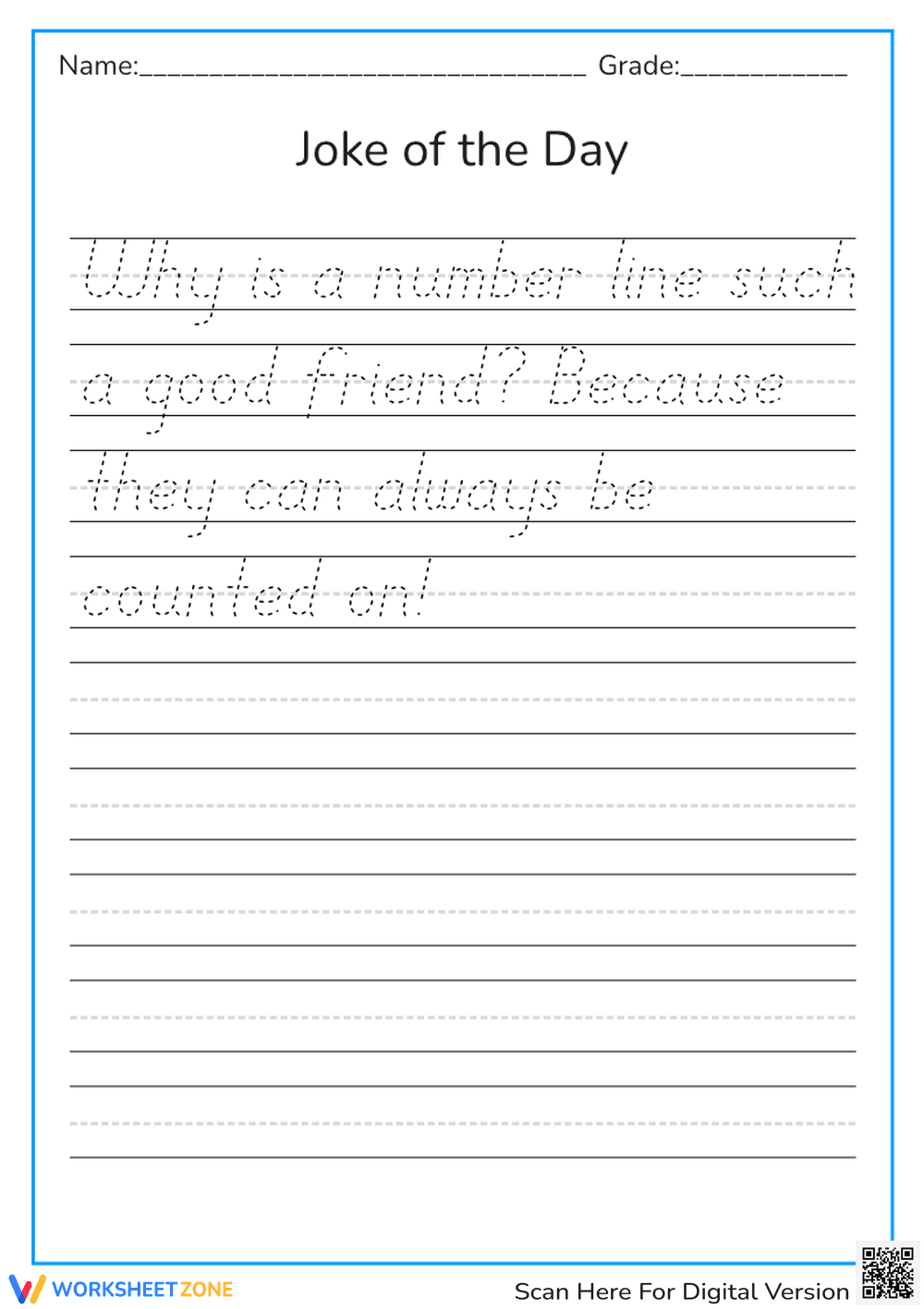

Printable Handwriting Practice: Number Line Jokes
Paste this activity's link or code into your existing LMS (Google Classroom, Canvas, Teams, Schoology, Moodle, etc.).
Students can open and work on the activity right away, with no student login required.
You'll still be able to track student progress and results from your teacher account.
This Grade 1 and 2 handwriting worksheet combines humor with essential fine motor practice. By tracing a clever "Joke of the Day" about number lines, students develop letter formation skills and sentence spacing in an engaging way. It transforms repetitive writing drills into a fun, rewarding activity that builds confidence and legibility.
At a Glance
At a Glance
- Grade: 1-2 · Subject: Handwriting
- Standard:
CCSS.ELA-LITERACY.L.1.1.A— Print all upper- and lowercase letters accurately and legibly- Skill Focus: Letter formation and spacing
- Format: 1 page · 4 tracing lines · Answer key N/A · PDF
- Best For: Morning work or early finishers
- Time: 10–15 minutes
What's Inside
The worksheet features a single page with a "Joke of the Day" formatted in a clear, dashed tracing font. It includes 4 lines of guided tracing followed by 8 blank primary-ruled lines for independent practice. This structure allows students to first model the correct letter shapes before attempting to rewrite the joke on their own.
Zero-Prep Workflow
This resource is designed for a zero-prep workflow. 1. Print: Select the PDF and print in seconds. 2. Distribute: Hand out to students as they enter the room or finish a math lesson. 3. Review: Quickly scan for proper grip and letter height. Total teacher preparation time is under 2 minutes, making it an ideal sub plan or transition activity.
Standards Alignment
Aligned to CCSS.ELA-LITERACY.L.1.1.A, which requires students to print all upper- and lowercase letters. It also supports CCSS.ELA-LITERACY.L.2.1 by reinforcing standard English capitalization and punctuation through the joke's structure. Both standard codes can be copied directly into lesson plans, IEP goals, or district curriculum mapping tools.
How to Use It
Use this worksheet as a "bell ringer" to settle the class during morning transitions. It also serves as an excellent formative assessment tool; observe students as they write to identify those struggling with pencil pressure or line orientation. Expect completion within 10 to 15 minutes depending on the student's fine motor development.
Who It's For
This is perfect for first and second-grade students who need to move beyond single-letter practice into full-sentence fluency. It is particularly helpful for students who find traditional drills boring. Pair this with a math lesson on number lines or a classroom "joke wall" to increase student engagement.
Research from Fisher & Frey (2014) emphasizes the importance of purposeful practice in the gradual release of responsibility model. This worksheet facilitates that transition by providing a clear model (tracing) before requiring independent production. Handwriting remains a foundational literacy skill; according to a 2024 analysis by ScienceDirect, students who develop fluent handwriting early on demonstrate better composition quality and length in later grades. By integrating humor, this resource reduces the cognitive load and anxiety often associated with fine motor tasks, allowing students to focus on the mechanics of letter formation. The inclusion of CCSS.ELA-LITERACY.L.1.1.A ensures that the practice is not just fun but pedagogically sound, meeting national requirements for primary language arts. This 1-page PDF provides a high-utility, low-stakes environment for students to master the 26 letters of the alphabet in a contextualized, sentence-based format.


