


























Views
Downloads

Pronoun Practice Worksheet | Essential Grade 1 ELA
Paste this activity's link or code into your existing LMS (Google Classroom, Canvas, Teams, Schoology, Moodle, etc.).
Students can open and work on the activity right away, with no student login required.
You'll still be able to track student progress and results from your teacher account.
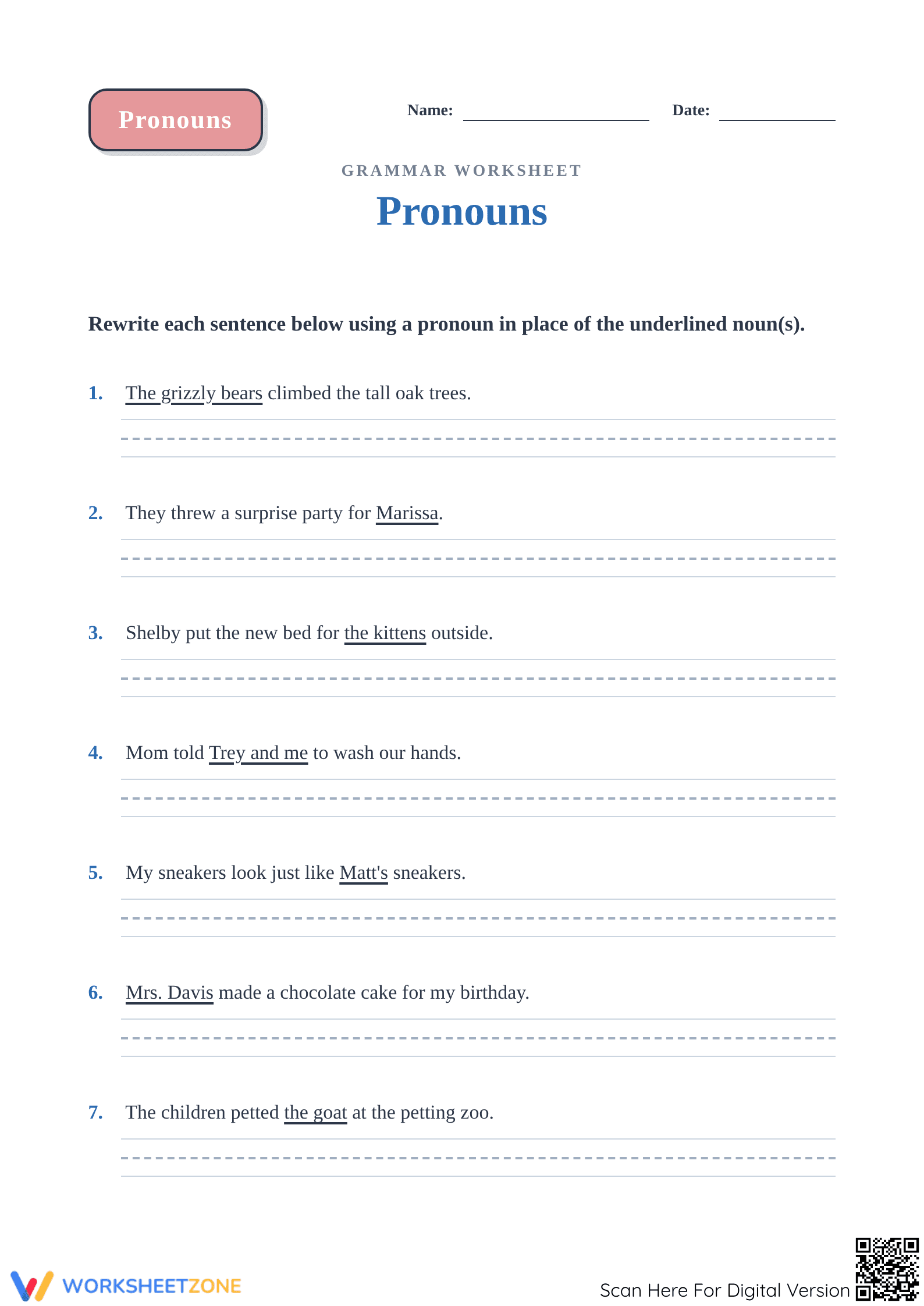
This Grade 1 ELA worksheet helps students master the transition from specific nouns to functional pronouns. By rewriting complete sentences, learners develop a practical understanding of how pronouns replace people, places, and things while maintaining sentence meaning. It is a foundational tool for building grammatical fluency and reducing repetitive writing patterns in early elementary students.
At a Glance
- Grade: 1 · Subject: ELA
- Standard:
CCSS.ELA-LITERACY.L.1.1.D— Use personal, possessive, and indefinite pronouns correctly in sentences- Skill Focus: Noun-to-pronoun replacement
- Format: 2 pages · 10 problems · Answer key included · PDF
- Best For: Grammar centers and independent practice
- Time: 15–20 minutes
What's Inside
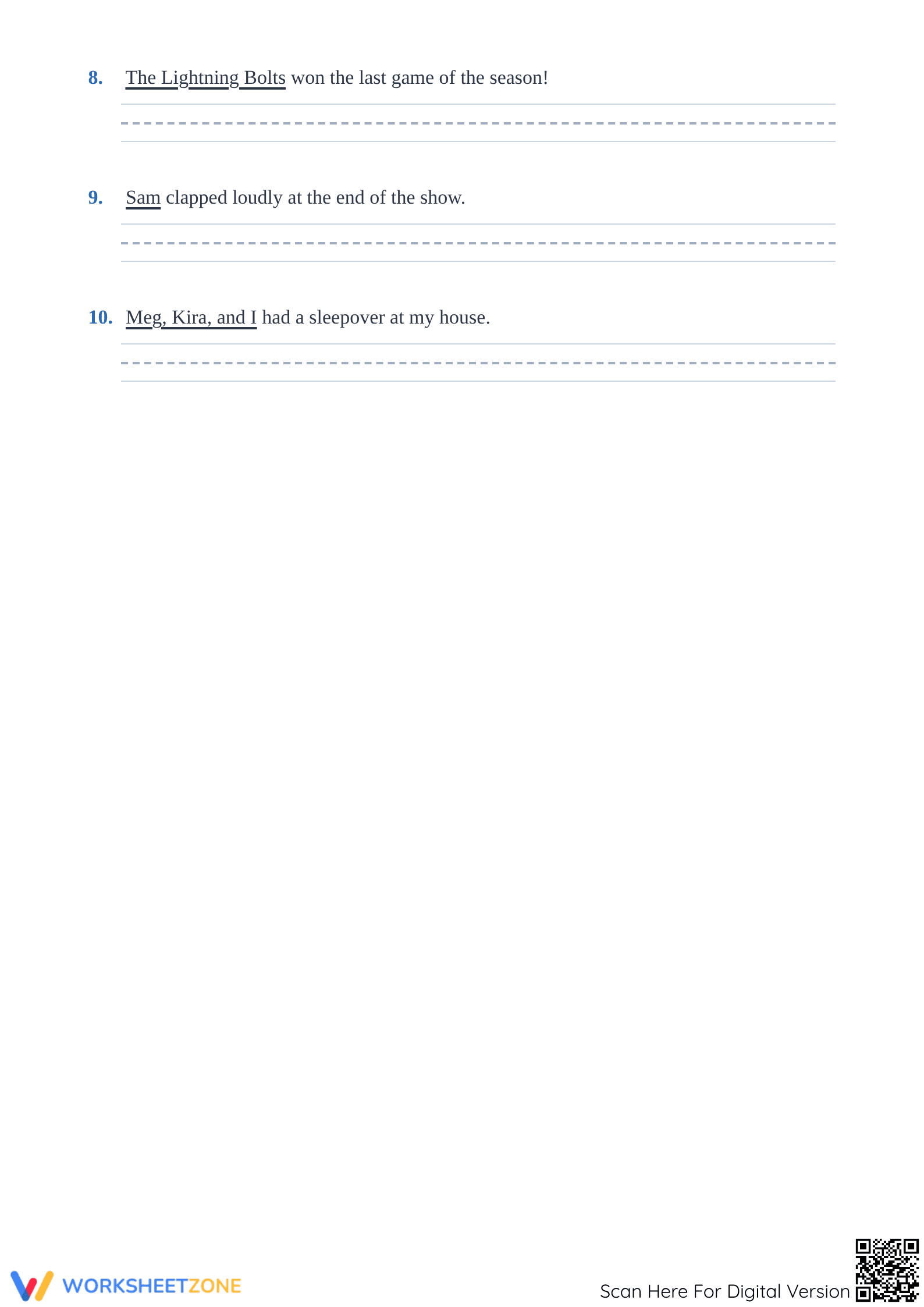
The resource consists of a 2-page student worksheet and a corresponding 2-page answer key. It features 10 distinct sentences where specific nouns or noun phrases are underlined. Students are provided with clear primary-ruled lines to rewrite the entire sentence, ensuring they practice handwriting and punctuation alongside the core grammar skill of pronoun substitution.
Skill Progression
- Guided Identification: Students begin by looking at underlined subjects like "The grizzly bears" to determine number and gender.
- Supported Practice: Learners select the correct pronoun (e.g., they, her, him) from their mental bank to replace the specific noun phrase.
- Independent Application: Students rewrite the full sentence to demonstrate syntactic control and proper capitalization.
This gradual-release model ensures students move confidently from recognition to application using an I Do, We Do, You Do approach.
Standards Alignment
This resource is directly aligned with `CCSS.ELA-LITERACY.L.1.1.D`, which requires students to use personal, possessive, and indefinite pronouns. It specifically targets the substitution of personal pronouns in the subject and object positions. Both standard codes can be copied directly into lesson plans, IEP goals, or district curriculum mapping tools.
How to Use It
Use this worksheet during the independent practice phase of a grammar lesson after introducing common pronouns like he, she, it, and they. It also serves as an effective formative assessment; observe if students correctly identify the plural nature of "The kittens" or "Trey and me" before they begin writing. Expected completion time ranges from 15 to 20 minutes.
Who It's For
This is designed for first-grade students but is highly effective for second-grade review or English Language Learners (ELL) who need practice with English syntax. It pairs naturally with a pronoun anchor chart or a shared reading passage where students hunt for pronouns before completing the written tasks.
According to the RAND AIRS 2024 report on elementary literacy, explicit instruction in word classes like pronouns is essential for developing reading comprehension and writing clarity. This worksheet addresses CCSS.ELA-LITERACY.L.1.1.D by requiring students to replace specific nouns with appropriate pronouns across 10 varied sentence contexts. Research from Fisher & Frey (2014) emphasizes that the gradual release of responsibility—moving from identifying underlined nouns to independently rewriting sentences—is a proven method for ensuring long-term retention of grammatical rules. By practicing with both singular and plural subjects, Grade 1 students build the linguistic flexibility needed for more complex narrative writing. This resource provides the structured repetition necessary for mastery, supported by a full answer key for immediate feedback or self-correction in a classroom setting.


