


























Views
Downloads

Essential CCSS 1.L.1.B Nouns Worksheet | Grade 1 Aligned
Paste this activity's link or code into your existing LMS (Google Classroom, Canvas, Teams, Schoology, Moodle, etc.).
Students can open and work on the activity right away, with no student login required.
You'll still be able to track student progress and results from your teacher account.
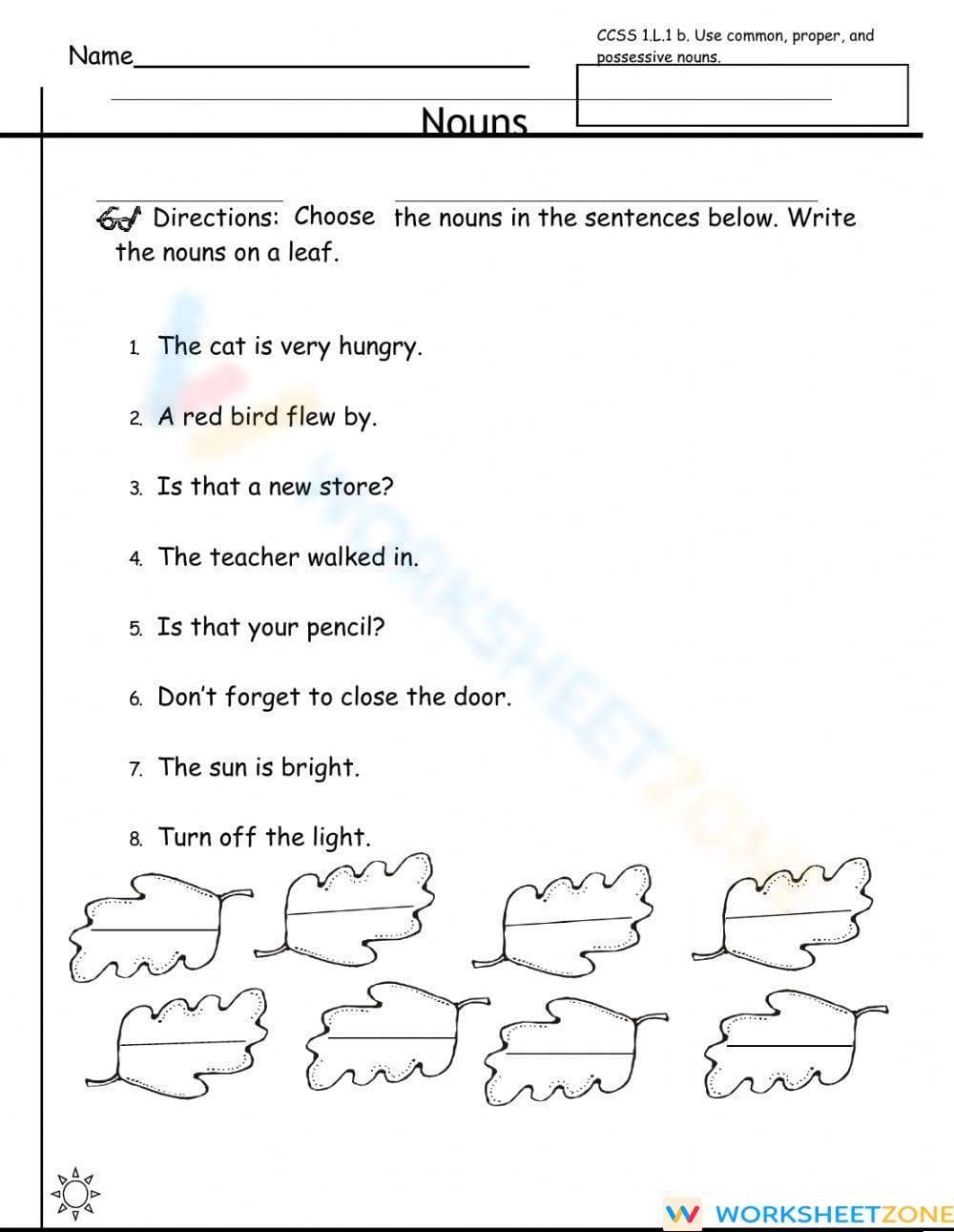
This Grade 1 Nouns worksheet provides students with targeted practice in identifying and extracting common nouns from complete sentences. By isolating nouns within a thematic leaf graphic organizer, learners develop a concrete understanding of how naming words function in syntax. This resource ensures students can accurately recognize people, places, and things in their reading.
At a Glance
- Grade: 1 · Subject: English Language Arts
- Standard:
CCSS.ELA-LITERACY.L.1.1.B— Use common, proper, and possessive nouns in written sentences.- Skill Focus: Noun identification and extraction
- Format: 1 page · 8 problems · Answer key included · PDF
- Best For: Small group grammar intervention sessions
- Time: 10–15 minutes
What's Inside
The worksheet features eight structured sentences, each containing a distinct common noun related to everyday concepts like animals or environments. Below the text, eight leaf-shaped writing spaces allow students to physically collect the nouns they find. This one-page PDF includes clear directions and a comprehensive answer key to streamline grading and provide immediate student feedback.
Mastery Evidence
This resource provides clear evidence of mastery for the L.1.1.B standard. Each task maps to the foundational ability to distinguish nouns from other parts of speech. The worksheet supports a tiered assessment approach: students Approaching mastery may identify the noun orally, while those Meeting or Exceeding expectations demonstrate their skill by writing the words accurately in the organizers for IEP documentation.
Standards Alignment
The primary focus is `CCSS.ELA-LITERACY.L.1.1.B`, which requires students to: 'Use common, proper, and possessive nouns.' This activity specifically targets the common noun component by having students identify them in context. This standard code can be copied directly into lesson plans, IEP goals, or district curriculum mapping tools to ensure instructional alignment.
How to Use It
Use this worksheet as a formative assessment after a direct grammar lesson. During independent work, circulate to observe if students confuse nouns with verbs, providing a quick check for understanding. It takes approximately 12 minutes to complete and works effectively as an exit ticket to gauge student readiness for more complex linguistic concepts.
Who It's For
Designed for first-grade students, this worksheet is also appropriate for Kindergarteners ready for advanced grammar or second-graders needing a review. It pairs naturally with a classroom anchor chart displaying categories of people, places, and things to support English Language Learners and students with varied processing needs.
Effective grammar instruction requires moving beyond rote memorization toward contextual application, as emphasized in the research by Fisher & Frey (2014) regarding the gradual release of responsibility. This worksheet aligns with the 'we do' and 'you do' phases of instructional delivery by providing a structured framework for noun identification. By requiring students to extract `CCSS.ELA-LITERACY.L.1.1.B` common nouns from full sentences and relocate them to a graphic organizer, the task bridges the gap between passive recognition and active linguistic manipulation. This method supports lexical development and syntactic awareness, which are critical precursors to fluent writing. Research indicates that when students interact with parts of speech within meaningful sentence structures rather than isolated lists, they demonstrate higher retention rates and better transfer to their own independent compositions. This printable resource offers a reliable, evidence-based tool for building core literacy foundations in early elementary classrooms.


