


























Views
Downloads
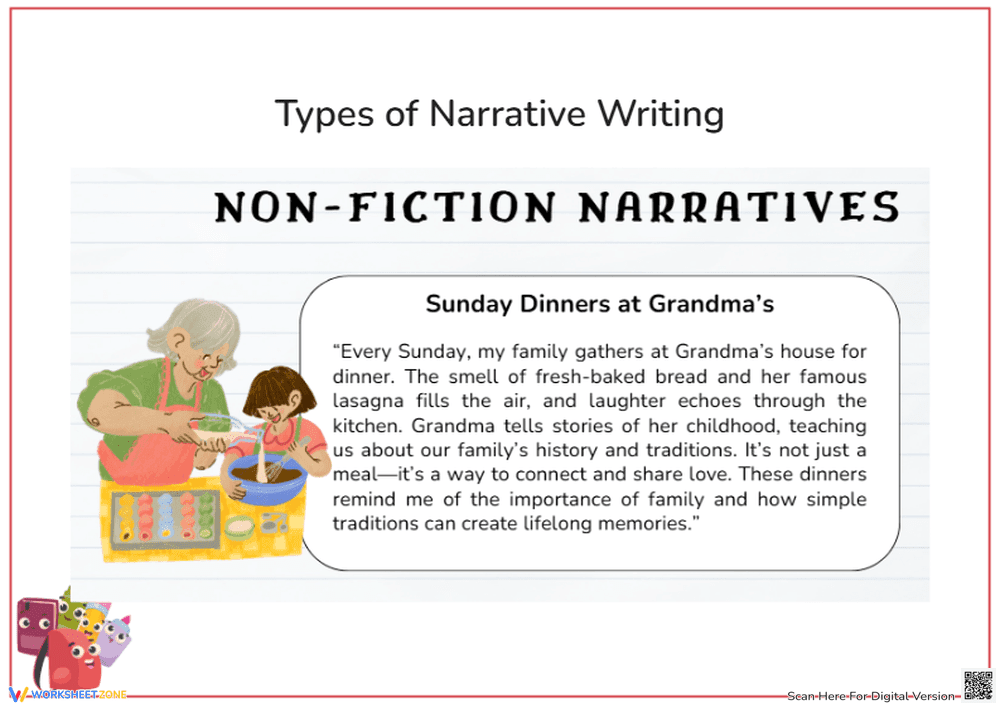

Printable Non-Fiction Narrative Writing Grade 3
Paste this activity's link or code into your existing LMS (Google Classroom, Canvas, Teams, Schoology, Moodle, etc.).
Students can open and work on the activity right away, with no student login required.
You'll still be able to track student progress and results from your teacher account.
This Grade 3 non-fiction narrative writing resource provides students with a clear, relatable example of personal storytelling. By reading about a family tradition, students observe how descriptive details and sensory language bring real-life events to the page, setting a strong foundation for their own narrative writing projects.
At a Glance
- Grade: 3 · Subject: ELA
- Standard:
CCSS.ELA-LITERACY.W.3.3— Write narratives about real experiences using descriptive details- Skill Focus: Non-fiction narrative writing
- Format: 1 page · 0 problems · No answer key · PDF
- Best For: Anchor chart or mentor text
- Time: 10–15 minutes
This single-page resource features a short, engaging mentor text titled "Sunday Dinners at Grandma's." It serves as a visual anchor chart demonstrating the core elements of a non-fiction narrative. The text highlights sensory details, emotional connections, and sequential storytelling without requiring students to complete any immediate written tasks, making it an ideal reference document for writing folders or classroom walls.
This resource is designed for immediate classroom implementation with absolutely zero teacher setup required.
- Print (1 minute): Generate enough copies for student writing folders or print one large version for a classroom anchor chart.
- Distribute (1 minute): Hand out the mentor text during the mini-lesson phase of your writing workshop.
- Review (5 minutes): Read the passage aloud and highlight the sensory words together.
With a total prep time of under two minutes, this is an excellent addition to emergency sub plans or quick writing interventions.
This resource is tightly aligned to CCSS.ELA-LITERACY.W.3.3: Write narratives to develop real or imagined experiences or events using effective technique, descriptive details, and clear event sequences. It also supports reading comprehension standards by asking students to identify the main idea of a short text. Both standard codes can be copied directly into lesson plans, IEP goals, or district curriculum mapping tools.
Introduce this mentor text before direct instruction on personal narratives to give students a concrete model. Project the image and have students circle sensory words like "fresh-baked bread." Alternatively, use it during independent writing time as a reference guide for students struggling to generate ideas. As a formative assessment observation tip, watch if students mimic the emotional reflection sentence in their own drafts. Expected completion time is 10 to 15 minutes.
This resource is primarily designed for third-grade students beginning a personal narrative or memoir writing unit. It provides excellent differentiation for visual learners and English Language Learners who benefit from clear, concise mentor texts rather than lengthy chapter books. Pair this example passage with a blank graphic organizer or a direct instruction lesson on adding sensory details to writing.
Providing students with strong mentor texts is a critical component of effective writing instruction. This resource targets CCSS.ELA-LITERACY.W.3.3, helping students write narratives about real experiences using descriptive details. According to Fisher & Frey (2014), utilizing clear, relatable examples during the direct instruction phase significantly reduces student anxiety and increases the overall quality of independent writing output. When students can clearly visualize the expected outcome through a concise non-fiction narrative, they are much better equipped to structure their own personal memories into cohesive, engaging stories. This specific one-page anchor text bridges the gap between abstract writing concepts and practical classroom application, ensuring that young writers understand exactly how to weave sensory language and emotional reflection into their personal narratives. By analyzing this short passage, students build the foundational skills necessary for advanced storytelling.


