


























Views
Downloads

Newton's Third Law Printable | Grade 8 Science
Paste this activity's link or code into your existing LMS (Google Classroom, Canvas, Teams, Schoology, Moodle, etc.).
Students can open and work on the activity right away, with no student login required.
You'll still be able to track student progress and results from your teacher account.
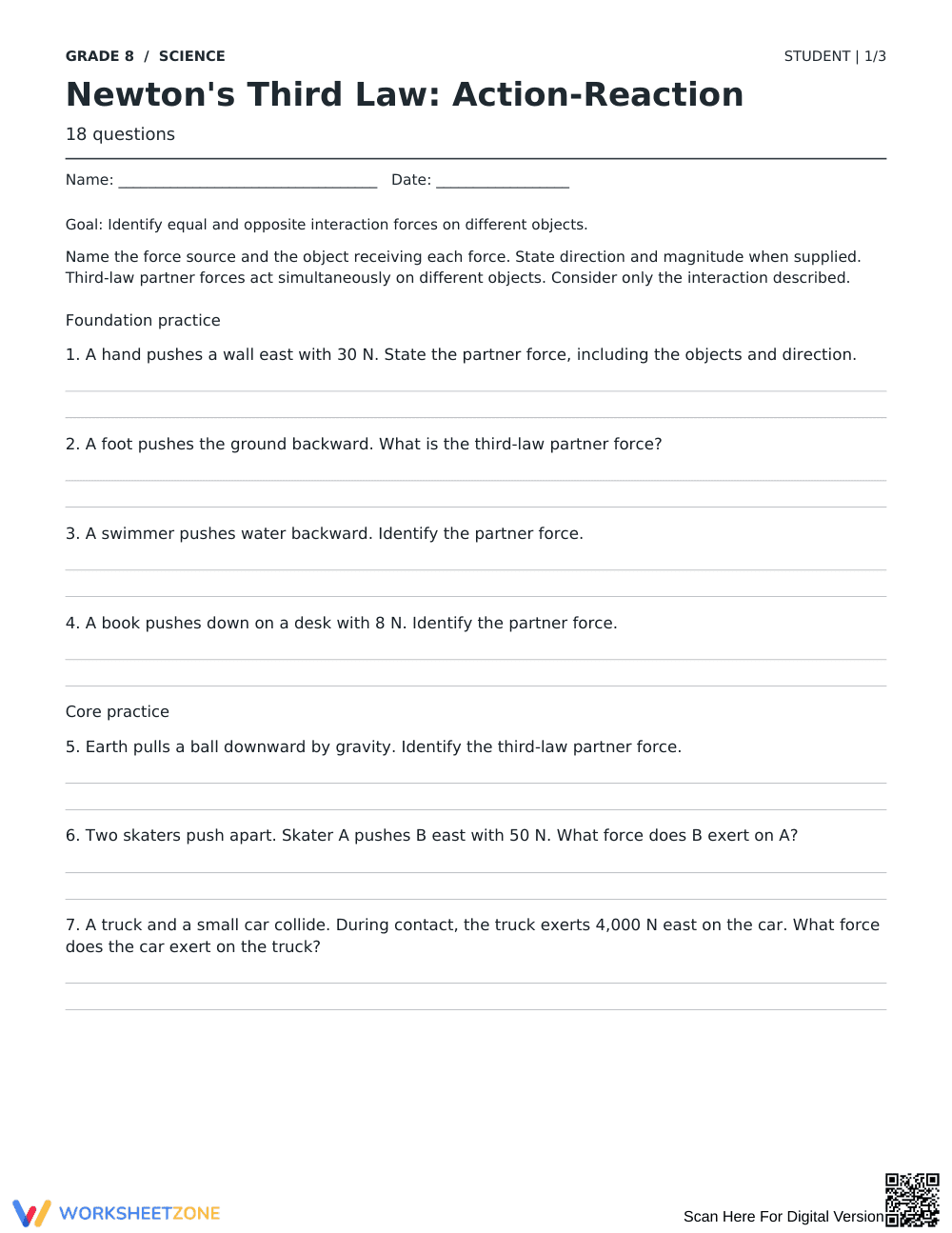
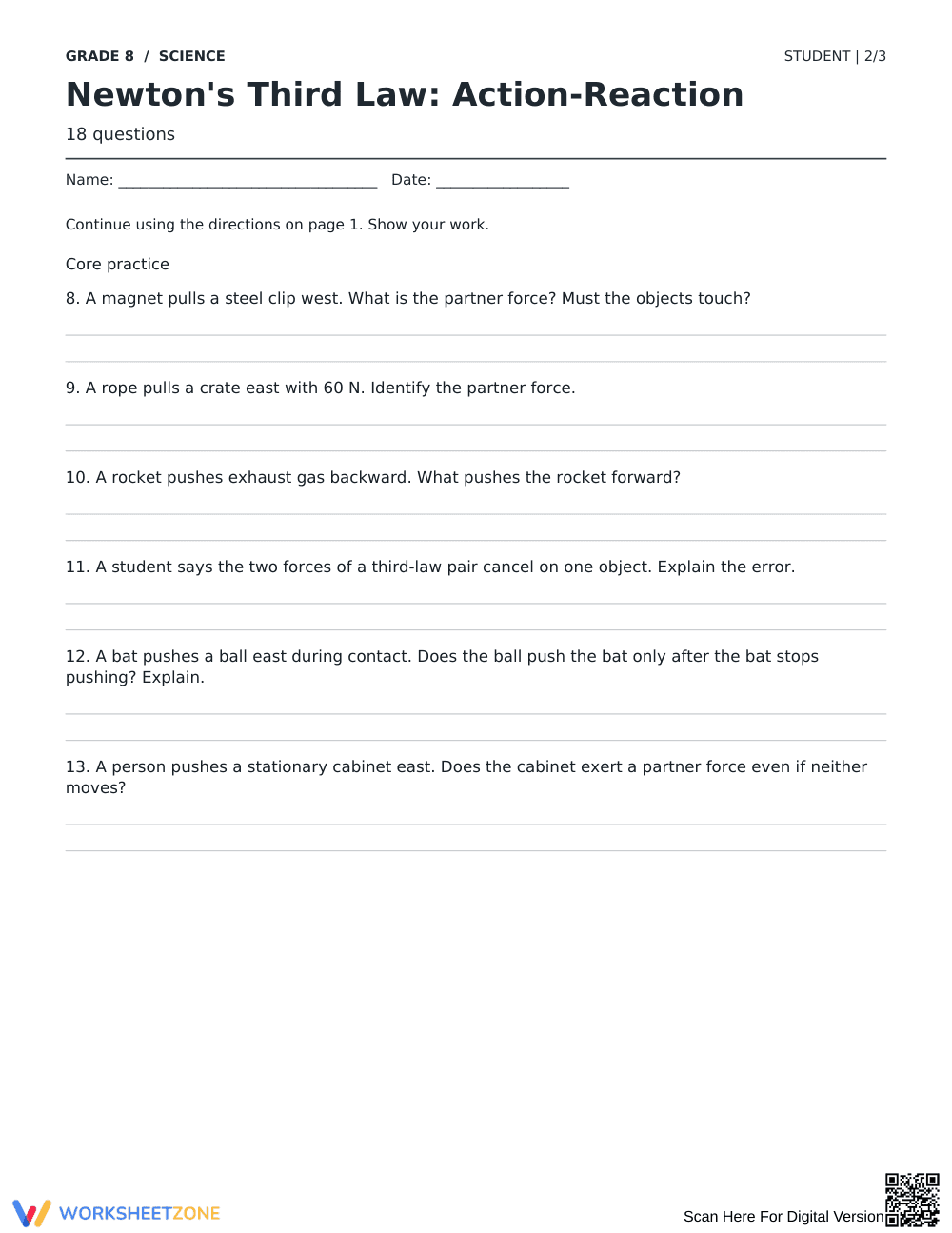
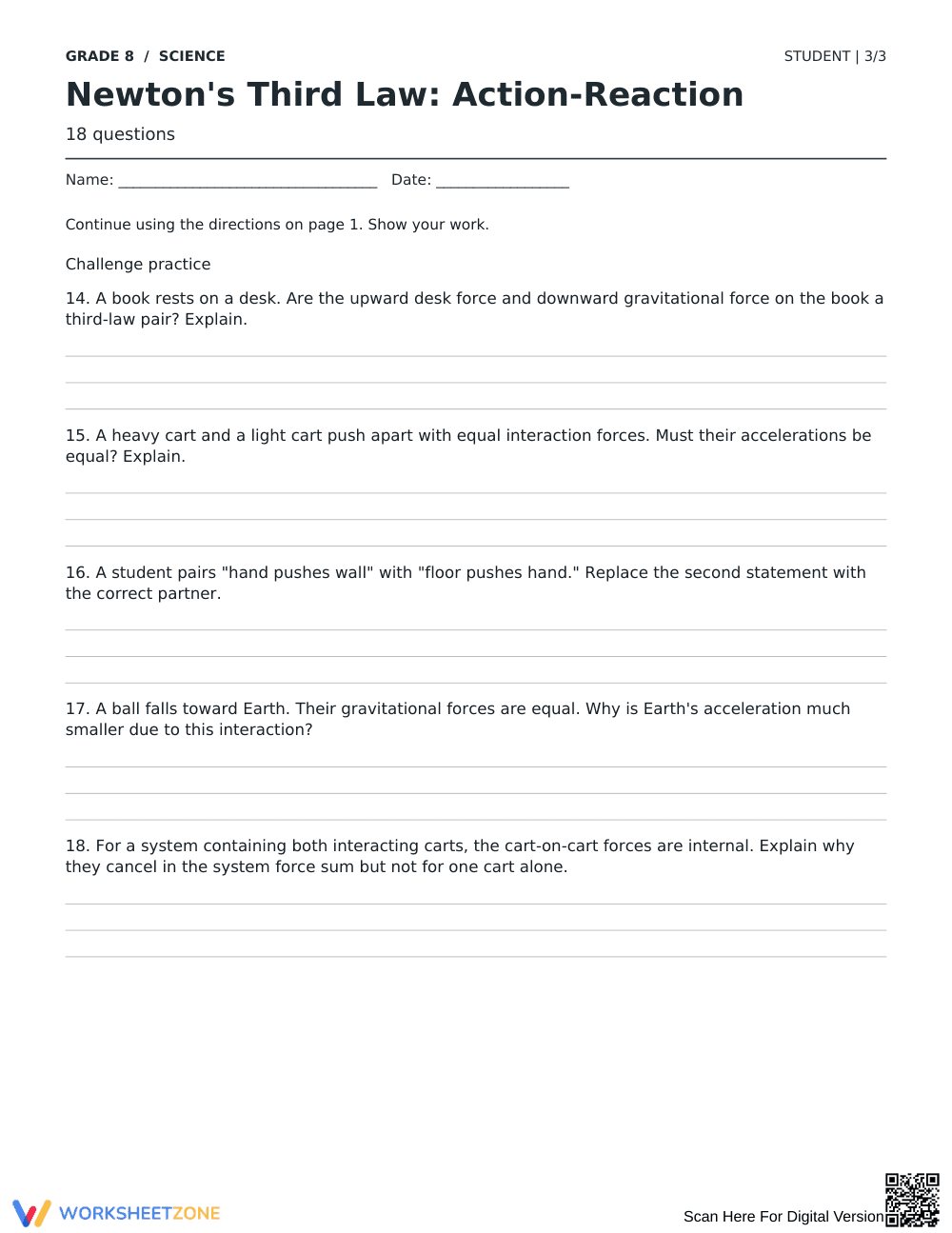
This Grade 8 science worksheet builds students' ability to identify and describe action-reaction force pairs using Newton's Third Law, giving them 18 structured problems that move from recognition to real-world application. Students finish the activity able to explain why forces always occur in equal and opposite pairs and apply that reasoning to everyday scenarios.
At a Glance
- Grade: 8 · Subject: Science (Physical Science)
- Standard:
MS-PS2-1— Apply Newton's Third Law to predict motion when two objects interact- Skill Focus: Identifying and describing action-reaction force pairs
- Format: 3 pages · 18 problems · Answer key included · PDF
- Best For: Guided or independent practice after direct instruction
- Time: 25–35 minutes
The worksheet spans three student pages and includes labeled diagram analysis, fill-in-the-blank force-pair identification, short-answer explanation prompts, and real-world scenario questions. The answer key provides complete responses for every item, making self-assessment or teacher review straightforward.
Skill Progression
- Guided practice (problems 1–6): Students examine diagrams with labeled objects and identify which force is the action and which is the reaction, with the object pair already named. Scaffold level is high.
- Supported practice (problems 7–12): Students read scenario descriptions and complete sentence frames requiring them to name both forces and both objects involved. Partial structure remains, but students supply the scientific language.
- Independent practice (problems 13–18): Students analyze open-ended real-world situations — such as a swimmer pushing off a pool wall or a rocket expelling gas — and write full explanations of the action-reaction pair without sentence support, mirroring NGSS performance-task demands.
The sequence follows a gradual-release model, allowing teachers to use the first section during whole-class instruction before releasing students to work independently.
Standards Alignment
Primary standard: MS-PS2-1 — recognizing that for every force exerted by one object on another, there is an equal and opposite force in return. Supporting standard MS-PS2-2 is touched upon in scenario problems where net force and resulting motion are discussed. Both codes can be copied directly into lesson plans or curriculum mapping tools.
How to Use It
Use problems 1–6 immediately after direct instruction as a formative check — circulate and note which students struggle to distinguish the two objects in a force pair, the most common misconception. Assign problems 7–18 as independent practice or homework. Alternatively, use the full worksheet as a unit-review activity; students typically finish in 25–35 minutes. Collect responses to problems 13–18 for a written-explanation formative grade.
Who It's For
Designed for Grade 8 physical science students working at grade level on force and motion concepts. Students needing additional support benefit from pairing this worksheet with a Newton's Third Law anchor chart. Advanced students can extend problems 13–18 by calculating force magnitudes using Newton's Second Law, connecting to MS-PS2-2.
Mastery of force-pair identification is a documented prerequisite for understanding momentum and collision analysis in high school physics. The 18-item format gives teachers sufficient data points to identify persistent misconceptions before summative assessment, and the included answer key supports both teacher scoring and student self-correction.


