


























Views
Downloads

Essential Nets of 3D Figures Worksheet | Grade 5 Math
Paste this activity's link or code into your existing LMS (Google Classroom, Canvas, Teams, Schoology, Moodle, etc.).
Students can open and work on the activity right away, with no student login required.
You'll still be able to track student progress and results from your teacher account.
This Essential Nets of 3D Figures worksheet allows students to master the spatial relationship between two-dimensional patterns and three-dimensional solids. Students will identify, match, and analyze various nets to predict the resulting geometric figures accurately. This focused practice ensures students develop the foundational visualization skills necessary for advanced geometry and future surface area calculations.
At a Glance
- Grade: 5 · Subject: Math
- Standard:
6.G.A.4— Represent three-dimensional figures using nets made up of rectangles and triangles- Skill Focus: 3D Figure Nets
- Format: 2 pages · 8 problems · Answer key included · PDF
- Best For: Geometry introduction or formative assessment
- Time: 15–20 minutes
What's Inside
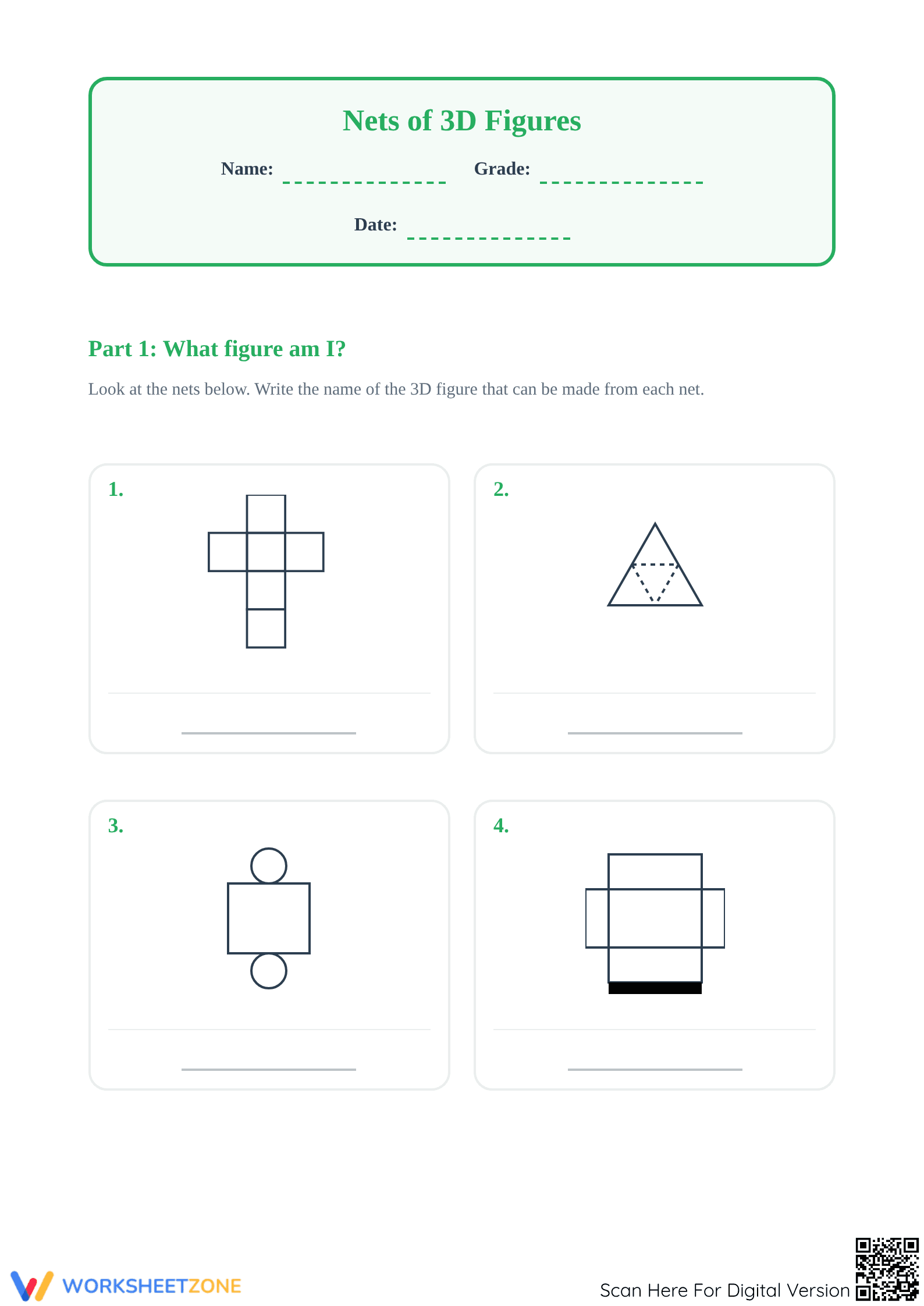
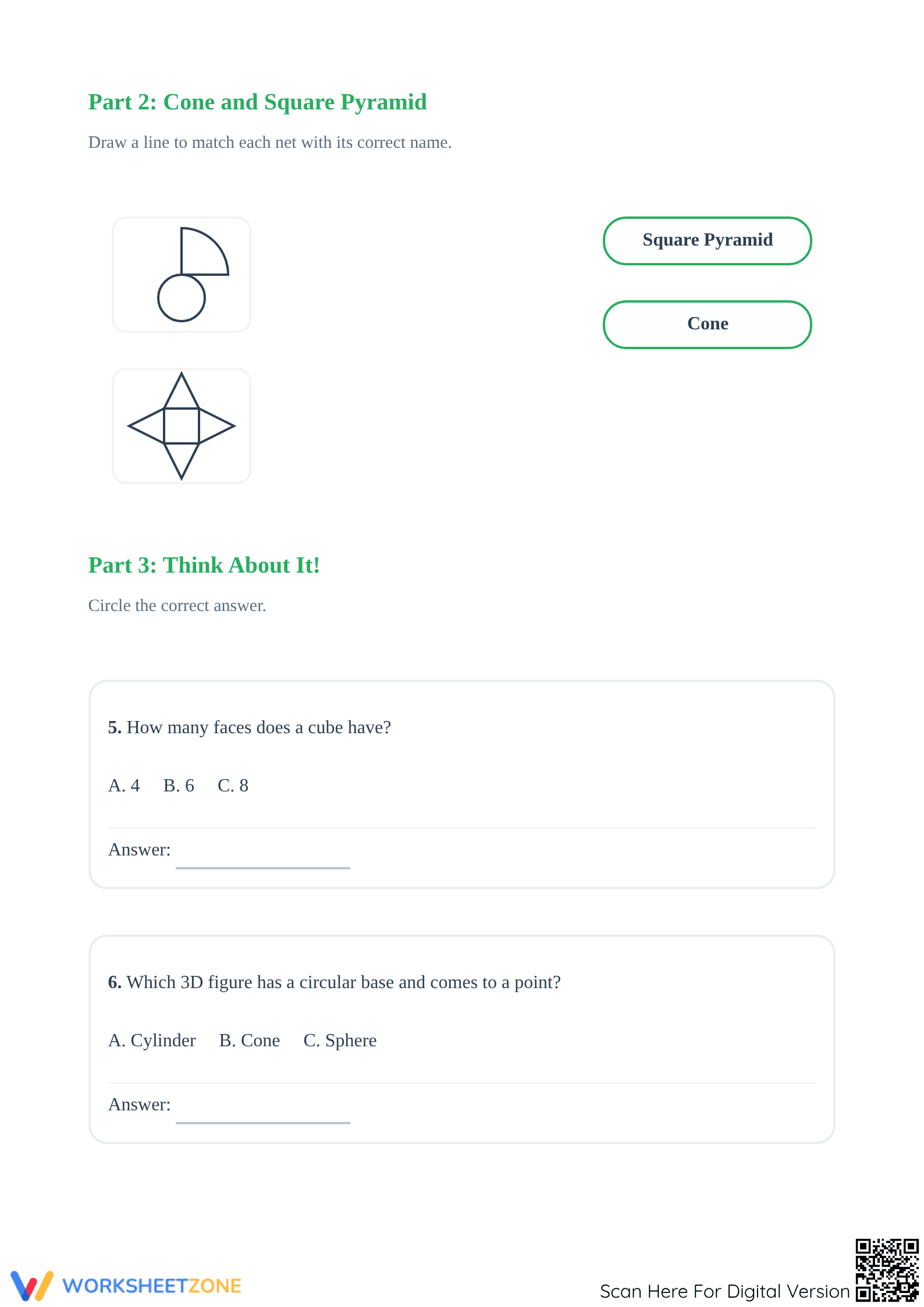
This comprehensive two-page resource features eight structured tasks designed to build geometric fluency. The first page presents four identification challenges where students name the 3D figure represented by each net, covering cubes, pyramids, cylinders, and prisms. The second page includes a matching activity for cones and square pyramids, followed by critical-thinking multiple-choice questions regarding face counts and base shapes. A full answer key is provided for immediate grading.
Zero-Prep Workflow
- Step 1: Print (30 seconds) — The high-contrast, clean layout is optimized for grayscale printing and digital viewing.
- Step 2: Distribute (1 minute) — Assign as a warm-up, independent practice, or a quick-check formative assessment.
- Step 3: Review (5 minutes) — Use the included answer key to provide instant feedback or facilitate a peer-grading session.
Total teacher preparation time is under two minutes, making this an ideal choice for emergency sub plans or last-minute lesson extensions.
Standards Alignment
This resource is specifically aligned to CCSS.MATH.CONTENT.6.G.A.4: "Represent three-dimensional figures using nets made up of rectangles and triangles, and use the nets to find the surface area of these figures." While it serves as an excellent introduction for Grade 5 students, it directly addresses the representation requirements of the middle-school geometry strand. Both standard codes can be copied directly into lesson plans, IEP goals, or district curriculum mapping tools.
How to Use It
Use this worksheet as a "Quick Check" immediately following a direct instruction lesson on three-dimensional shapes to gauge student spatial reasoning. Alternatively, it functions perfectly as a math center activity where students can attempt to draw the 3D figure next to each net. During the activity, observe if students can accurately count the faces on a flat net to match the attributes of a solid solid, providing a valuable formative observation tip.
Who It's For
This resource is designed for Grade 5 and Grade 6 students who are transitioning from basic shape identification to complex geometric analysis. It is particularly effective for visual learners who benefit from seeing the unfolded components of a solid. This worksheet pairs naturally with physical 3D manipulatives or paper folding activities to reinforce the concrete-to-abstract connection.
According to the RAND AIRS 2024 analysis of instructional materials, spatial visualization exercises like those found in the 6.G.A.4 standard are pivotal for long-term success in STEM fields. This worksheet targets the identification of nets for three-dimensional figures, a skill that bridges concrete manipulative work with abstract geometric reasoning. By requiring students to mentally fold two-dimensional patterns into three-dimensional solids, the activity strengthens cognitive mapping and geometric fluency. Research by Fisher & Frey (2014) emphasizes that such guided practice with non-textual representations supports deeper conceptual understanding of mathematical modeling and spatial logic. The inclusion of diverse figures, including cylinders and pyramids, ensures a comprehensive mastery of the representation phase of the standard. This resource provides a validated pathway for students to demonstrate proficiency in representing solid figures, making it an essential component of any standards-aligned geometry curriculum or classroom assessment toolkit.


