




























Views
Downloads


Properties of Water Worksheet | Grade 9 Essential

Paste this activity's link or code into your existing LMS (Google Classroom, Canvas, Teams, Schoology, Moodle, etc.).
Students can open and work on the activity right away, with no student login required.
You'll still be able to track student progress and results from your teacher account.
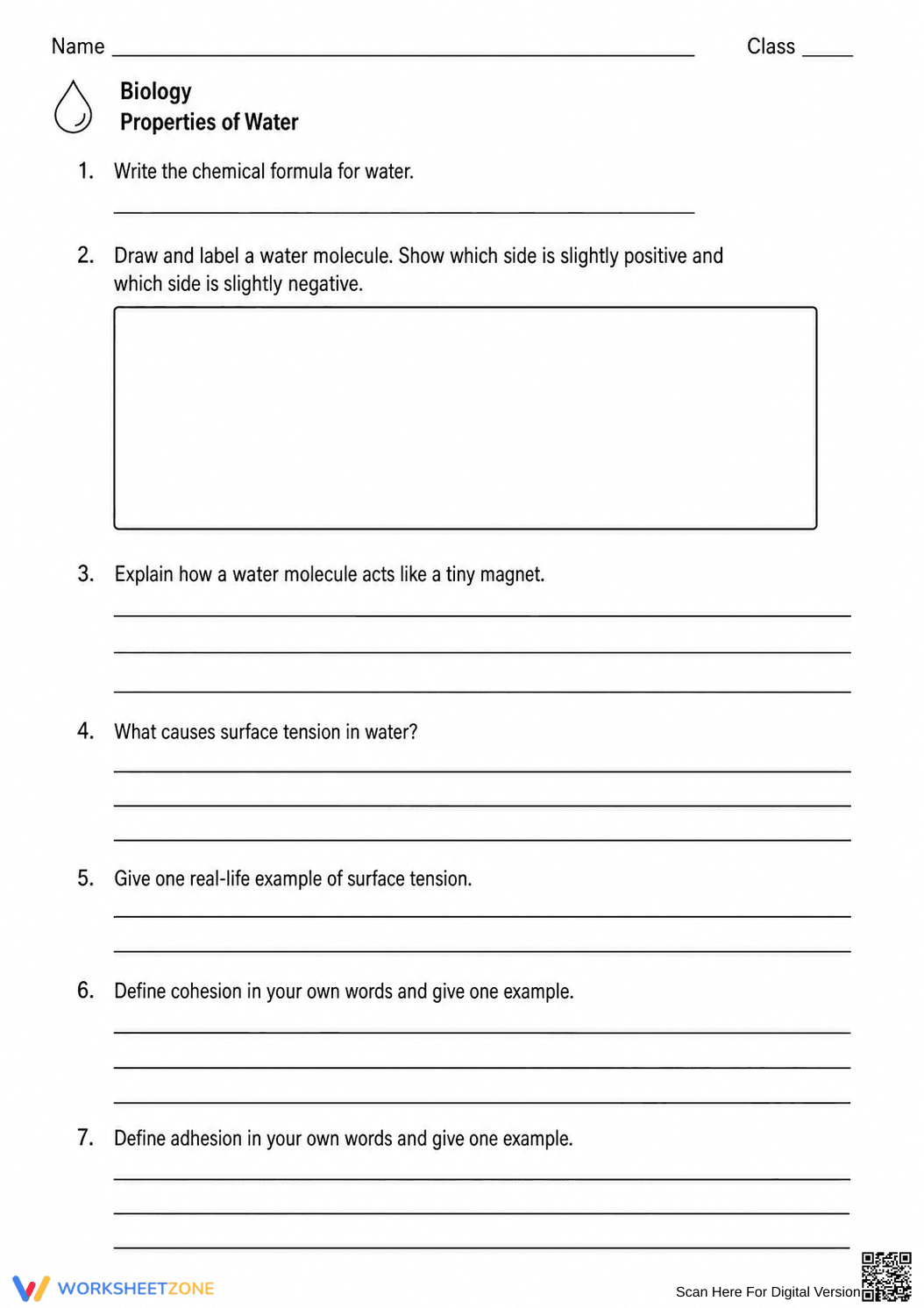
This Grade 9 Biology worksheet ensures students master the fundamental properties of water, including polarity, cohesion, and adhesion. By completing 10 targeted problems, learners will explain how molecular structures support life on Earth. Students move from basic chemical formulas to complex modeling of hydrogen bonding and capillary action to build scientific literacy.
At a Glance
- Grade: 9 · Subject: Biology
- Standard:
HS-ESS2-5— Plan and conduct an investigation of the properties of water and its effects.- Skill Focus: Properties of Water (Polarity, Cohesion, Adhesion)
- Format: 2 pages · 10 problems · No answer key · PDF
- Best For: Independent practice or homework
- Time: 20–30 minutes
Inside this two-page PDF, educators will find 10 sequenced short-answer and modeling questions. The tasks require students to write chemical formulas, draw and label a polarized water molecule, and define key terms like surface tension in their own words. The layout provides ample space for detailed sketches and written explanations, though please note that an answer key is not included with this specific version.
Zero-Prep Workflow
Designed for immediate use with minimal teacher overhead:
- Print (1 min): Download the PDF and print double-sided. No special lab materials or chemicals are required for this theoretical review.
- Distribute (1 min): Hand out at the start of the lesson as a bell-ringer or assign as a focused homework task.
- Review (5 mins): Use the straightforward questions to gauge student understanding during a quick whole-class review session.
With total teacher prep time under two minutes, this resource is an ideal option for emergency sub plans or last-minute curriculum supplements.
Standards Alignment
This worksheet aligns with `HS-ESS2-5`, requiring students to plan and conduct an investigation of the properties of water and its effects on Earth materials and surface processes. It also supports foundational life science standards regarding the role of water in biological systems. Both standard codes can be copied directly into lesson plans, IEP goals, or district curriculum mapping tools.
How to Use It
Use this as independent practice following direct instruction on biochemistry, allowing students to apply knowledge of polarity. Alternatively, assign it as homework to reinforce learning after a lecture on the chemical foundations of life. For a formative assessment tip, observe students drawing their water molecule models in Question 2. Check that they correctly label positive and negative regions, as this is critical for grasping cohesion and adhesion. Expected completion time is 20 to 30 minutes.
Who It's For
Designed for 9th-grade biology or introductory chemistry students, this serves as an excellent foundational activity. To support differentiation, provide struggling learners with an anchor chart illustrating a water molecule. This worksheet pairs perfectly with a hands-on lab demonstrating surface tension, bridging theoretical concepts with observable phenomena for diverse learners.
Understanding the unique characteristics of water is a critical stepping stone for all subsequent biological and chemical sciences. Aligning with `HS-ESS2-5`, this resource helps students explain the unique properties of water and their effects on natural systems. Providing students with structured, multimodal tasks—such as combining written definitions with molecular drawing—significantly enhances their retention of abstract scientific concepts. When learners actively model polarity and articulate the mechanisms behind cohesion and adhesion, they transition from rote memorization to deep conceptual understanding. This targeted practice ensures students can apply these principles to more complex topics, such as cellular transport, homeostasis, and ecological systems. By integrating visual models with written explanations, educators foster greater scientific literacy and analytical skills. This specific worksheet provides the necessary scaffolding to bridge the gap between microscopic molecular interactions and macroscopic biological phenomena.


