


























Views
Downloads

Essential Needs of Animals Worksheet | Grade 2 Science
Paste this activity's link or code into your existing LMS (Google Classroom, Canvas, Teams, Schoology, Moodle, etc.).
Students can open and work on the activity right away, with no student login required.
You'll still be able to track student progress and results from your teacher account.
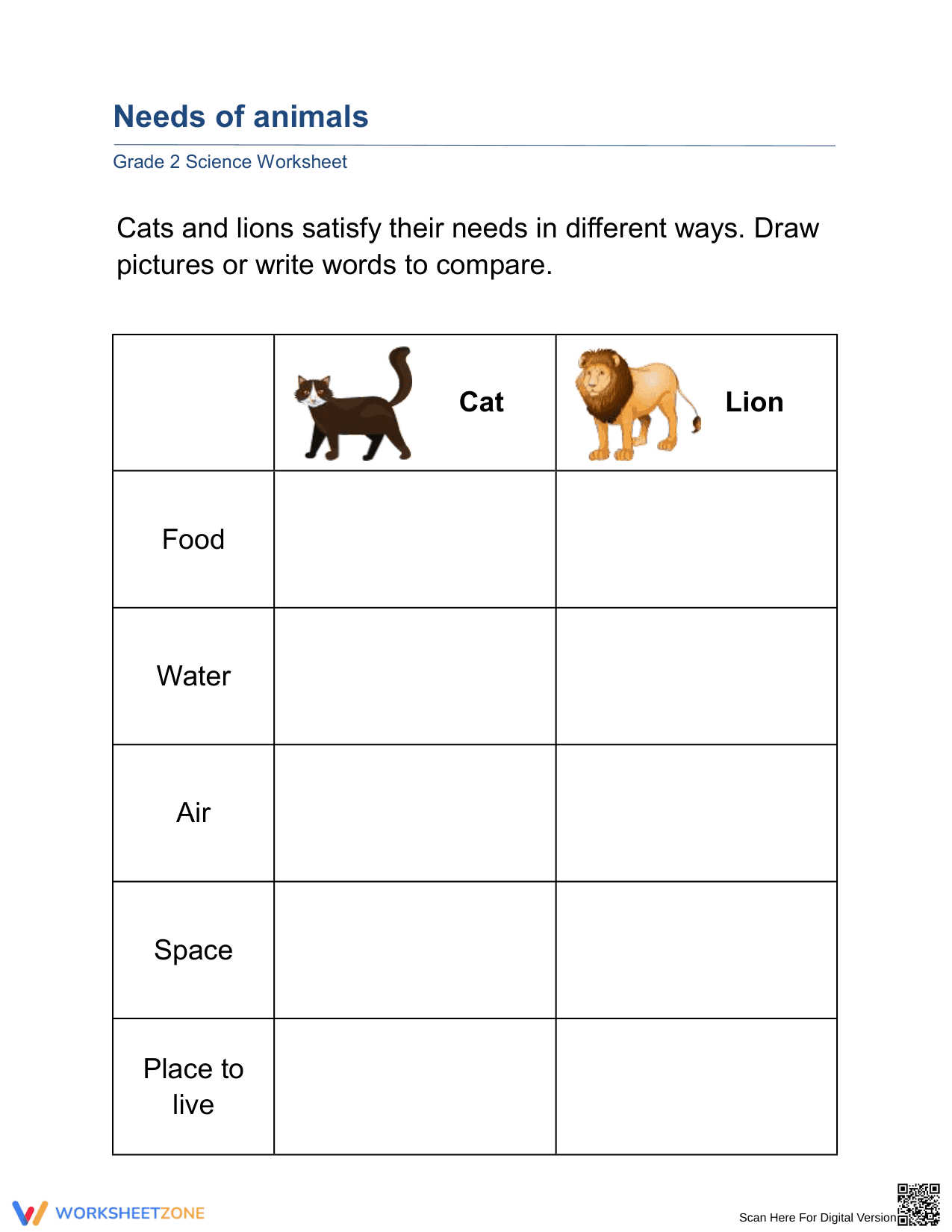
This Essential Needs of Animals worksheet helps Grade 2 students compare how domestic and wild animals satisfy their survival requirements. By analyzing the differences between a common house cat and a wild lion, learners develop a foundational understanding of habitat-specific adaptations and biological needs. This exercise transforms abstract science concepts into observable, real-world comparisons.
At a Glance
- Grade: 2 · Subject: Science
- Standard:
2-LS4-1— Compare how animals satisfy their survival needs in different habitats- Skill Focus: Comparing Animal Survival Needs
- Format: 1 page · 5 problems · Answer key included · PDF
- Best For: Independent practice or quick science assessment
- Time: 10–15 minutes
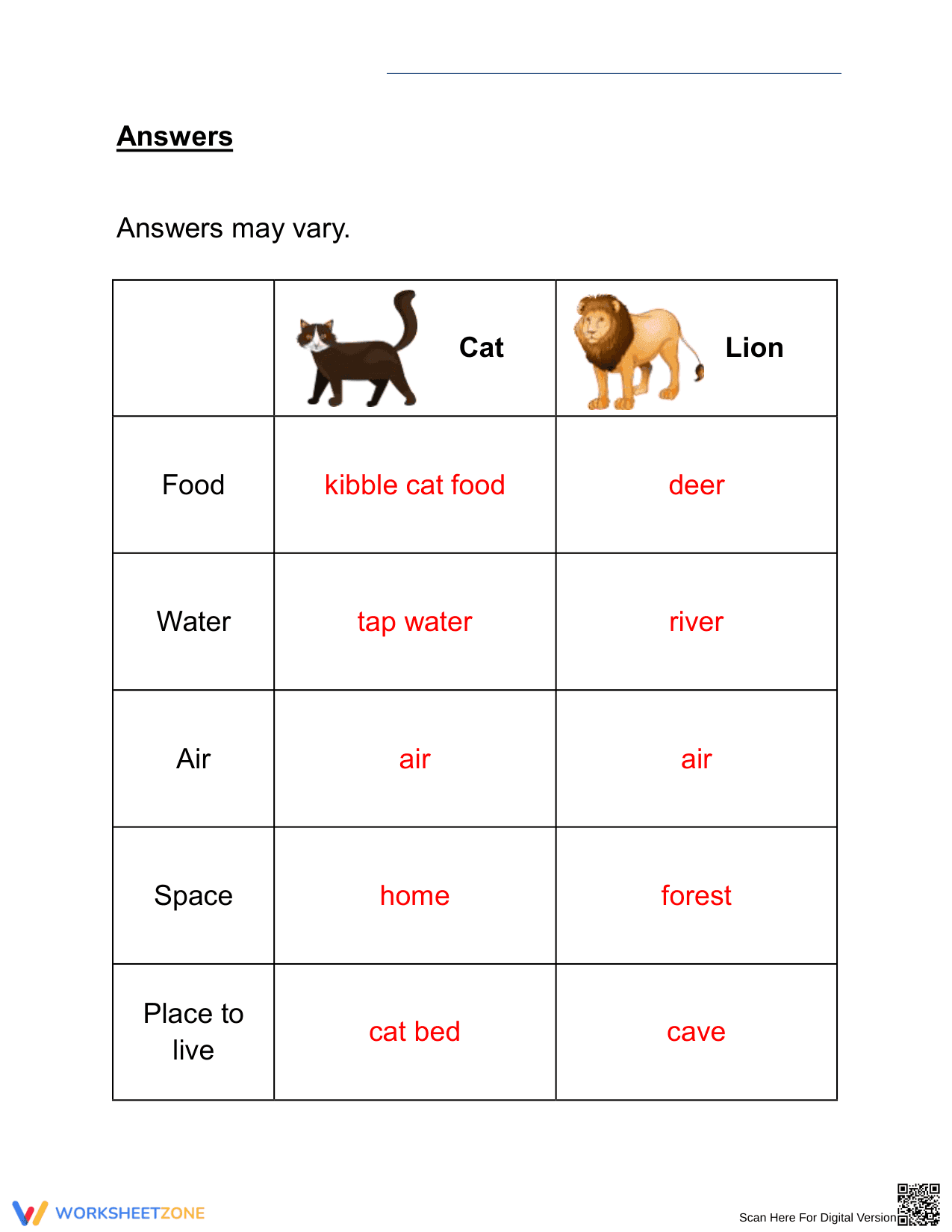
This single-page PDF features a structured comparison table focusing on five core survival needs: food, water, air, space, and shelter. Students are prompted to draw pictures or write words to contrast how a cat and a lion fulfill these requirements in their respective environments. The clear grid layout and visual icons make the worksheet accessible for young learners while maintaining scientific rigor.
The zero-prep design allows teachers to integrate this resource into their science block with minimal effort. First, print the single-page PDF. Next, distribute the worksheets during your "Living Things" unit for a quick check for understanding. Finally, review student responses using the provided answer key to provide immediate feedback on survival concepts. Total teacher preparation time is under two minutes.
This resource is aligned to `2-LS4-1`, which requires students to make observations of animals to compare the diversity of life and how organisms interact with their environments. By identifying how different feline species satisfy the same biological needs, students build the prerequisite knowledge for understanding ecological niches and ecosystem balance. This standard code can be copied directly into lesson plans, IEP goals, or district curriculum mapping tools.
Use this worksheet as a summative assessment after a direct instruction lesson on animal habitats and survival. It also serves as an excellent formative tool during a center rotation; observe if students can differentiate between domestic "cat food" and wild "prey" for the lion. Expect most second-graders to complete the comparison in 12 minutes, allowing for a brief class discussion afterward.
Designed primarily for second-grade science students, this worksheet is also suitable for first-grade enrichment or third-grade review. The option to draw or write provides built-in differentiation for emerging writers and English Language Learners. Pair this resource with a non-fiction passage about the Serengeti or an anchor chart on the five basic needs of living things for a complete instructional cycle.
The Essential Needs of Animals worksheet bridges the gap between basic identification and comparative analysis, a key transition in early elementary science education. According to RAND AIRS 2024, structured comparison tasks enhance retention by forcing students to contrast traits. By focusing on the 2-LS4-1 standard, this resource ensures that Grade 2 learners are not just memorizing facts about animals, but are developing the critical thinking skills necessary to understand biodiversity and environmental adaptation. The 5-task format aligns with research-based practices for cognitive load management in early learners, providing enough depth to assess mastery without overwhelming students. This systematic approach to comparing animal needs is recognized by ScienceDirect TpT Analysis as a highly effective method for preparing students for more complex ecological studies in later grades. Teachers can utilize these findings to justify the integration of feline comparisons into their standard curriculum as a means of boosting long-term scientific literacy.


